Art! Art! Art! › Works
Arearea
 Paul Gauguin, 1892
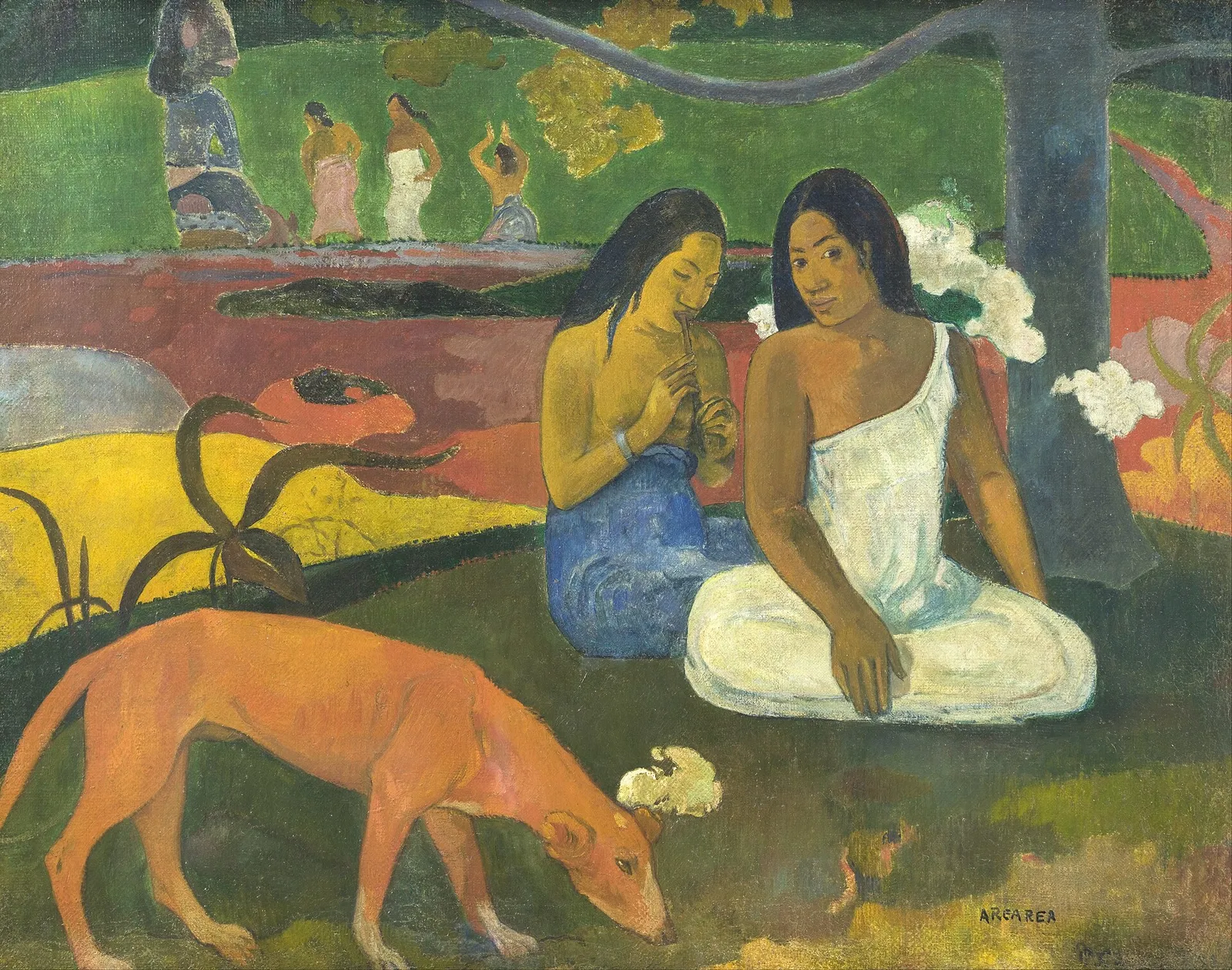
Arearea is an 1892 painting by Paul Gauguin, made during his first stay in Tahiti, and it belongs to the collection of the Musée d'Orsay. Two women rest beneath a tree beside an orange-red dog while figures dance before an idol behind them. The dog earned the picture its informal nickname, 'The Red Dog'.
Where to see it
Arearea is held by the Musée d'Orsay, and the museum is listed as its location. The canvas measures 74.5 cm high by 93.5 cm wide. Works in a museum collection are not always on view, so check the Musée d'Orsay's official website for the painting's current display status before you visit.
What to look for in person
The orange-red dog
Begin with the lower foreground, where a dog appears beside the two seated women. Its coat is painted a vivid orange-red, a colour no real dog has, and it is the detail behind the painting's informal nickname, 'The Red Dog'. When Gauguin showed the work in Paris in 1893, this animal attracted ridicule. Gauguin later insisted that colours like this were chosen on purpose. Ask yourself how differently the scene would read if the dog were painted a natural brown.
Two women beneath the tree
At the foot of a tree in the foreground sit two women. One is playing a flute; the other sits in front of her with her legs crossed in a lotus position. Spend some time with this pair, because they hold the front of the composition and set its unhurried tone. The flute is worth noticing too: it brings music into a painting whose maker compared his use of colour and line to music, intended to suggest sensations rather than describe things literally.
Dancers and the idol in the background
Let your eye move past the women into the distance. There, three small figures dance in front of an idol, which has been identified as Hina, the moon goddess. The picture is effectively split into two zones: a quiet moment of rest close to the viewer, and a ritual scene set further back. Look at how Gauguin places the religious episode behind the everyday one, so that the two are seen together but at different distances from you.
About the painting
Paul Gauguin painted Arearea in 1892, during his stay in Tahiti, which began in April 1891 and lasted until 1893. It is an oil on canvas showing two women seated under a tree, one playing a flute, with a dog beside them and, in the background, three figures dancing before an idol of the moon goddess Hina.
After returning to France, Gauguin included the painting in his 1893 exhibition at the Durand-Ruel gallery in Paris, held in November of that year. The bright orange-red dog was mocked by some viewers, and the work is still informally called 'The Red Dog'. Gauguin defended this kind of colour. In an 1895 interview in the Écho de Paris, he explained that his red dogs and orange rivers were intentional, meant to build a harmony of colour and line that could evoke sensations in the way music does. That statement is a useful key for visitors: the colours are not mistakes or exaggerations of nature, but deliberate choices.
Gauguin thought highly of the painting himself. He counted it among his best works and bought it back in 1895, before he left Europe for the last time. The painting was later bequeathed to the French state in 1961. It is recorded as number 469 in the Wildenstein catalogue of Gauguin's work.
In front of the canvas, it rewards slow looking: start with the dog, move to the two women and the flute, and then let your gaze travel back to the dancers and the idol.
Key facts
| Artist | Paul Gauguin |
|---|---|
| Date | 1892 |
| Size | 74.5 × 93.5 cm |
| Medium | oil paint, canvas |
| Collection | Musée d'Orsay |
How to visit: Musée d'Orsay
Paris, France · Museum guide
| Opening hours | Tue–Wed, Fri–Sun 09:30–18:00 (galleries close at 17:30) Thu 09:30–21:45 (late opening; galleries close at 21:15) |
|---|---|
| Closed | Every Monday, 1 May and 25 December. |
| Last entry | 17:00 (exhibitions 17:15); Thursdays 21:00 |
| Admission | Full rate, online EUR 16 Full rate, at the museum EUR 14 Reduced rate (on site only) EUR 11 Enfant & Cie, online EUR 13 Enfant & Cie, at the museum EUR 11 Night rate (Thursday), online EUR 12 Night rate (Thursday), at the museum EUR 10 Under 18s; EEA residents under 26 free |
| Free entry | Free for under 18s and residents of the European Economic Area under 26. Free on the first Sunday of the month, with booking required. |
| Booking | Booking is strongly recommended. Entry is by timed slot. |
The museum stays open and all collections and exhibitions remain accessible, but entrances have changed: timed-ticket holders use Entrance 1 (Quay); priority visitors, reseller voucher holders, visitors without tickets and groups use Entrance 2 (Forecourt). Arrive at least 15 minutes before your time slot.
Official ticket page
Official website
View on map
Hours and prices can change. Please check the official website before you go. (Checked on: 2026-11-11)
More by Paul Gauguin
 Young boy from Brittany
 Study of a Nude
 Mahana Ma'a — Cincinnati Art Museum
 Where Do We Come From? What Are We? Where Are We Going? — Museum of Fine Arts Boston
Sources
- Wikidata Q3622074
- Wikipedia (en) (CC BY-SA 4.0)
- Wikipedia (it) (CC BY-SA 4.0)
- Wikipedia (fr) (CC BY-SA 4.0)
- Wikipedia (es) (CC BY-SA 4.0)
- billetterie.musee-orsay.fr
- www.musee-orsay.fr