Art! Art! Art! › Works
Study of a Nude
 Paul Gauguin, 1879
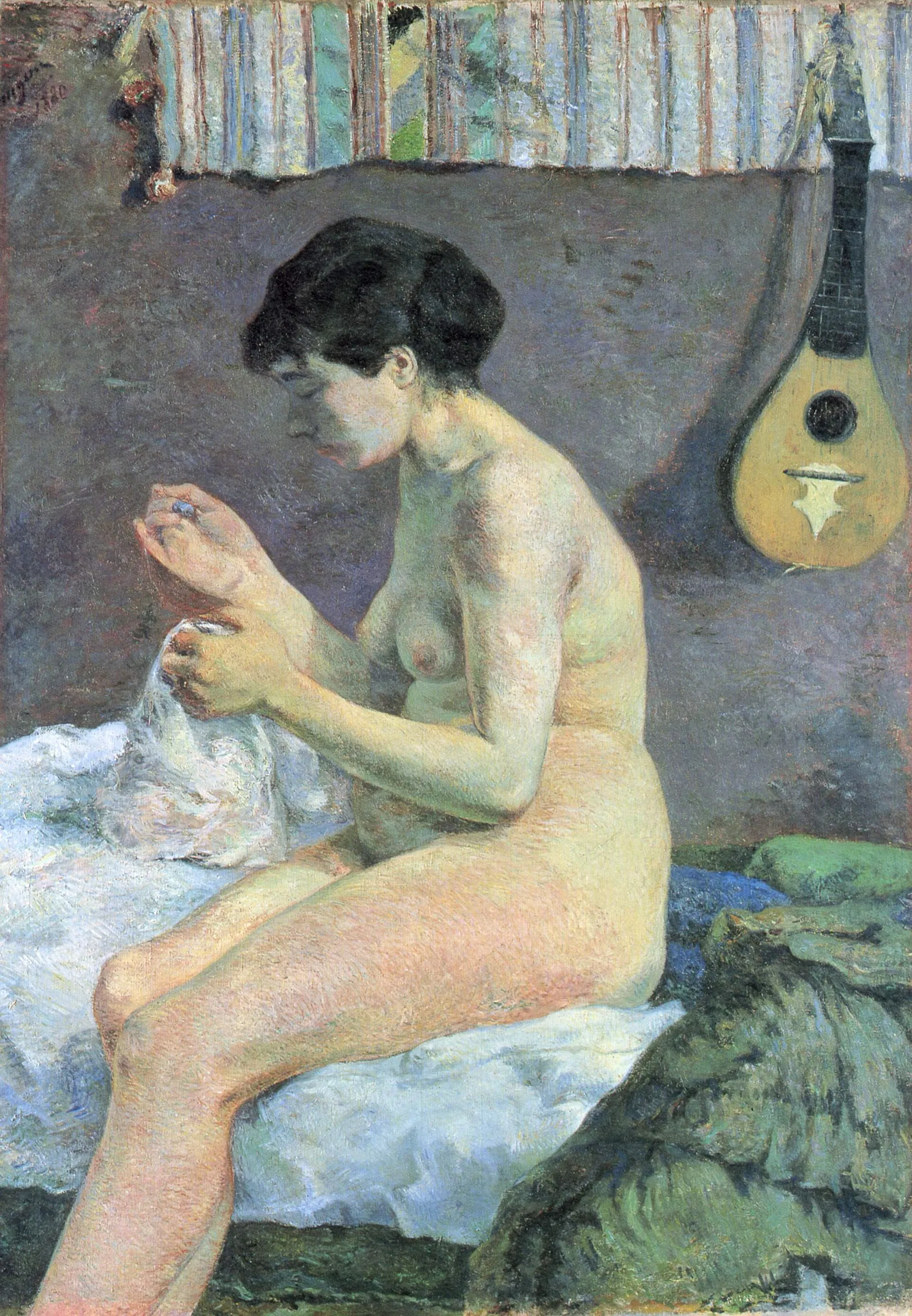
Paul Gauguin's Study of a Nude, dated 1879, shows a woman seated on a bed, absorbed in sewing, painted with a directness that sets it apart from the polished nudes of its time. The canvas measures 114.5 × 79.5 cm and is recorded in Copenhagen collections. It is an early work, made years before the bold colour and Pacific subjects for which Gauguin is best known.
Where to see it
The available collection record links Study of a Nude to two Copenhagen institutions, the Ny Carlsberg Glyptotek and the Statens Museum for Kunst. Before you plan a visit, check the official websites of both museums to confirm which one currently holds and displays the painting. Works can be off view for conservation, rehanging or loans, so confirm current display status shortly before you go. Both museums are in central Copenhagen, so if you are visiting the city you can check both and plan accordingly.
What to look for in person
An Unidealized Body
Stand back first and take in the figure as a whole. The woman sits on the edge of a bed, her body turned slightly, shown without the smoothing and polish that academic nudes of the period usually received. Look at how the skin is modelled with varied, broken touches of colour rather than a single even tone, and how the posture, with shoulders curved and head bent, reads as a moment of ordinary absorption rather than a pose held for the viewer. This frankness is what early critics noticed about the picture.
The Act of Sewing
Move closer to the figure's hands and lap. The woman is occupied with a piece of fabric, and this small domestic task gives the painting its quiet focus. Her attention is directed downward, away from the spectator, so the scene feels observed rather than staged. Notice how the light falls across her back and arm, and how the cloth in her lap picks up highlights that echo the tones of the skin. The subject is everyday, and Gauguin treats it with a seriousness usually reserved for grander themes.
Interior Details and Brushwork
Let your eye move into the background. The setting is a modest interior, with draperies and wall surfaces built up in a dense, textured manner. A stringed instrument hanging on the wall is often pointed out as a detail; look for it in the upper part of the composition. Compare the handling here with the figure: the brushwork is tight, layered and still close to Impressionist practice. It is a reminder that this is an early work, painted well before the flat areas of colour Gauguin later became known for.
About the painting
Study of a Nude belongs to the period when Paul Gauguin was still working in finance in Paris and painting in his spare time. In these years he was drawn into the circle of the Impressionists, and Camille Pissarro in particular encouraged and guided him. The painting reflects that apprenticeship: its loose but careful brushwork and its interest in light on skin and fabric are closely tied to Impressionist methods, while its unflattering realism looks back to the naturalist tradition. Gauguin showed the work at one of the Impressionist group exhibitions, where the critic Joris-Karl Huysmans singled it out for praise, admiring its truthful treatment of a contemporary woman's body in contrast to the idealized nudes of the official Salon. That reception gave Gauguin some of his first serious critical recognition as a painter. The work is also sometimes known by the title Suzanne Sewing. Its presence in Copenhagen fits a wider pattern: Gauguin married a Danish woman, Mette Gad, and spent time in Copenhagen, and Danish collections hold a notable group of his works. For visitors, the painting offers a useful point of comparison. Seen alongside Gauguin's later works from Brittany or the South Pacific, it shows where he started: with close observation, modelled form and a sober palette, before he moved toward simplified shapes, flattened colour and symbolic subject matter. Looking at it closely helps make sense of how far and how deliberately his style later changed.
Key facts
| Artist | Paul Gauguin |
|---|---|
| Date | 1879 |
| Size | 114.5 × 79.5 cm |
| Medium | oil paint, canvas |
| Collection | Ny Carlsberg Glyptotek / Statens Museum for Kunst |
How to visit: Ny Carlsberg Glyptotek
Copenhagen Municipality, Denmark
Hours and prices can change. Please check the official website before you go.
More by Paul Gauguin
 Young boy from Brittany
 Arearea — Musée d'Orsay
 Mahana Ma'a — Cincinnati Art Museum
 Where Do We Come From? What Are We? Where Are We Going? — Museum of Fine Arts Boston