Art! Art! Art! › Works
View of the Village
 Jean Frédéric Bazille, 1868
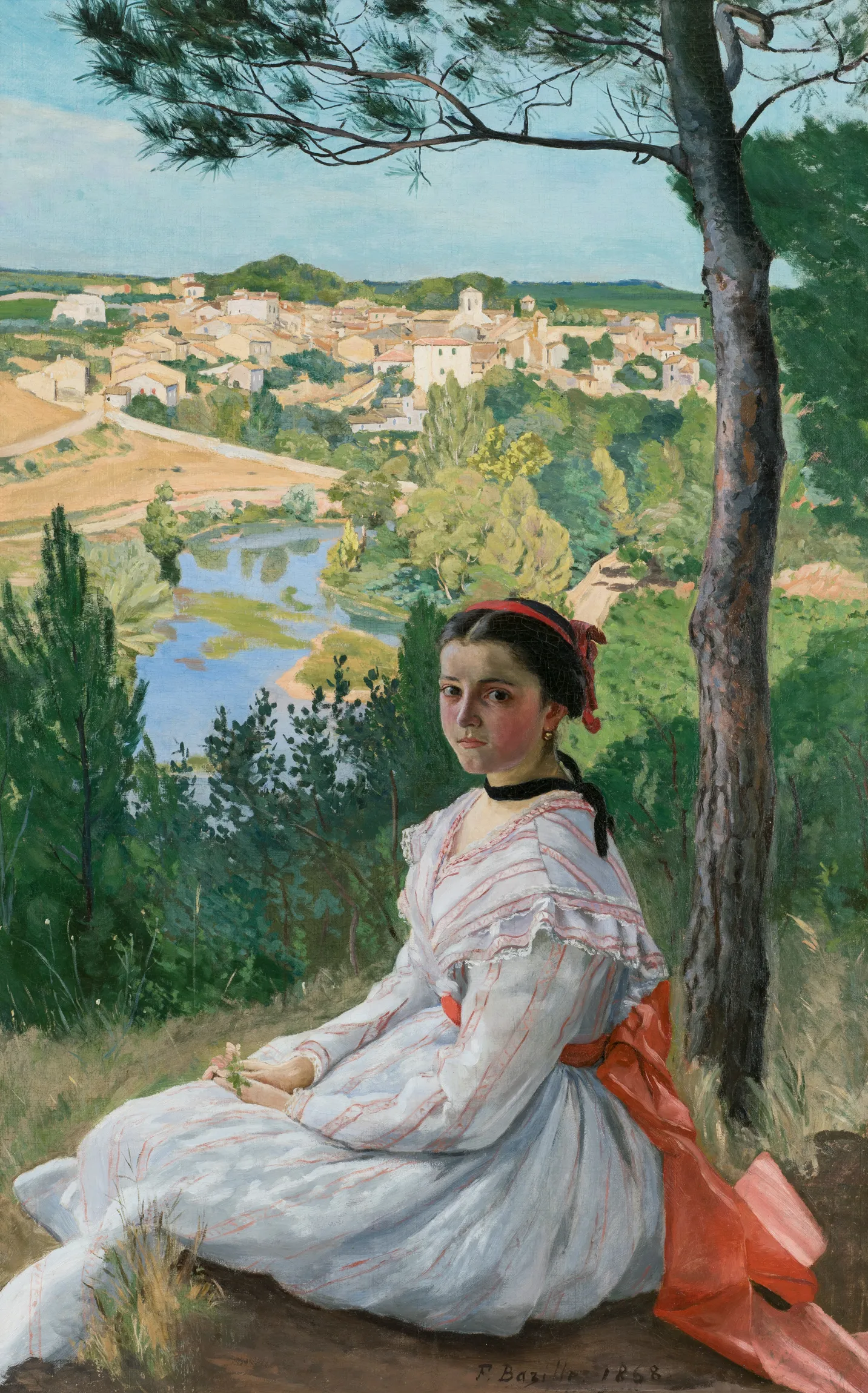
View of the Village is an 1868 painting by Jean Frédéric Bazille, held in the collection of the Musée Fabre. A young woman sits in the shade in the foreground while a sunlit village spreads out behind her, a pairing of figure and landscape that Bazille explored throughout his short career.
Where to see it
View of the Village belongs to the collection of the Musée Fabre, which is also listed as its location. The canvas measures 137.5 cm high by 85.5 cm wide, so it is a tall, upright picture that is easy to take in from a few steps back. Display arrangements can change because of rehangs, conservation work or loans, so check the Musée Fabre's official website for current display status, opening hours and ticketing before you visit.
What to look for in person
A figure in the shade
Start with the young woman in the foreground. She sits beneath a tree, turned toward the viewer, wearing a light striped dress. Notice how Bazille keeps her in soft, filtered shade while the land behind her is in full sun. That contrast separates the figure from the background without heavy outlines. Look at how the stripes of the dress follow the folds of the fabric, and how patches of light fall through the leaves onto her clothing and the ground around her.
The village in the distance
Let your eye move past the figure to the village that gives the painting its title. Pale walls and roofs sit within green trees and open ground, set out in clear, simple blocks of colour. Because the canvas is taller than it is wide, foreground and background are stacked one above the other rather than spread side by side. Step back to see how the tree, the seated figure and the distant houses lock together into a single upright composition.
Painting bright outdoor light
Bazille belonged to the circle of young painters, including Claude Monet and Auguste Renoir, who set out to paint figures in real daylight. Here the light is strong and clear, and shadows are crisp rather than murky. Compare the cool tones in the shaded areas with the warmer, brighter colours of the sunlit village. Up close, look at the brushwork in the foliage and grass, then step away and watch it resolve into a coherent landscape.
About the painting
Jean Frédéric Bazille came from a well-off family in the south of France and moved to Paris in the early 1860s, officially to study medicine. He soon turned to painting and trained in the studio of Charles Gleyre, where he met Claude Monet, Auguste Renoir and Alfred Sisley. These friendships shaped his work: the group shared ideas about painting modern life and outdoor light, and Bazille, who had more financial means than some of his friends, shared studio space with them and supported them at times.
A recurring subject for Bazille was the human figure placed in a landscape, painted to look as though it were seen in natural daylight. Summers spent in the south gave him the intense sun and dry, open scenery that appear in many of his pictures. View of the Village, dated 1868, belongs to this body of work. It combines a carefully posed figure with an expansive view, and it shows his interest in solid forms and clear structure alongside the brighter palette his circle was developing.
Bazille's career was brief. He enlisted during the Franco-Prussian War and was killed in 1870, before his 29th birthday and several years before his friends held the first Impressionist exhibition in 1874. Because of this, his surviving output is relatively small, and each of his finished paintings offers a useful view of the ideas the future Impressionists were working out in the late 1860s. Seeing View of the Village in person lets you judge the effect of its tall format and its handling of light in a way that reproductions rarely capture.
Key facts
| Artist | Jean Frédéric Bazille |
|---|---|
| Date | 1868 |
| Size | 137.5 × 85.5 cm |
| Medium | oil paint, canvas |
| Collection | Musée Fabre |
How to visit: Musée Fabre
Montpellier, France
Hours and prices can change. Please check the official website before you go.


