Art! Art! Art! › Works
The Pink Dress
 Jean Frédéric Bazille, 1864
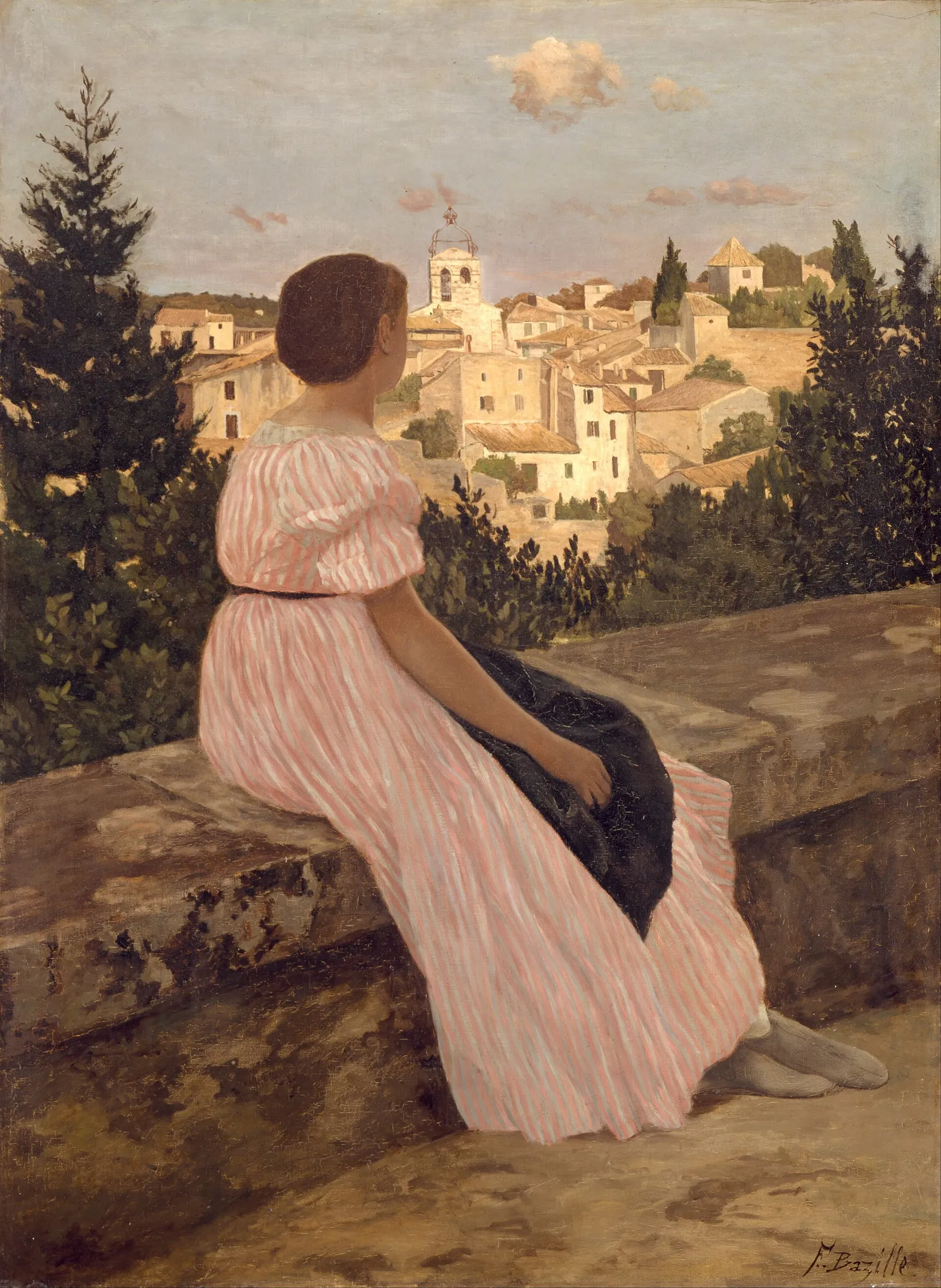
The Pink Dress is an 1864 painting by Jean Frédéric Bazille, held in the collection of the Musée d'Orsay. It shows a young woman seen from behind, seated in sunlight and looking out over a southern French village. This early work points toward the open-air painting Bazille and his circle would develop over the following years.
Where to see it
The Pink Dress belongs to the collection of the Musée d'Orsay, which is also listed as its location. Works in large collections are sometimes moved, rotated or lent to other institutions, so check the Musée d'Orsay's official website for current display status, opening hours and ticket information before you visit.
What to look for in person
A figure who turns away
Start with the sitter herself. Bazille paints her from behind, so you never see her face. Your eye follows hers, out across the landscape toward the houses in the distance. This choice makes the viewer a companion rather than an observer of a portrait. Notice how still she is, with her body angled slightly and her head turned. The pose feels unposed and private, closer to a moment glimpsed in daily life than to a formal studio portrait of the period.
The striped dress against the landscape
Look closely at the dress that gives the painting its title. The pink and grey stripes are painted with care, catching light along the folds of the fabric, while the darker garment over her upper body sets off the brighter skirt. Compare these cool and warm tones with the ochres and greens of the village and the hillside beyond. The dress acts as a bridge between the shaded foreground and the sunlit view, tying figure and setting into one composition.
Southern light and shadow
Step back and consider the light. The foreground, where the woman sits, lies largely in shadow, while the village in the distance is flooded with bright sun. Bazille uses this contrast to build depth: the eye moves from cool shade to a pale, glowing background. The buildings are reduced to simple, solid blocks of colour under a clear sky. This attention to natural daylight in an outdoor setting is one of the qualities that links the painting to the early development of Impressionism.
About the painting
Jean Frédéric Bazille painted The Pink Dress in 1864, at the start of his short career. Born into a well-off family in Montpellier in the south of France, Bazille went to Paris and trained in the studio of Charles Gleyre, where he met Claude Monet, Pierre-Auguste Renoir and Alfred Sisley. These friendships shaped his work, and he became one of the painters closely associated with the group that would later be called the Impressionists. The painting is generally connected with Méric, the Bazille family property near Montpellier, where the artist spent summers and painted several outdoor scenes. The young woman is usually identified as one of his cousins, and the village she looks toward is commonly identified as Castelnau-le-Lez. What makes the work worth time in front of it is the way Bazille combines a carefully observed figure with a real landscape under strong southern light. Rather than placing a model in a studio, he sets her in the open air and lets sunlight and shadow organise the scene. This interest in painting figures outdoors runs through his later work as well. Bazille's career was cut short when he was killed in 1870 during the Franco-Prussian War, before he turned thirty. As a result, his surviving body of work is relatively small, and early paintings such as this one are important for understanding how his ideas, and those of his circle, took shape in the 1860s. Viewing it alongside works by his contemporaries helps place it within that moment.
Key facts
| Artist | Jean Frédéric Bazille |
|---|---|
| Date | 1864 |
| Size | 1470 × 1100 cm |
| Medium | oil paint, canvas |
| Collection | Musée d'Orsay |
How to visit: Musée d'Orsay
Paris, France · Museum guide
| Opening hours | Tue–Wed, Fri–Sun 09:30–18:00 (galleries close at 17:30) Thu 09:30–21:45 (late opening; galleries close at 21:15) |
|---|---|
| Closed | Every Monday, 1 May and 25 December. |
| Last entry | 17:00 (exhibitions 17:15); Thursdays 21:00 |
| Admission | Full rate, online EUR 16 Full rate, at the museum EUR 14 Reduced rate (on site only) EUR 11 Enfant & Cie, online EUR 13 Enfant & Cie, at the museum EUR 11 Night rate (Thursday), online EUR 12 Night rate (Thursday), at the museum EUR 10 Under 18s; EEA residents under 26 free |
| Free entry | Free for under 18s and residents of the European Economic Area under 26. Free on the first Sunday of the month, with booking required. |
| Booking | Booking is strongly recommended. Entry is by timed slot. |
The museum stays open and all collections and exhibitions remain accessible, but entrances have changed: timed-ticket holders use Entrance 1 (Quay); priority visitors, reseller voucher holders, visitors without tickets and groups use Entrance 2 (Forecourt). Arrive at least 15 minutes before your time slot.
Official ticket page
Official website
View on map
Hours and prices can change. Please check the official website before you go. (Checked on: 2026-11-11)


