Art! Art! Art! › Works
Réunion de famille
 Jean Frédéric Bazille, 1867
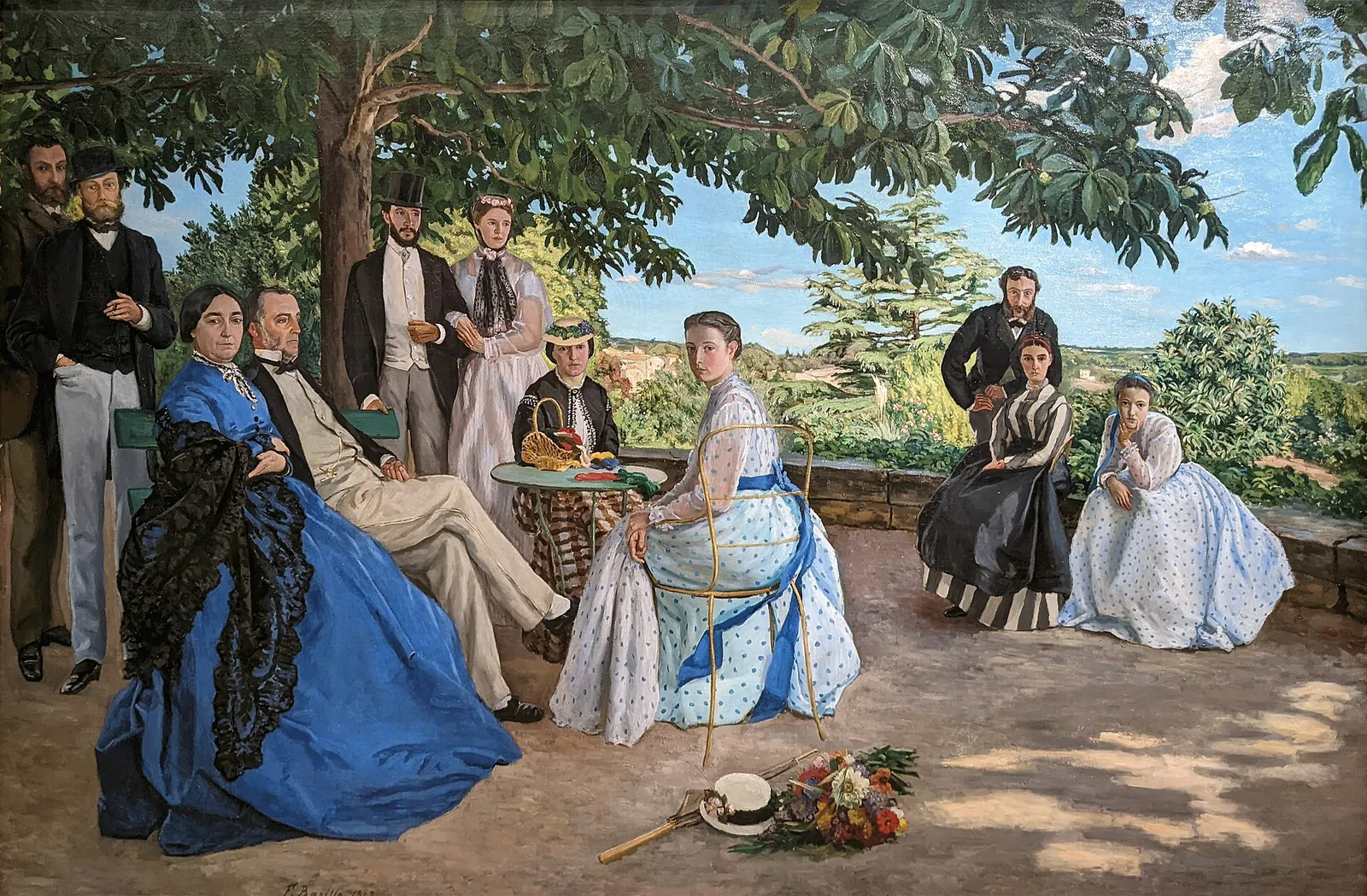
Jean Frédéric Bazille's Réunion de famille (Family Reunion), dated 1867, is held by the Musée d'Orsay. At 152 x 230 cm, it is a large group portrait of the painter's relatives gathered outdoors in summer light, a work often discussed for its place in the early development of Impressionism.
Where to see it
Réunion de famille is in the collection of the Musée d'Orsay, which is also its listed location. Paintings can be moved, rehung or lent, so check the Musée d'Orsay's official website for current display status before you plan a visit specifically to see this work.
What to look for in person
Light filtered through leaves
Start with the light. The family sits on a terrace in the shade of a tree, and Bazille treats the scene as a study of outdoor illumination. Look at the patches of brightness falling across the pale dresses and the ground, and compare them with the cooler, shaded areas around the faces. The landscape behind the group is bathed in strong sunlight, which makes the shaded foreground feel like a pocket of relief from summer heat. This interest in natural light places the painting close to the concerns of Bazille's Impressionist circle.
A family that looks back at you
Notice how many of the sitters turn toward the viewer rather than toward each other. The effect is closer to a posed photograph than to a casual snapshot: people stand or sit in loose rows, some formal, some slightly stiff. Take time to read the group from left to right and see how Bazille varies poses, clothing and expressions while keeping everyone in one shared space. The steady gazes give the scene a quiet, slightly reserved mood, and invite you to consider the relationships within this well-to-do provincial family.
The painter at the edge
Look to the far left edge of the canvas. Bazille is generally identified as having included himself there, a tall figure partly tucked into the margin of the composition. His placement suggests both belonging and observation: he is a member of the family, yet also the one who records it. Spotting him changes how the whole picture reads, turning a family portrait into something more personal. Standing back, you can also appreciate how the large size of the canvas lets the figures appear nearly life-sized, as if continuing your own space.
About the painting
Jean Frédéric Bazille was a French painter associated with the group of young artists who would become known as the Impressionists, working alongside figures such as Claude Monet and Pierre-Auguste Renoir. Bazille came from a prosperous family in the south of France, and Réunion de famille, dated 1867, depicts members of that family gathered outdoors at their country property. The painting measures 152 x 230 cm and is now in the collection of the Musée d'Orsay.
What makes the work significant for visitors is the way it combines two traditions. On one hand, it is a formal group portrait, with sitters arranged deliberately and many of them facing the viewer directly. On the other, it is an ambitious attempt to paint figures in real outdoor light, at a large scale usually reserved for more conventional subjects. Bazille pays close attention to how sunlight and shade fall on fabric, skin and foliage, and the bright landscape beyond the terrace contrasts with the cooler shaded foreground where the family sits.
The painting also carries a personal dimension. Bazille is generally recognised as having placed himself at the left edge of the group, an understated self-portrait within a family scene. His career was brief: he was killed while serving in the Franco-Prussian War, which is why his surviving body of work is relatively small. As a result, Réunion de famille is one of the key pieces for understanding his ambitions as a painter. In front of the canvas, it rewards slow looking, first at the overall arrangement of figures and then at the details of light and shadow that animate the scene.
Key facts
| Artist | Jean Frédéric Bazille |
|---|---|
| Date | 1867 |
| Size | 152 × 230 cm |
| Medium | oil paint, canvas |
| Collection | Musée d'Orsay |
How to visit: Musée d'Orsay
Paris, France · Museum guide
| Opening hours | Tue–Wed, Fri–Sun 09:30–18:00 (galleries close at 17:30) Thu 09:30–21:45 (late opening; galleries close at 21:15) |
|---|---|
| Closed | Every Monday, 1 May and 25 December. |
| Last entry | 17:00 (exhibitions 17:15); Thursdays 21:00 |
| Admission | Full rate, online EUR 16 Full rate, at the museum EUR 14 Reduced rate (on site only) EUR 11 Enfant & Cie, online EUR 13 Enfant & Cie, at the museum EUR 11 Night rate (Thursday), online EUR 12 Night rate (Thursday), at the museum EUR 10 Under 18s; EEA residents under 26 free |
| Free entry | Free for under 18s and residents of the European Economic Area under 26. Free on the first Sunday of the month, with booking required. |
| Booking | Booking is strongly recommended. Entry is by timed slot. |
The museum stays open and all collections and exhibitions remain accessible, but entrances have changed: timed-ticket holders use Entrance 1 (Quay); priority visitors, reseller voucher holders, visitors without tickets and groups use Entrance 2 (Forecourt). Arrive at least 15 minutes before your time slot.
Official ticket page
Official website
View on map
Hours and prices can change. Please check the official website before you go. (Checked on: 2026-11-11)


