Art! Art! Art! › Works
The Repentant Magdalen
 Georges de La Tour, 17th century
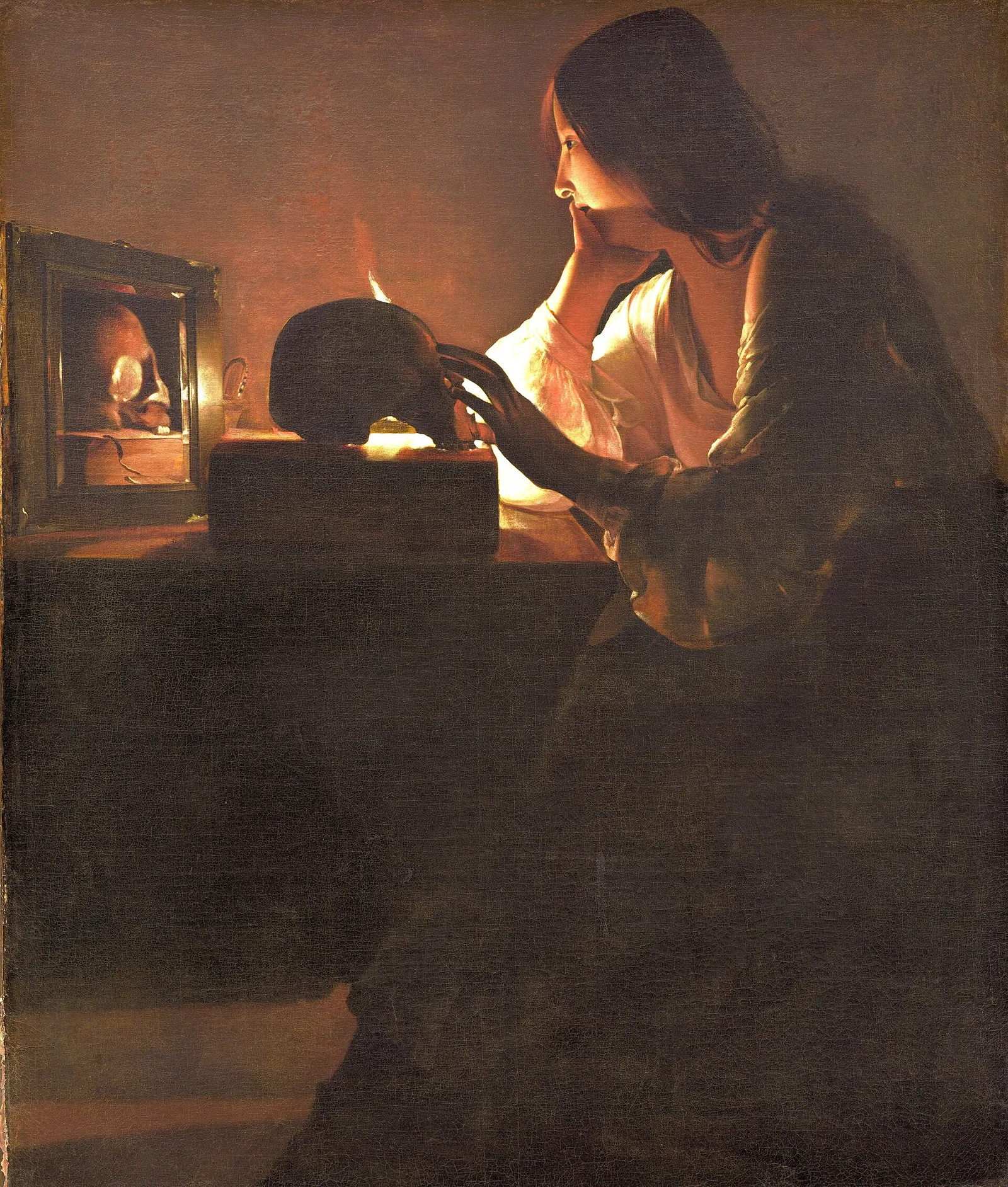
The Repentant Magdalen is a 17th-century painting by the French artist Georges de La Tour, measuring 113 x 92.7 cm. It belongs to a group of quiet, inward-looking images of Mary Magdalene for which La Tour is widely known. Seeing it in person lets you judge its scale and close-toned surface, which reproductions rarely convey.
Where to see it
Our fact sheet records both the collection and the location of The Repentant Magdalen under the Wikidata identifier Q214867, the institution that holds the painting. The source does not give the museum's name, so confirm the identity of that institution through the Wikidata record linked below before planning a trip. Displays change because of rehangs, conservation and loans, so check the holding museum's official website for current display status before visiting. Wikidata record for the painting: https://www.wikidata.org/wiki/Q3210250
What to look for in person
A Single Figure, Quietly Absorbed
Start with the Magdalen herself. La Tour's treatments of this subject typically show her seated and still, lost in thought rather than caught in a dramatic gesture. Stand back far enough to take in the whole canvas, about 113 cm high and just under a metre wide, and notice how the figure fills the space at close to life scale. The mood comes from stillness. Watch how the pose, the turn of the head and the placement of the hands lead your attention inward, toward contemplation rather than outward toward the viewer.
Light and Shadow
La Tour is especially associated with scenes lit by a single, contained light source set against deep darkness. Look closely at how light is handled across the picture. See where forms emerge softly from shadow and where edges dissolve into darkness. The effect is less about showing off than about creating a hushed, private atmosphere. Move slightly from side to side, because the dark passages of 17th-century paintings can read differently depending on gallery lighting and your angle. Give your eyes a moment to adjust to the darker areas before judging the colours.
Simplified Forms and Symbolic Objects
La Tour often reduced shapes to smooth, almost geometric volumes, with little fussy detail. Notice how the clothing, flesh and any objects read as clear, calm masses. In images of the penitent Magdalen, artists commonly included objects tied to her story and to reflection on mortality, such as a skull, or set aside items suggesting worldly vanity. Look for any such objects here and consider how they relate to her pose and gaze. The meaning builds slowly, through what she looks at and what she has put aside.
About the painting
Georges de La Tour was a French painter of the 17th century. The Repentant Magdalen is dated by our source simply to that century and measures 113 x 92.7 cm. Mary Magdalene was a popular subject in European art of the period. In Christian tradition she was understood as a sinner who turned to a life of repentance, and painters often showed her alone, meditating on her past and on the brevity of life. This made her a fitting subject for devotional pictures meant to encourage quiet reflection. La Tour returned to the penitent Magdalen more than once, and his versions are among the best-known works associated with him. They share a restrained, meditative tone, a limited palette and a careful use of light emerging from darkness. For a visitor, the value of seeing the painting in person lies largely in these qualities. The subtle shifts between light and shadow, the smooth modelling of forms and the overall stillness are hard to appreciate in a small reproduction or on a screen. Because La Tour painted related versions of this theme, it is worth checking that the picture you plan to see is this specific work. The fact sheet links it to the Wikidata record Q3210250, and the holding institution is identified there as Q214867. Use those records, together with the museum's own website, to confirm the painting's identity, current display status and visiting details. Give the painting time. Its effect builds slowly, and a few minutes of steady looking will reveal details that a passing glance misses.
Key facts
| Artist | Georges de La Tour |
|---|---|
| Date | 17th century |
| Size | 113 × 92.7 cm |
| Medium | oil paint, canvas |
| Collection | Q214867 |
How to visit: National Gallery of Art
Washington, D.C., United States · Museum guide
| Opening hours | Mon–Sun 10:00–17:00 (open daily) |
|---|---|
| Closed | 25 December and 1 January |
| Admission | All visitors: free (including special exhibitions) |
| Free entry | Admission is always free. No passes or tickets are needed for the galleries, exhibitions or guided tours; some events require free registration. |
| Booking | No reservation is required and there is no timed entry. |
Hours and prices can change. Please check the official website before you go. (Checked on: 2026-11-11)
More by Georges de La Tour
 The Cheat with the Ace of Diamonds — Louvre Museum
 The Penitent Magdalen — Metropolitan Museum of Art
 The Fortune Teller — Metropolitan Museum of Art
 Joseph the Carpenter — Louvre Museum