Art! Art! Art! › Works
The Cheat with the Ace of Diamonds
 Georges de La Tour, 1635
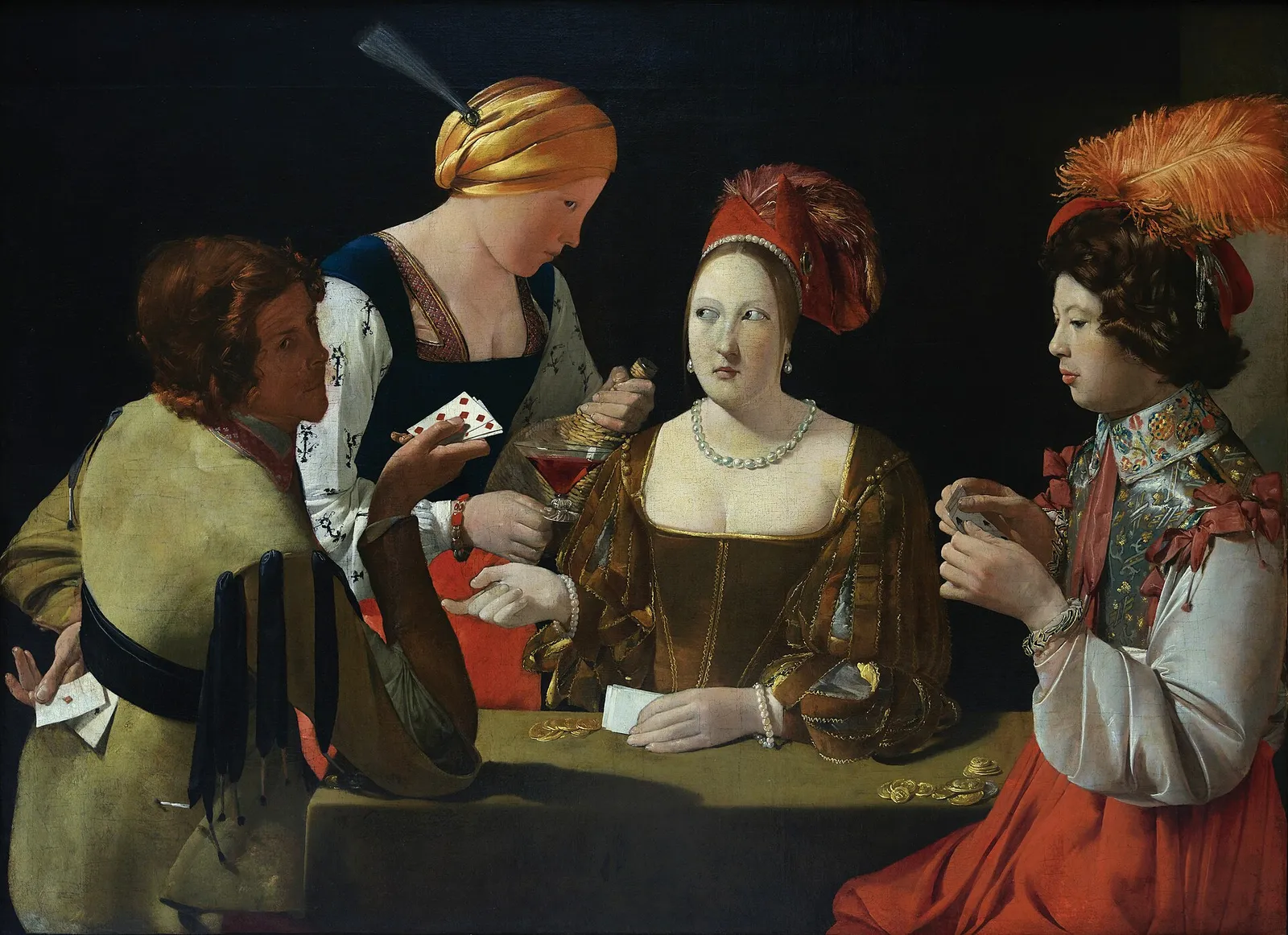
Georges de La Tour's The Cheat with the Ace of Diamonds belongs to the Department of Paintings of the Louvre. Four figures sit around a card table, and a quiet swindle unfolds through glances, gestures and a card hidden behind one player's back. It is a painting that rewards standing still and reading it slowly.
Where to see it
The painting is held by the Department of Paintings of the Louvre, and the fact sheet lists its location as Room 912. Displays can change because of rehangs, conservation work or loans, so check the Louvre's official website for the painting's current display status before you visit. If you also plan a trip to the Kimbell Art Museum in Fort Worth, you can see La Tour's second version of the subject, The Cheat with the Ace of Clubs.
What to look for in person
A story told by eyes and hands
Start with the faces rather than the cards. Three figures are playing, while a standing servant pours wine for the woman at the centre. Follow the sideways looks that pass between the cheat, the woman and the servant, and the small gestures of their hands. The well-dressed young man on the right is the target. He studies his own cards and takes no part in the silent exchange around him. You can see the whole plot unfold, but he cannot.
The ace behind the back
Look at the player on the far left. With his back half-turned toward us, he slips the ace of diamonds out of his belt behind him. The painting gives this card to its title and hides it from the victim, who never sees it. Before you move on, lower your gaze to the shadowed tablecloth beneath the cheat's elbow. The artist's signature, 'Georgius De La Tour fecit', is tucked away there. It is easy to miss unless you look for it.
Cloth, costume and a darkened stage
La Tour sets the four half-length figures against a dark, almost empty background. All the colour and detail sit on the bodies, the costumes and the green-yellow cloth that covers the table. Compare the textures of the sleeves, feathers and headwear. The servant's turban has a history of its own: a strip was added to the top of the canvas, which led to the turban being repainted and to the addition of its cabochon jewel and aigrette plume.
About the painting
The Cheat with the Ace of Diamonds is an oil on canvas measuring 106 × 146 cm, with an inception date given as 1635. The person who commissioned it is not known.
For much of its modern history the picture was not recognised as La Tour's work. The tennis player Pierre Landry bought it from an antiques dealer in 1926. Five years later, in 1931, the art historian Hermann Voss published an article in the journal Formes that attributed it to Georges de La Tour. This was part of a wider rediscovery of an artist whose reputation had faded after his lifetime.
The painting stayed with Landry until 1972. That year the Orangerie held a retrospective devoted to La Tour, and during the exhibition the Louvre bought the work from him for 10,000,000 francs. It has since been part of the Department of Paintings.
La Tour treated the same subject more than once. A second version, The Cheat with the Ace of Clubs, was bought by the Kimbell Art Foundation in 1981 and is now in the Kimbell Art Museum in Fort Worth. Visitors who know one version can look for differences in the other, such as the card being palmed and the details of the figures and costumes.
In front of the canvas, the most rewarding approach is to read it like a scene on a stage. Note who is looking at whom, whose hands are busy, and who remains unaware. Then look for the small, deliberate details: the hidden ace, the signature in the shadow of the tablecloth, and the repainted turban of the servant.
Key facts
| Artist | Georges de La Tour |
|---|---|
| Date | 1635 |
| Size | 106 × 146 cm |
| Medium | oil paint, canvas |
| Collection | Department of Paintings of the Louvre |
| Gallery | Room 912, Sully wing, level 2 Checked in the museum's open data on 2026-11-12 (galleries can change) Source |
How to visit: Louvre Museum
Paris, France · Museum guide
| Opening hours | Mon, Thu, Sat, Sun 09:00–18:00 Wed, Fri 09:00–21:00 (evening opening) Rooms are cleared 30 minutes before closing |
|---|---|
| Closed | Every Tuesday; 1 January, 1 May and 25 December. Other public holidays are open unless they fall on a Tuesday. |
| Last entry | 1 hour before closing |
| Admission | Adult (non-EEA visitors) EUR 32 Adult (EEA citizens and residents) EUR 22 Under 18 free (ID required) EEA citizens/residents under 26 free (photo ID; residents also need a residence permit of over 90 days) Audio guide rental EUR 6 (can be booked in advance online) Rates apply from 14 January 2026 |
| Free entry | Free for under-18s, EEA citizens/residents under 26, all visitors on the first Friday of the month after 18:00 (except July and August) and on 14 July, and disabled visitors plus one carer. Also free with proof for EEA art and art-history teachers, ICOM members, journalists, EEA job seekers and EEA residents on income support. |
| Booking | Entry is by timed slot, and booking in advance is recommended. |
The Cour Carrée entrance is currently closed. On Thursday 12 November 2026 the museum may open later and some exhibition rooms may remain closed.
Official ticket page
Official website
View on map
Hours and prices can change. Please check the official website before you go. (Checked on: 2026-11-11)
More by Georges de La Tour
 The Repentant Magdalen — National Gallery of Art
 The Penitent Magdalen — Metropolitan Museum of Art
 The Fortune Teller — Metropolitan Museum of Art
 Joseph the Carpenter — Louvre Museum
Sources
- Wikidata Q1193312
- Wikipedia (en) (CC BY-SA 4.0)
- Wikipedia (ja) (CC BY-SA 4.0)
- Wikipedia (fr) (CC BY-SA 4.0)
- Wikipedia (de) (CC BY-SA 4.0)
- www.louvre.fr
- contact.louvre.fr