Art! Art! Art! › Works
Joseph the Carpenter
 Georges de La Tour, 1642
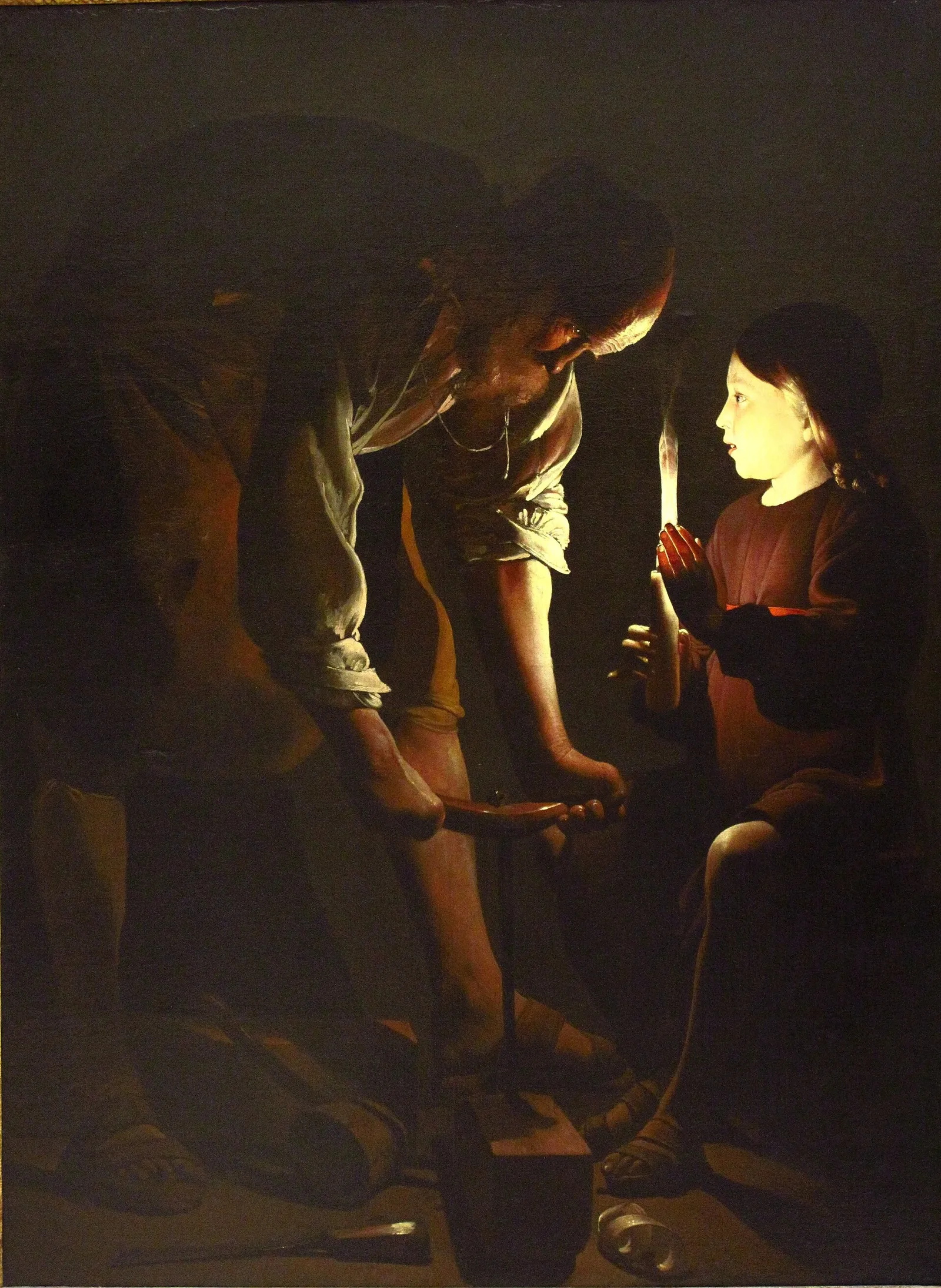
Georges de La Tour's Joseph the Carpenter, dated 1642, belongs to the Department of Paintings of the Louvre. In a dark workshop, a single candle held by a child lights an old man bent over his work, and the whole scene is built from that one small flame. It rewards a slow, close look.
Where to see it
Joseph the Carpenter is held by the Louvre, in the collection of its Department of Paintings. The fact sheet lists its location as Room 912. Rooms and display arrangements can change, and works are sometimes taken off view for conservation or loans. Check the Louvre's official website for the painting's current display status before you visit. Once there, give your eyes a moment to adjust: this is a dark picture, and its details emerge slowly.
What to look for in person
The candle and the child's hand
Start with the light source. The young Christ holds a candle and shields the flame with his other hand, and the light passes through his fingers so that they glow a warm, translucent red. This passage is one of the most closely studied in the painting. Step close and see how La Tour paints the edge of the fingers against the flame, then step back and notice how that small patch of light illuminates the child's calm face from below. Very little else in the room is lit.
Joseph at work
Opposite the child, Joseph leans over a heavy beam of wood, turning a hand drill (an auger) into it. La Tour gives him a lined forehead, a balding head and strong, working forearms, all picked out by light from below. His gaze is fixed on the child rather than on the tool. Look down at the floor too: wood shavings and the angle of the beam pull your eye into the foreground. The figure is solid and everyday, a craftsman in his workshop rather than an idealised saint.
Stillness, shadow and meaning
La Tour keeps his colours restrained: browns, ochres, deep reds and a dense dark background with no detailed setting. This simplicity concentrates attention on the two faces and the exchange of looks between them. Many viewers and scholars read the beam and the drilling of wood as a quiet allusion to the Cross that lies in the child's future. Whatever you make of that, notice how silent the scene feels. Nothing is dramatic; the tension comes from the closeness of the figures and the fragile flame between them.
About the painting
Georges de La Tour was a seventeenth-century French painter from the Duchy of Lorraine, best known today for his night scenes lit by a single candle or lamp. Joseph the Carpenter, dated 1642, is one of the clearest examples of that approach. The canvas measures 137 by 102 centimetres, large enough that the two half-length figures dominate the space in front of you. The subject is a domestic moment from the childhood of Christ: Joseph, the carpenter, working at a beam while the boy Jesus holds a candle to light his task. Religious painting of the period often used grand settings and crowds of figures. La Tour instead reduces the scene to two people, a few tools and darkness. That restraint is what most visitors remember. The light falls only where he needs it, on the old man's brow and arms, on the child's face and on the hand screening the flame, and everything else dissolves into shadow. La Tour was well regarded in his own lifetime but was largely forgotten afterwards; his reputation was rebuilt by art historians in the twentieth century, and paintings like this one became central to how he is understood today. When you stand in front of it, try looking first from a distance to take in the overall pattern of light and dark, then move in to study the surfaces: the texture of the wood, the creases in Joseph's skin, and the luminous edge of the child's fingers. The painting is part of the Louvre's Department of Paintings, where it can be seen alongside other French works of the seventeenth century.
Key facts
| Artist | Georges de La Tour |
|---|---|
| Date | 1642 |
| Size | 137 × 102 cm |
| Medium | oil paint, canvas |
| Collection | Department of Paintings of the Louvre |
| Gallery | Room 912, Sully wing, level 2 Checked in the museum's open data on 2026-11-12 (galleries can change) Source |
How to visit: Louvre Museum
Paris, France · Museum guide
| Opening hours | Mon, Thu, Sat, Sun 09:00–18:00 Wed, Fri 09:00–21:00 (evening opening) Rooms are cleared 30 minutes before closing |
|---|---|
| Closed | Every Tuesday; 1 January, 1 May and 25 December. Other public holidays are open unless they fall on a Tuesday. |
| Last entry | 1 hour before closing |
| Admission | Adult (non-EEA visitors) EUR 32 Adult (EEA citizens and residents) EUR 22 Under 18 free (ID required) EEA citizens/residents under 26 free (photo ID; residents also need a residence permit of over 90 days) Audio guide rental EUR 6 (can be booked in advance online) Rates apply from 14 January 2026 |
| Free entry | Free for under-18s, EEA citizens/residents under 26, all visitors on the first Friday of the month after 18:00 (except July and August) and on 14 July, and disabled visitors plus one carer. Also free with proof for EEA art and art-history teachers, ICOM members, journalists, EEA job seekers and EEA residents on income support. |
| Booking | Entry is by timed slot, and booking in advance is recommended. |
The Cour Carrée entrance is currently closed. On Thursday 12 November 2026 the museum may open later and some exhibition rooms may remain closed.
Official ticket page
Official website
View on map
Hours and prices can change. Please check the official website before you go. (Checked on: 2026-11-11)
More by Georges de La Tour
 The Cheat with the Ace of Diamonds — Louvre Museum
 The Repentant Magdalen — National Gallery of Art
 The Penitent Magdalen — Metropolitan Museum of Art
 The Fortune Teller — Metropolitan Museum of Art