Art! Art! Art! › Works
The Fortune Teller
 Georges de La Tour, 1630
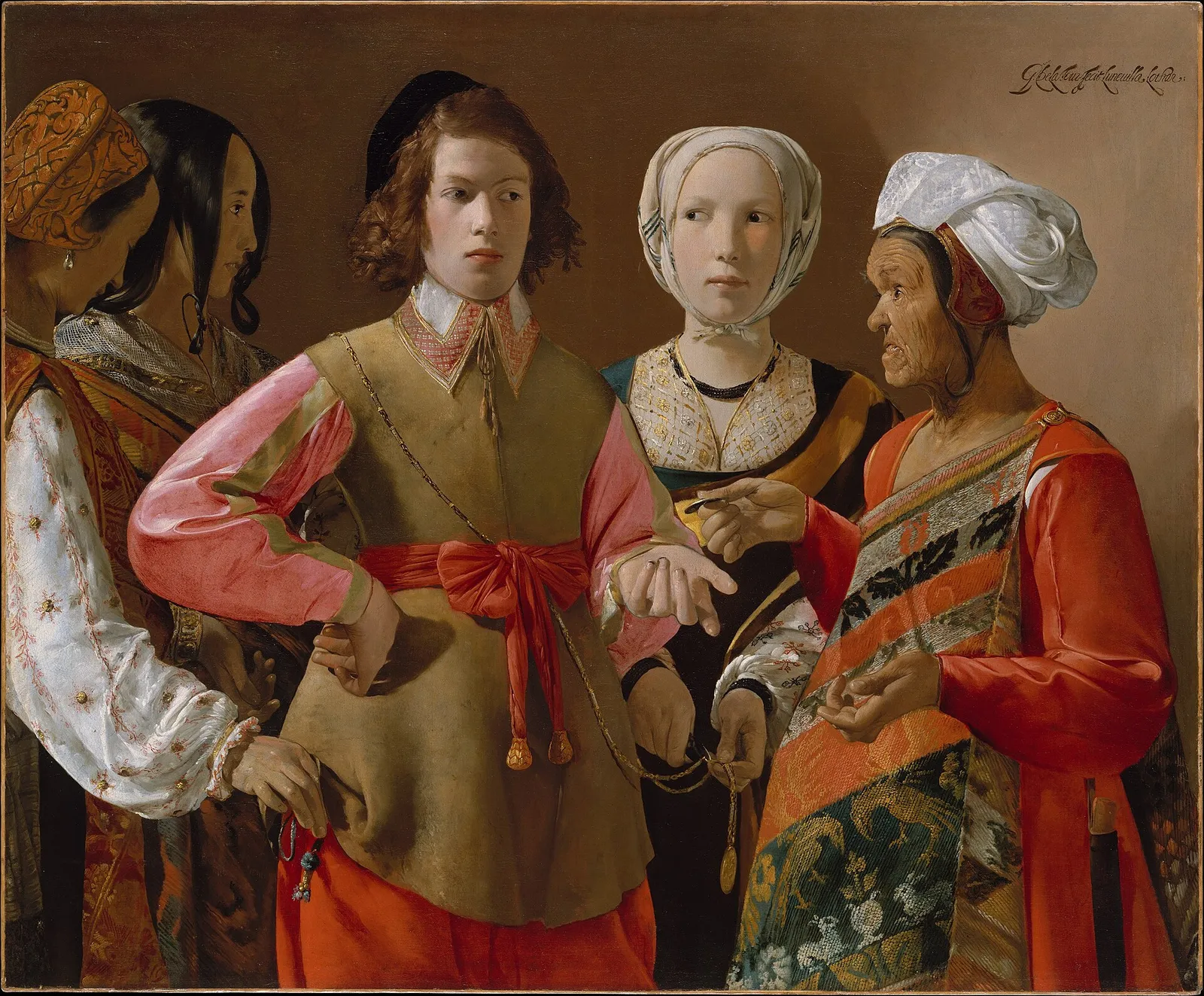
Georges de La Tour's The Fortune Teller is in the collection of the Metropolitan Museum of Art. The painting is dated 1630. It shows a well-dressed young man whose attention is held by an old woman while the people around him quietly go about their own business, and the scene rewards slow, close looking.
Where to see it
The Fortune Teller belongs to the Metropolitan Museum of Art, which is also listed as its location. Works in large collections can be moved, rotated off view, lent or taken for conservation, so check the Metropolitan Museum of Art's official website for current display status before you visit. If seeing this painting is the reason for your trip, confirm it is on view close to your date. The canvas measures 101.9 cm high by 123.5 cm wide. It is wider than it is tall, and the figures fill most of the picture, so you can take in the whole group from a short distance.
What to look for in person
Follow the hands, not the faces
The story is told mostly through hands. Start with the young man at the center. He is turned toward the old woman, and his attention is clearly fixed on her. Then let your eyes move slowly across the picture, away from the expressions and down to the fingers. Several hands are busy close to his clothing and belongings, and he does not seem to notice any of them. Telling a story through quiet gestures while the main character looks elsewhere is the central device of the painting. Give yourself time to find each one.
Glances that pass sideways
Look at where each figure's eyes are directed. Several of the women do not look at the young man directly. They exchange sideways glances or look past him, and this creates a silent network of communication that he is left out of. The faces are smooth and still, almost mask-like, which makes small shifts of the eyes stand out. Stepping back and then moving closer helps: from a distance the group reads as a calm gathering, while up close the looks suggest cooperation and intent.
Costume, pattern and a daylight scene
La Tour is best known for night scenes lit by a single candle, but this picture is set in even, cool daylight. That light lets him concentrate on surfaces: patterned fabrics, embroidered sleeves, lace, and the textures of skin and hair. Compare the young man's fine clothing with the old woman's weathered face and heavily patterned wrap. The contrast between youth and age, and between a fresh, unsuspecting face and an experienced one, is set out clearly. Close up, the crisp painting of fabric details is worth examining.
About the painting
Georges de La Tour was a French painter from the Duchy of Lorraine. He worked in the first half of the seventeenth century. Today he is admired for simplified, carefully ordered figures and for his candlelit religious scenes. The Fortune Teller, dated 1630, belongs to a different side of his work: daylight genre subjects drawn from everyday life, often with a moral edge. The theme of a naive young man being deceived by fortune tellers or cardsharps was popular among European painters influenced by Caravaggio, and La Tour's picture belongs to that tradition. It is usually read as a cautionary tale about vanity, credulity and the danger of being distracted. The young man listens to a prediction about his future while losing something in the present. What makes the painting distinctive is its restraint. There is no violent action, only a frieze of half-length figures pressed close to the picture surface against a plain background, and stillness that makes small movements easy to miss. The painting measures 101.9 by 123.5 cm, and the figures fill nearly the whole width. That arrangement places you almost at the edge of the group, as if you were a bystander who can see what the young man cannot. For visitors, the reward is in the details: how the hands are placed, the direction of each glance, and the careful treatment of fabrics and faces. Allow several minutes in front of it rather than a passing look.
Key facts
| Artist | Georges de La Tour |
|---|---|
| Date | 1630 |
| Size | 101.9 × 123.5 cm |
| Medium | oil paint, canvas |
| Collection | Metropolitan Museum of Art |
| Gallery | Gallery 622 Checked in the museum's open data on 2026-11-12 (galleries can change) Source |
How to visit: Metropolitan Museum of Art
New York City, United States · Museum guide
| Opening hours | Sun, Mon, Tue, Thu 10:00–17:00 Fri, Sat 10:00–21:00 |
|---|---|
| Closed | Wednesdays; Thanksgiving Day, 25 December, 1 January and the first Monday in May |
| Admission | Adults USD 30 Seniors (65 and over) USD 22 Visitors with a disability (in person only) USD 22 Students USD 17 Children (12 and under) free Care partners of visitors with a disability (in person only) free New York State residents; NY, NJ and CT students: pay what you wish (minimum USD 0.01). Online requires a NY State billing address; NJ/CT students in person with student ID |
| Free entry | Free for children 12 and under, Members and Patrons, and care partners of visitors with a disability. Pay what you wish for New York State residents and NY/NJ/CT students. |
| Booking | No reservation is required and there is no timed entry. |
The Cantor Roof Garden, the Modern and Contemporary Galleries, and the Ancient West Asia and Ancient Cyprus Galleries are closed for renovation.
Official ticket page
Official website
View on map
Hours and prices can change. Please check the official website before you go. (Checked on: 2026-11-09)
More by Georges de La Tour
 The Cheat with the Ace of Diamonds — Louvre Museum
 The Repentant Magdalen — National Gallery of Art
 The Penitent Magdalen — Metropolitan Museum of Art
 Joseph the Carpenter — Louvre Museum