Art! Art! Art! › Works
The Golden Bough
 J. M. W. Turner, 1834
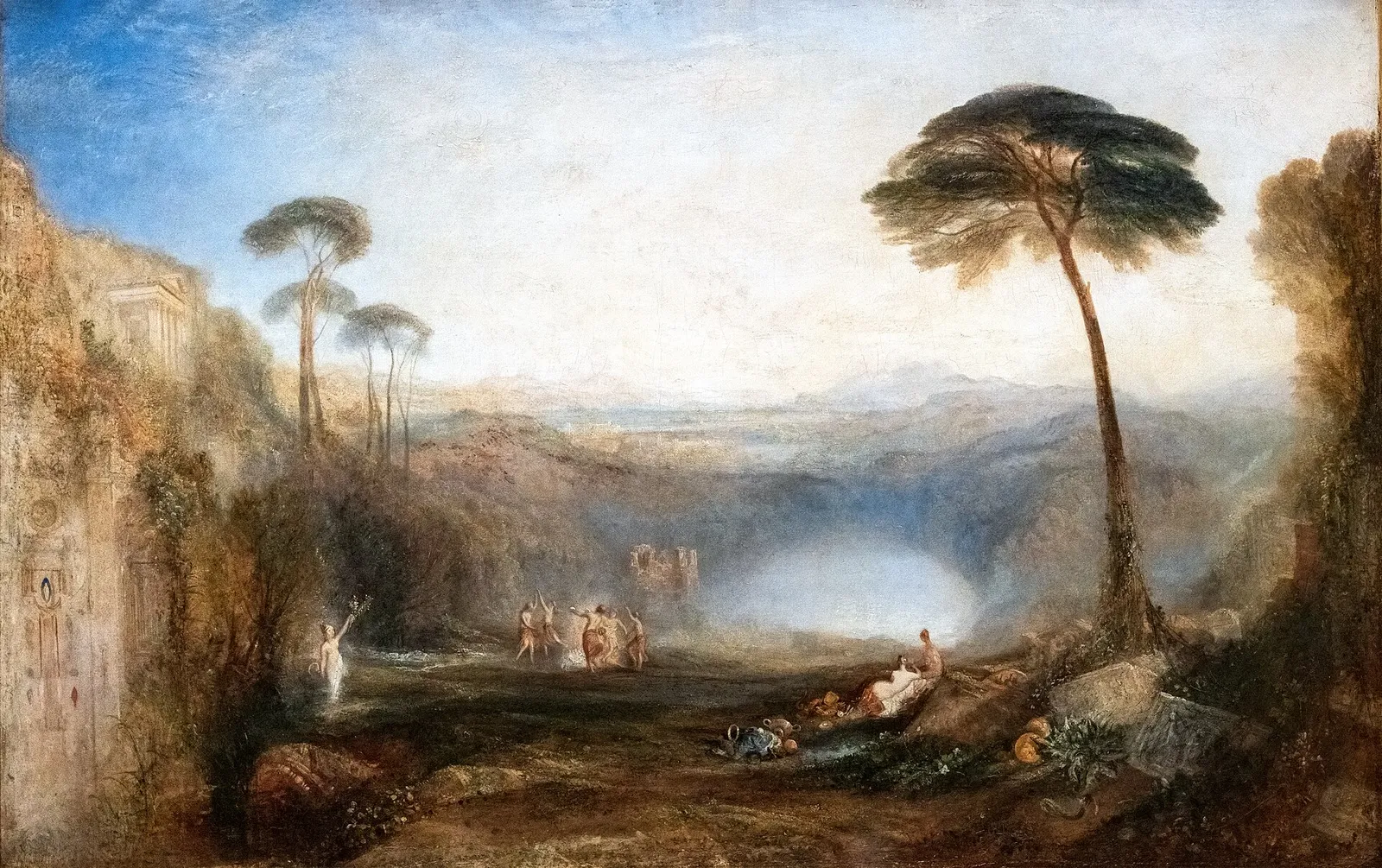
The Golden Bough is a painting by J. M. W. Turner dated 1834, and its location is recorded as Tate. It draws on a story from Virgil's Aeneid and turns it into a wide, light-filled landscape where the atmosphere matters as much as the figures.
Where to see it
The Golden Bough is located at Tate, and its collection is recorded as Tate; National Gallery. Tate has more than one site, and works are not always on display, so check Tate's official website before you visit to confirm where the painting is currently shown and whether it is on view.
What to look for in person
Light as the main subject
Stand back first. The painting measures 104.1 x 163.8 cm, wide enough that the eye travels across it like a view from a hillside. Notice how a warm, hazy glow fills the centre and seems to dissolve the distance. Turner builds this effect with pale, layered colour rather than sharp outlines. Trees, water and far hills soften into the same golden air, so the picture feels less like a record of a place and more like a study of light and atmosphere.
Finding the golden bough
Then look for the story. In Virgil's Aeneid, the hero Aeneas must obtain a golden bough before the Cumaean Sibyl can guide him into the underworld. Search among the figures for the raised branch, which Turner makes a small, bright accent against the surrounding landscape. Because the figures are modest in scale compared with the scenery, it can take a moment to spot. That shift in proportion is typical of Turner, who often let the setting carry the mood of a legend instead of the people in it.
A dialogue with classical landscape
Turner deeply admired the classical landscapes of the seventeenth-century painter Claude Lorrain, and this picture belongs to that tradition: framing trees, a calm stretch of water, an idealised southern landscape and an ancient subject. Compare the steady, ordered composition with the looser, almost vaporous handling of light and distance. That combination, a traditional structure filled with Turner's own freer treatment of colour and air, is one of the most rewarding things to notice when you stand in front of the canvas.
About the painting
J. M. W. Turner (1775-1851) was one of the leading British painters of his time, known above all for his treatment of light, weather and atmosphere. Alongside storms, seascapes and modern subjects, he repeatedly returned to classical history and literature, and The Golden Bough, dated 1834, is one of those pictures. Its subject comes from Book Six of Virgil's Aeneid. Before the Trojan hero Aeneas can visit the underworld to meet the spirit of his father, the Cumaean Sibyl tells him he must find and pluck a golden bough as an offering. The episode is linked with Lake Avernus near Naples, which ancient writers associated with the entrance to the underworld. Turner, however, does not paint a dark or frightening scene. He presents a serene, sunlit landscape in which the mythical moment sits within a broad, glowing view. For visitors, the painting is a useful way into Turner's classical work. It shows his debt to Claude Lorrain in the balanced arrangement of trees, water and distant hills, while also showing how far his own handling of colour had moved toward softness and luminosity by the 1830s. Take time with the surface at a closer distance: the background in particular is built from delicate, pale layers that blur the edges between land, water and sky. The painting's collection is recorded as Tate; National Gallery, reflecting the shared history of Britain's national collections, and its location is Tate. Check Tate's official website before visiting for its current display status.
Key facts
| Artist | J. M. W. Turner |
|---|---|
| Date | 1834 |
| Size | 104.1 × 163.8 cm |
| Medium | oil paint, canvas |
| Collection | Tate / National Gallery |
How to visit: Tate Britain
London, United Kingdom · Museum guide
| Opening hours | Mon–Sun 10:00–18:00 (galleries start closing at 17:50) |
|---|---|
| Closed | 24–26 December (all Tate galleries, festive period). |
| Last entry | 17:30 |
| Admission | Collection (everyone): free, no booking needed Tate Collective (16–25) exhibition ticket: GBP 5 (free Tate Collective sign-up required) Family child ticket, ages 12–18 (exhibitions): GBP 5 Children 11 and under (exhibitions): free (up to four per parent/guardian) |
| Free entry | The collection is free for everyone. Exhibitions are free for Members, and some exhibitions are free for all (listed as FREE). Disabled visitors pay a concessionary rate; companions go free. |
| Booking | No reservation is required and there is no timed entry. |
The Millbank entrance is closed until 2027 for construction of the Clore Garden; use the Manton Entrance on Atterbury Street.
Official ticket page
Official website
View on map
Hours and prices can change. Please check the official website before you go. (Checked on: 2026-11-09)
More by J. M. W. Turner
 Rain, Steam and Speed – The Great Western Railway — National Gallery
 The Fighting Temeraire — National Gallery
 Stormy Sea with Dolphins — Tate Britain
 ‘Hurrah! for the Whaler Erebus! Another Fish!’ — Tate Britain
 The Fall of an Avalanche in the Grisons — Tate Britain
 Fishermen at Sea — Tate Britain