Art! Art! Art! › Works
The Fighting Temeraire
 J. M. W. Turner, 1839
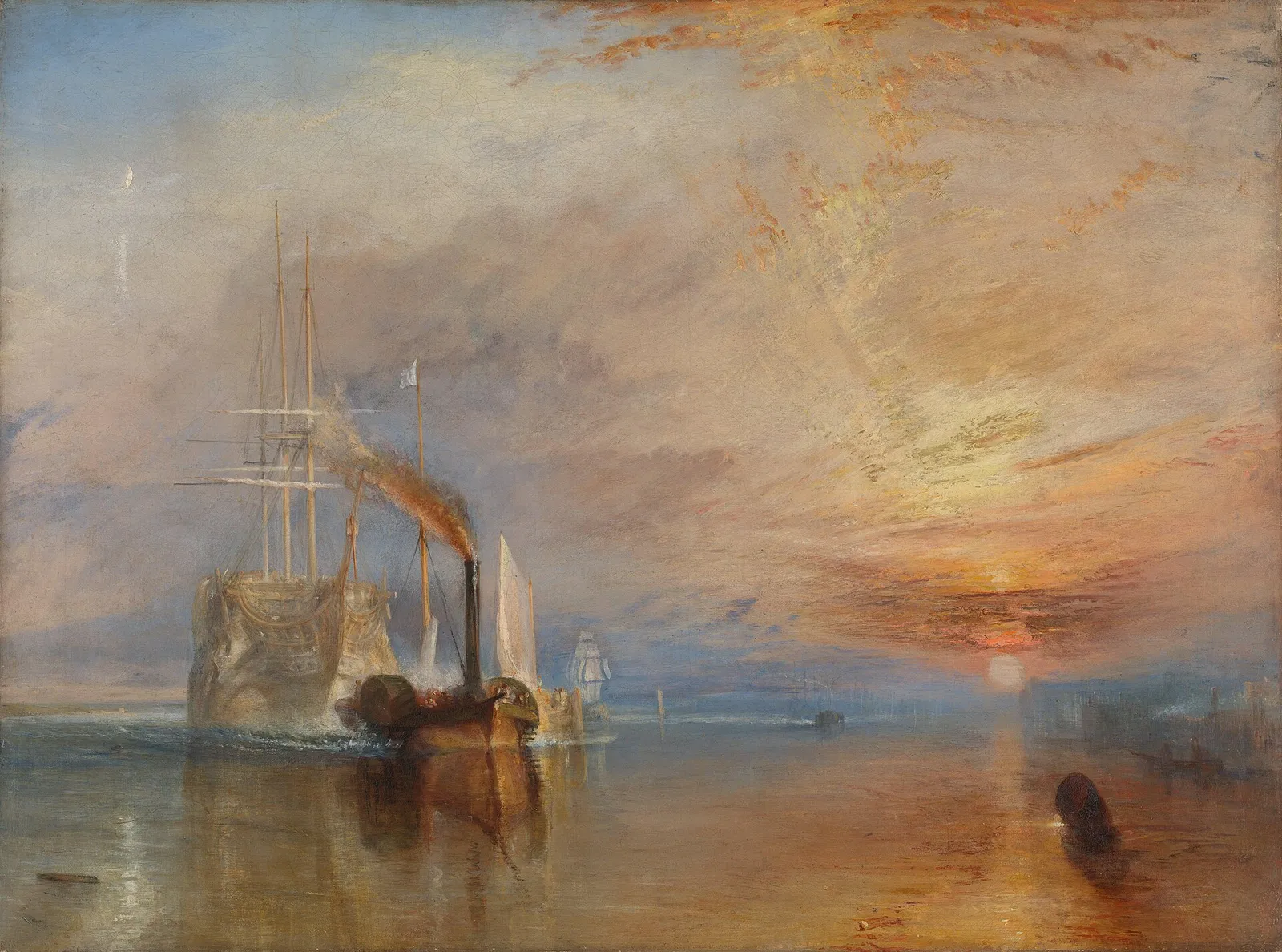
The Fighting Temeraire, dated 1839, is in the collection of the National Gallery. In it, J. M. W. Turner shows an old sailing warship being towed by a small steam tug toward the end of its working life, set against a blazing sunset. At 90.7 by 121.6 cm, it is a canvas you can take in at once from across the room and then study closely for its paint surface.
Where to see it
The Fighting Temeraire is held by the National Gallery, which is listed as both its collection and its location. Paintings can be moved, rehung or lent, so check the National Gallery's official website for current display status, opening hours and visiting information before you go.
What to look for in person
The pale ship and the dark tug
Start with the pair of vessels left of centre. The old warship rises pale, almost translucent, its hull and rigging painted in soft silvery and cream tones. In front, the small steam tug is dark, low and solid, its tall funnel trailing smoke and sparks. The tug leads and the great ship follows. The contrast is widely read as old giving way to new: the age of wooden sailing warships passing to the age of steam. Step back and notice how the warship seems to fade into the sky around it.
The sunset and the paint surface
On the right, the sun goes down in bands of red, orange and yellow that spill across the water. Move closer and compare the handling: the sky and reflections are built up with thick, textured paint, while the ghostly ship on the left is handled more thinly and smoothly. The sunset is commonly understood as a visual metaphor for the end of the ship's career. Then look to the upper left, where a thin crescent moon sits in a cooler sky, balancing the heat on the right.
An image, not a record
Turner was making a picture rather than a documentary report. Look at the ship's tall masts and neatly furled sails, which give it the bearing of a vessel still in service; it is generally accepted that a ship on its way to be broken up would have been stripped of much of this. Notice too how the broad, calm river and low horizon keep attention on the two boats, with other craft kept small and secondary. These choices shape the mood of farewell you feel in front of the canvas.
About the painting
The Fighting Temeraire is dated 1839 and measures 90.7 by 121.6 cm. Its subject is HMS Temeraire, a large sailing warship of the Royal Navy that fought at the Battle of Trafalgar in 1805. Decades later the ship was sold out of service and towed up the River Thames to be broken up, and Turner turned that final journey into the subject of this painting. The picture is often known by its longer title, The Fighting Temeraire tugged to her last berth to be broken up, 1838, under which Turner showed it in public.
For visitors, the painting rewards two kinds of looking. From a distance, it works as a clear, almost diagrammatic contrast: a pale, stately ship on the left, a dark working tug in front of it, and a fiery sunset filling the right half of the sky. Up close, the interest shifts to Turner's handling of paint, from the heavy, built-up colour of the sky and water to the delicate, thin treatment of the old ship's rigging.
The work is widely discussed as a reflection on change and loss, with the passing of a famous wooden warship standing for the passing of an era of sail as steam power took over. Turner did not paint a strictly accurate scene; he adjusted details of the ship and the light to strengthen this mood. When you stand in front of it, try following the eye's path from the bright sun, across the reflections, to the tug and finally to the fading ship behind it.
Key facts
| Artist | J. M. W. Turner |
|---|---|
| Date | 1839 |
| Size | 90.7 × 121.6 cm |
| Medium | oil paint, canvas |
| Collection | National Gallery |
How to visit: National Gallery
London, United Kingdom · Museum guide
| Opening hours | Mon–Thu, Sat, Sun 10:00–18:00 Fri 10:00–21:00 (Friday late) |
|---|---|
| Closed | 24–26 December and 1 January. |
| Admission | General admission (collection) free; donations invited Some exhibitions are charged (e.g. Renoir and Love, until 31 Jan 2027) |
| Free entry | General admission is always free. |
| Booking | No reservation or timed entry is required. Free timed booking gives fast-track entry. |
Building work and improvements are under way: some rooms are closed and some paintings have moved, so check the floorplans or collection search before visiting. A new Research Centre is due to open in 2028. On 17 November only, some east wing rooms and the Espresso Bar close from 16:00.
Official ticket page
Official website
View on map
Hours and prices can change. Please check the official website before you go. (Checked on: 2026-11-11)
More by J. M. W. Turner
 Rain, Steam and Speed – The Great Western Railway — National Gallery
 Stormy Sea with Dolphins — Tate Britain
 The Golden Bough — Tate Britain
 ‘Hurrah! for the Whaler Erebus! Another Fish!’ — Tate Britain
 The Fall of an Avalanche in the Grisons — Tate Britain
 Fishermen at Sea — Tate Britain