Art! Art! Art! › Works
The Fall of an Avalanche in the Grisons
 J. M. W. Turner, 1810
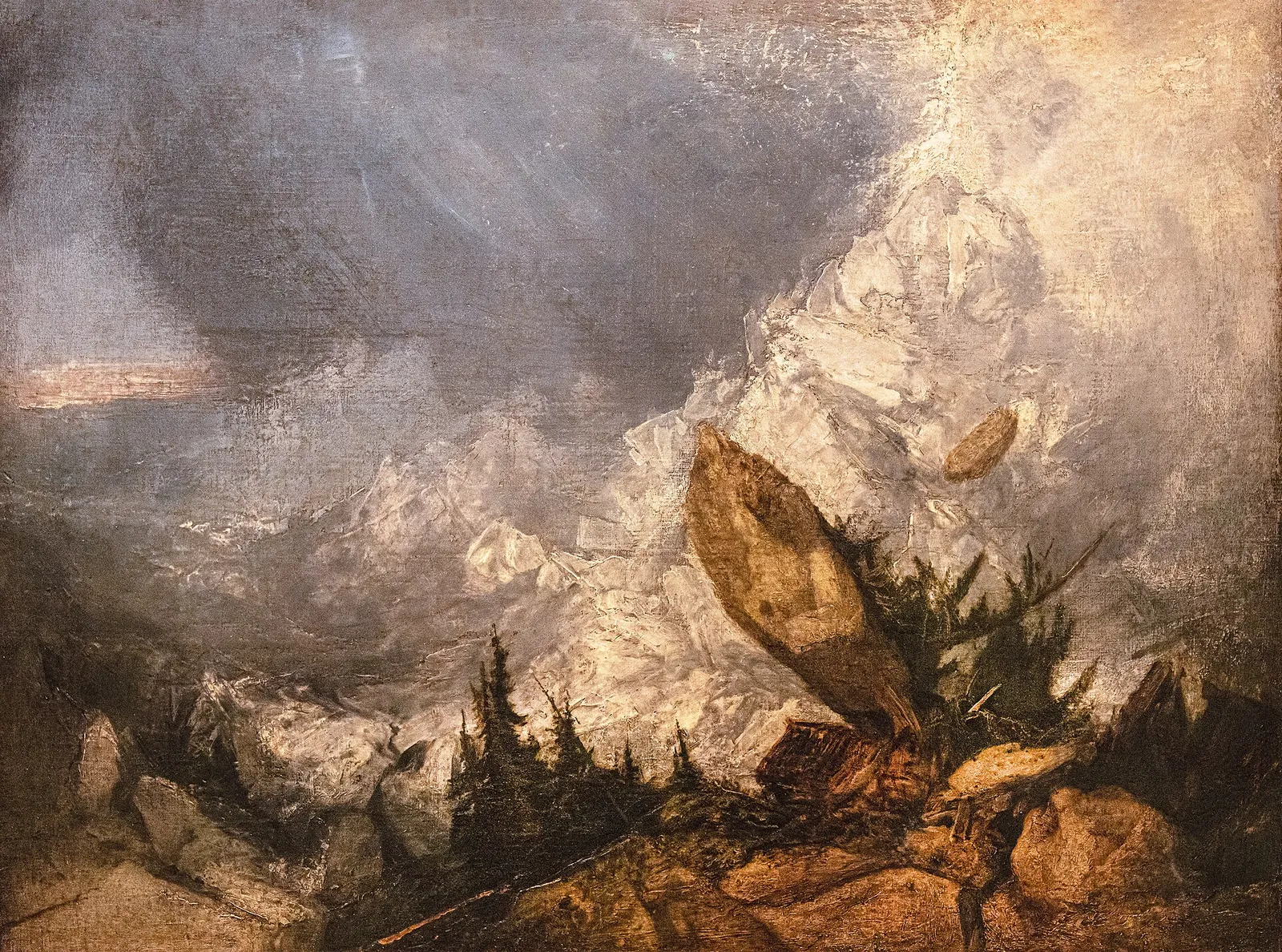
J. M. W. Turner's The Fall of an Avalanche in the Grisons shows a mountain disaster at the instant it strikes: a torrent of snow and rock bearing down on a small hut in the Swiss canton of Grisons. The oil on canvas was exhibited in 1810 and is held by Tate, which shows it in London.
Where to see it
The painting belongs to Tate, and the collection listing also names the National Gallery. Its location is given as Tate, with Tate Britain in London named as the holding site. Artworks are sometimes moved between rooms, lent to other venues or taken off view for conservation, so check Tate's official website for the painting's current display status before you plan your visit.
What to look for in person
The rock and the hut
Start with the lower part of the picture, where a huge boulder is about to crush a small hut. The building looks fragile beside the falling rock, and that contrast in scale is the core of the image. Turner does not show the calm after the disaster or a distant view of it. He puts you at the moment of impact. Notice how close the viewpoint feels, as if you were standing just outside the path of the slide.
Snow, cloud and stone run together
Look at how hard it is to tell where the snow ends and the sky begins. Greys, whites and earthy browns churn across the canvas, and the shapes of rock, cloud and falling snow blur into one another. Step close and you can see the paint handling that creates this effect. Then step back to see the whole mass sweep down at an angle across the picture. The painting conveys force and confusion more than precise detail.
A picture shown with a poem
Turner accompanied this painting with an eight-line poem. Pairing a picture with verse was part of how he wanted the scene to be received: the words and the image were meant to work together and deepen the sense of danger and human helplessness. When you stand in front of the canvas, think of it as half of a combined work. If the gallery label or Tate's website reproduces the lines, read them first and then look at the painting again.
About the painting
The Fall of an Avalanche in the Grisons is an oil painting on canvas by the English painter J. M. W. Turner, measuring 90.2 × 120 cm. Turner did not date the canvas, but it was exhibited in 1810, and that is the date it is known by. The subject is a natural catastrophe in the Grisons, a mountainous canton in eastern Switzerland. An avalanche sends rocks crashing onto a hut, and the painting concentrates on that single destructive moment.
The work belongs to a strand of Turner's art that explores the power of nature and the smallness of human life within it. This idea, often described as the sublime, attracted many artists and writers of his generation. The only sign of human presence is a modest dwelling. Its fate stands for the vulnerability of anyone living in such a landscape. Rather than painting a clear, topographical view of the Alps, Turner uses energetic, loosely defined forms. Snow, stone and storm seem to merge into one overwhelming movement.
Turner presented the canvas together with an eight-line poem, so text was part of how the work first met the public. For visitors today, the painting rewards both close and distant viewing. Up close, you can study the physical texture of the paint. From further back, the diagonal rush of the avalanche and the doomed hut come into focus as a single dramatic statement.
The painting is held by Tate, with the National Gallery also named in its collection listing, and it is shown at Tate Britain in London.
Key facts
| Artist | J. M. W. Turner |
|---|---|
| Date | 1810 |
| Size | 90.2 × 120 cm |
| Medium | oil paint, canvas |
| Collection | Tate / National Gallery |
How to visit: Tate Britain
London, United Kingdom · Museum guide
| Opening hours | Mon–Sun 10:00–18:00 (galleries start closing at 17:50) |
|---|---|
| Closed | 24–26 December (all Tate galleries, festive period). |
| Last entry | 17:30 |
| Admission | Collection (everyone): free, no booking needed Tate Collective (16–25) exhibition ticket: GBP 5 (free Tate Collective sign-up required) Family child ticket, ages 12–18 (exhibitions): GBP 5 Children 11 and under (exhibitions): free (up to four per parent/guardian) |
| Free entry | The collection is free for everyone. Exhibitions are free for Members, and some exhibitions are free for all (listed as FREE). Disabled visitors pay a concessionary rate; companions go free. |
| Booking | No reservation is required and there is no timed entry. |
The Millbank entrance is closed until 2027 for construction of the Clore Garden; use the Manton Entrance on Atterbury Street.
Official ticket page
Official website
View on map
Hours and prices can change. Please check the official website before you go. (Checked on: 2026-11-09)
More by J. M. W. Turner
 Rain, Steam and Speed – The Great Western Railway — National Gallery
 The Fighting Temeraire — National Gallery
 Stormy Sea with Dolphins — Tate Britain
 The Golden Bough — Tate Britain
 ‘Hurrah! for the Whaler Erebus! Another Fish!’ — Tate Britain
 Fishermen at Sea — Tate Britain
Sources
- Wikidata Q28540780
- Wikipedia (fr) (CC BY-SA 4.0)
- www.tate.org.uk