Art! Art! Art! › Works
‘Hurrah! for the Whaler Erebus! Another Fish!’
 J. M. W. Turner, 1846
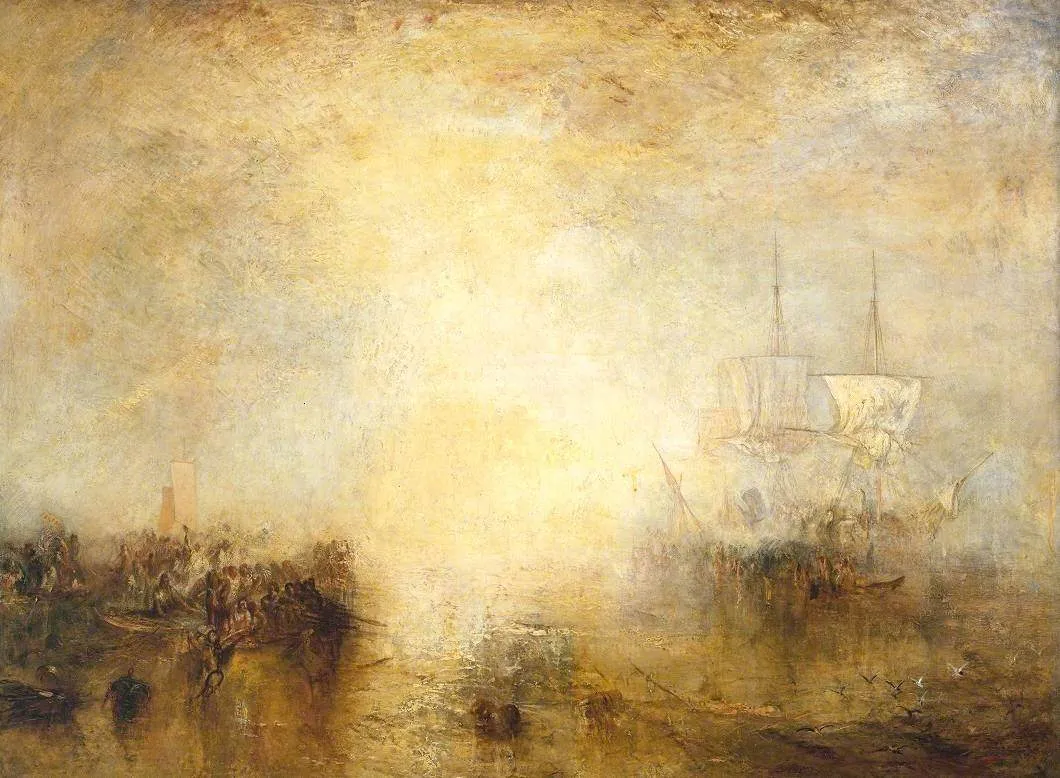
‘Hurrah! for the Whaler Erebus! Another Fish!’ is a late painting by J. M. W. Turner, dated 1846, and it belongs to Tate. It shows a whaling scene dissolved into light and vapour, and it rewards slow looking, because the ship, boats and catch emerge only gradually from the haze.
Where to see it
The painting is held by Tate, and the collection record also lists the National Gallery. Tate is the location given for the work. Tate operates more than one gallery, and works are rotated, lent or taken off view for conservation, so check Tate's official website, including the online collection entry for this painting, for current display status before you plan your visit.
What to look for in person
Find the ship and the catch in the haze
Stand back first. At a distance the canvas can read as a field of pale gold, cream and grey, with darker forms gathering in one area. Those darker passages resolve into the whaling ship, its rigging and the small boats crowded near it, where the crew are at work on the whale. Turner gives you just enough structure to recognise a working scene, then lets mist and spray blur the edges. Notice how your eye has to piece the event together, rather than being handed a clear, detailed narrative.
Light as the real subject
Look at how much of the surface is given over to sky and glowing atmosphere rather than to the vessel itself. In his later years Turner was deeply concerned with light, weather and the effect of sun through moisture, and this picture is a good example. Follow the way warm tones near the centre fade into cooler, greyer areas towards the edges. The brightness seems to come from within the paint, and the figures and boats are almost absorbed by it, giving the scene an unsettled, dreamlike quality.
Up close: the brushwork
Move nearer and the image breaks apart into marks. Turner's late technique is loose and layered: thin veils of colour, scraped or dragged passages, and touches of thicker paint where light catches spray or sail. These details are hard to see in reproductions, which tend to flatten the surface. Compare the busier, more defined area around the ship with the soft, open passages of sky and sea. That contrast between worked detail and broad atmosphere is one of the main pleasures of seeing the painting in person.
About the painting
J. M. W. Turner painted ‘Hurrah! for the Whaler Erebus! Another Fish!’ in 1846, towards the end of a long career that had made him one of the best-known landscape and marine painters in Britain. In the mid-1840s he produced a small group of paintings on the theme of whaling, and this canvas belongs to that group. Whaling was a dangerous, commercially important industry at the time, and Turner's interest seems to have lain less in documenting its procedures than in the drama of men, ships and creatures caught up in sea, weather and light.
The exclamatory title, presented in quotation marks, reads like a cry from the deck at the moment a whale is secured. It sets an energetic, almost celebratory tone that contrasts with the hazy, uncertain way the scene is actually painted. That tension between a lively, specific title and a dissolving image is characteristic of Turner's late work, where narrative is often present but subordinate to atmosphere.
The canvas measures 120.6 by 90.2 cm according to the collection data, a substantial size that lets the luminous colour fill much of your field of view when you stand in front of it. The work is part of Tate's collection, with the National Gallery also named in its collection history, reflecting the way much of Turner's output passed into the British national collections. For visitors, the painting offers a compact introduction to late Turner: a recognisable subject, a strong sense of place at sea, and a painted surface in which light, rather than outline, does most of the work.
Key facts
| Artist | J. M. W. Turner |
|---|---|
| Date | 1846 |
| Size | 120.6 × 90.2 cm |
| Medium | oil paint, canvas |
| Collection | Tate / National Gallery |
How to visit: Tate Britain
London, United Kingdom · Museum guide
| Opening hours | Mon–Sun 10:00–18:00 (galleries start closing at 17:50) |
|---|---|
| Closed | 24–26 December (all Tate galleries, festive period). |
| Last entry | 17:30 |
| Admission | Collection (everyone): free, no booking needed Tate Collective (16–25) exhibition ticket: GBP 5 (free Tate Collective sign-up required) Family child ticket, ages 12–18 (exhibitions): GBP 5 Children 11 and under (exhibitions): free (up to four per parent/guardian) |
| Free entry | The collection is free for everyone. Exhibitions are free for Members, and some exhibitions are free for all (listed as FREE). Disabled visitors pay a concessionary rate; companions go free. |
| Booking | No reservation is required and there is no timed entry. |
The Millbank entrance is closed until 2027 for construction of the Clore Garden; use the Manton Entrance on Atterbury Street.
Official ticket page
Official website
View on map
Hours and prices can change. Please check the official website before you go. (Checked on: 2026-11-09)
More by J. M. W. Turner
 Rain, Steam and Speed – The Great Western Railway — National Gallery
 The Fighting Temeraire — National Gallery
 Stormy Sea with Dolphins — Tate Britain
 The Golden Bough — Tate Britain
 The Fall of an Avalanche in the Grisons — Tate Britain
 Fishermen at Sea — Tate Britain