Art! Art! Art! › Works
Stormy Sea with Dolphins
 J. M. W. Turner, 19th century
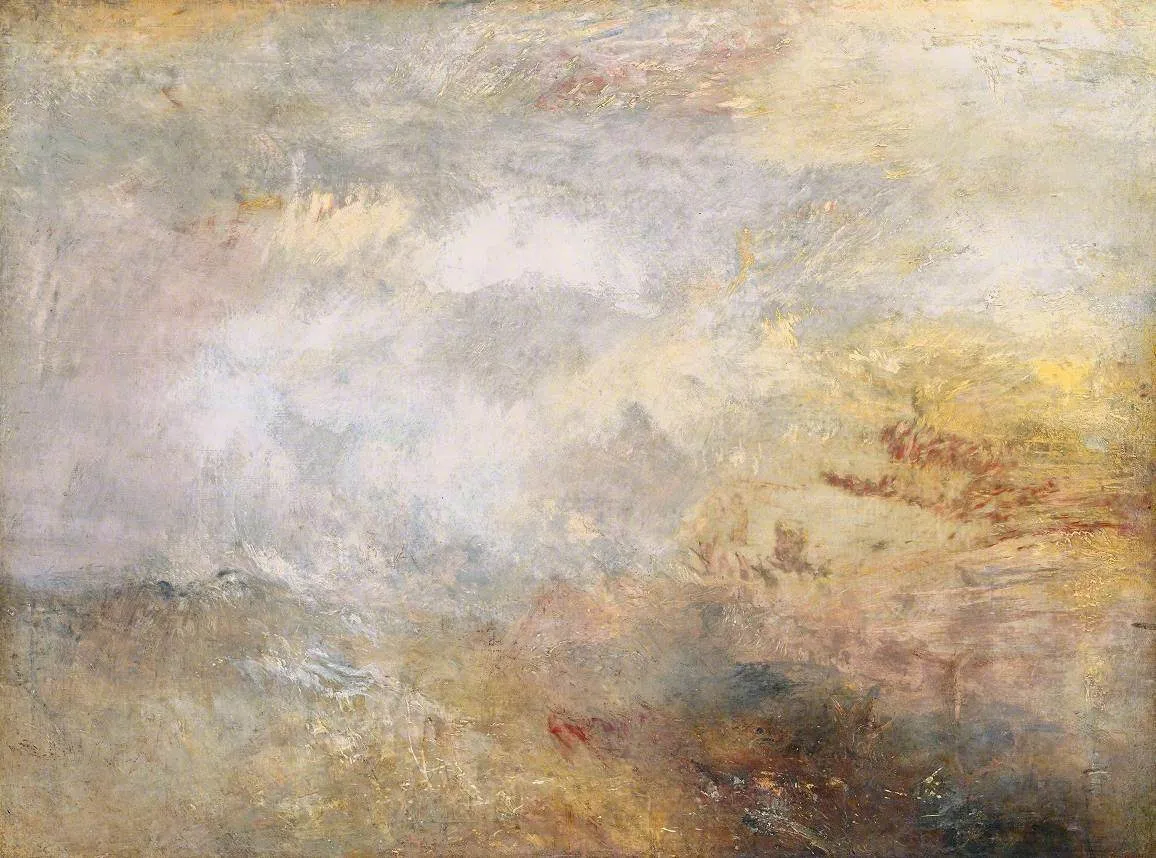
Stormy Sea with Dolphins is a 19th-century painting by J. M. W. Turner in which sea, spray and sky seem to merge into a single field of moving colour. Its collection is recorded as Tate and the National Gallery, and its location as Tate. Seeing it in person lets you follow the brushwork and the shifting light that reproductions tend to flatten.
Where to see it
The painting is recorded as located at Tate, with its collection listed as Tate and the National Gallery. Tate has more than one gallery site, and works are rotated, lent or kept in storage, so check Tate's official website, ideally its online collection entry for this painting, for current display status and the relevant site before you plan your visit.
What to look for in person
A sea without a horizon line to hold on to
Stand back first and try to find where the water ends and the sky begins. Turner lets the two run together, so the boundary is suggested by changes in tone and texture rather than drawn as a line. Light and dark areas swirl across the canvas, and the eye is pulled into the turbulence instead of resting on a fixed point. Give yourself a minute: the composition reads less as a scene with objects and more as weather and motion, which is typical of Turner's later approach to the sea.
Looking for the dolphins
The title points you to creatures in the water, but do not expect a crisp natural-history illustration. Look towards the lower part of the picture for darker, curving shapes caught in the waves. They are built from the same loose strokes as the sea around them, so they appear and dissolve depending on where you stand and how the light falls on the surface. Part of the experience is this slow act of recognition, as forms emerge from the paint and then blend back into the surrounding water.
Brushwork up close
Move closer and the storm turns into evidence of making. You can see thin washes alongside more thickly worked passages, areas where paint seems dragged or scumbled across the surface, and places where the canvas texture shows through. This freedom of handling is one reason Turner's late seascapes are so closely studied: the paint itself carries the sense of wind and spray. Compare the busier, more densely worked zones with the quieter, open areas, and notice how much of the effect depends on contrast between them.
About the painting
J. M. W. Turner was one of the leading British painters of the 19th century, and the sea was among his most persistent subjects. Across his career he moved from detailed marine pictures towards increasingly free, atmospheric treatments in which light, air and water take priority over clear outlines. Stormy Sea with Dolphins belongs to this freer side of his work, and it is often discussed alongside other late sea pictures in which Turner seems more interested in the energy of the elements than in describing ships, coasts or figures.
For visitors, this means the painting rewards a different kind of looking. Rather than searching for a story, it helps to watch how colour and tone build a sense of movement, and to notice how the dolphins of the title are woven into the surging water rather than set apart from it. Paintings like this have often been described as unfinished or as studies, and debate about how Turner regarded such canvases is part of their interest.
The work is recorded with a height of 121.3 cm and a width of 90.2 cm, so it is large enough to fill your field of view when you stand close. The fact sheet lists its collection as Tate and the National Gallery, and its location as Tate. Because Turner's work is extensive and displays change, the painting may not always be on view; confirm on Tate's official website before travelling specifically to see it.
Key facts
| Artist | J. M. W. Turner |
|---|---|
| Date | 19th century |
| Size | 121.3 × 90.2 cm |
| Medium | oil paint, canvas |
| Collection | Tate / National Gallery |
How to visit: Tate Britain
London, United Kingdom · Museum guide
| Opening hours | Mon–Sun 10:00–18:00 (galleries start closing at 17:50) |
|---|---|
| Closed | 24–26 December (all Tate galleries, festive period). |
| Last entry | 17:30 |
| Admission | Collection (everyone): free, no booking needed Tate Collective (16–25) exhibition ticket: GBP 5 (free Tate Collective sign-up required) Family child ticket, ages 12–18 (exhibitions): GBP 5 Children 11 and under (exhibitions): free (up to four per parent/guardian) |
| Free entry | The collection is free for everyone. Exhibitions are free for Members, and some exhibitions are free for all (listed as FREE). Disabled visitors pay a concessionary rate; companions go free. |
| Booking | No reservation is required and there is no timed entry. |
The Millbank entrance is closed until 2027 for construction of the Clore Garden; use the Manton Entrance on Atterbury Street.
Official ticket page
Official website
View on map
Hours and prices can change. Please check the official website before you go. (Checked on: 2026-11-09)
More by J. M. W. Turner
 Rain, Steam and Speed – The Great Western Railway — National Gallery
 The Fighting Temeraire — National Gallery
 The Golden Bough — Tate Britain
 ‘Hurrah! for the Whaler Erebus! Another Fish!’ — Tate Britain
 The Fall of an Avalanche in the Grisons — Tate Britain
 Fishermen at Sea — Tate Britain