Art! Art! Art! › Works
The Eiffel Tower
 Georges Seurat, 1889
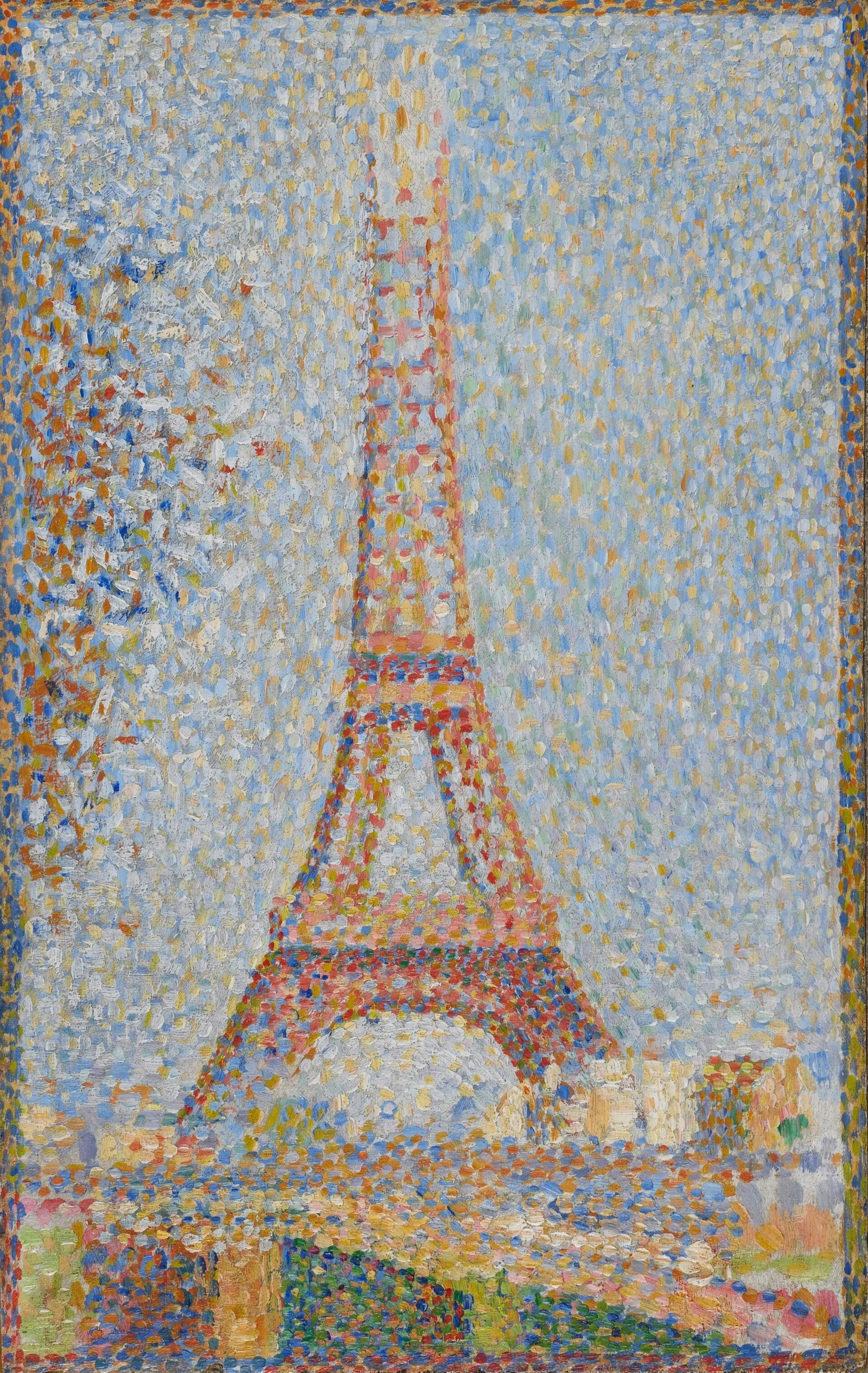
Georges Seurat's The Eiffel Tower is a small painting from 1889 that turns the newest landmark in Paris into a field of tiny, separate touches of color. It belongs to the Fine Arts Museums of San Francisco and is associated with the Legion of Honor. At just 24.1 by 15.2 cm, it rewards close, unhurried looking.
Where to see it
The Eiffel Tower is in the collection of the Fine Arts Museums of San Francisco, with its location listed as the Legion of Honor. Works on paper and small paintings may be rotated, lent or temporarily removed from view, so check the Fine Arts Museums of San Francisco's official website for current display status, opening hours and ticket information before you visit.
What to look for in person
The dot technique, up close and at a distance
Seurat built this image from small, distinct touches of color rather than smoothly blended brushstrokes. Step in close and the surface breaks apart into separate flecks of warm and cool hues sitting side by side. Step back a few paces and those touches begin to combine in the eye into a vibrating, unified image. This method, developed by Seurat in the 1880s and later called pointillism or divisionism, is the heart of his work. Because the panel is so small, you can shift between both viewing distances in a matter of seconds and watch the effect change.
A brand-new modern subject
In 1889 the Eiffel Tower was a new and much-debated structure, built for the Exposition Universelle held in Paris that year. Seurat chose to paint it at the very moment it was changing the city's skyline. Notice that the iron lattice is not rendered with crisp, engineer-like lines. Instead, the structure is suggested through color and texture, and its edges soften where they meet the sky. Look at how the tower and the background are made from the same kind of touches, so that the iron seems to share the atmosphere around it rather than stand apart from it.
A small, vertical, intimate picture
Measuring 24.1 cm high and 15.2 cm wide, this is a painting you need to approach closely. Its tall, narrow format echoes the upward thrust of the tower itself, and the small scale makes the experience personal rather than monumental. In a gallery it can be easy to walk past a work this size, so give it a moment. Notice how much variation in color is packed into a small area, and how the density of the touches changes across the surface. If the room allows, view it from slightly different angles as the light falls on the paint.
About the painting
Georges Seurat (1859-1891) was a French painter who became the leading figure of Neo-Impressionism. He is best known for large, carefully planned compositions such as A Sunday on La Grande Jatte, but he also made many small paintings in which he tested his ideas about color and light. Seurat was interested in the scientific color theories of his day, especially the idea that placing pure colors next to one another, rather than mixing them on the palette, could produce brighter and livelier effects when the viewer's eye combined them.
The Eiffel Tower, dated 1889, comes from late in Seurat's short career; he died in 1891 at the age of 31. The subject was strikingly up to date. The tower was erected for the 1889 Exposition Universelle in Paris and was controversial at the time, criticized by some artists and writers and celebrated by others as a symbol of modern engineering. By choosing it, Seurat aligned his modern painting method with a thoroughly modern motif.
For visitors, the painting offers a compact introduction to how Seurat worked. Rather than describing the tower's ironwork in detail, he translates it into color, letting the structure emerge from the same kind of small touches used for the sky. The result asks you to take part in completing the image by adjusting your distance from it.
The work is part of the Fine Arts Museums of San Francisco and is listed at the Legion of Honor. Its modest size, 24.1 by 15.2 cm, makes it a quiet but rewarding stop for anyone interested in late nineteenth-century French painting.
Key facts
| Artist | Georges Seurat |
|---|---|
| Date | 1889 |
| Size | 24.1 × 15.2 cm |
| Medium | oil paint, panel |
| Collection | Fine Arts Museums of San Francisco |
How to visit: Fine Arts Museums of San Francisco
San Francisco, United States
Hours and prices can change. Please check the official website before you go.
More by Georges Seurat
 A Sunday Afternoon on the Island of La Grande Jatte — Art Institute of Chicago
 Bathers at Asnières — National Gallery
 The Circus — Musée d'Orsay
 The Circus Parade — Metropolitan Museum of Art
 Le Chahut — Kröller-Müller Museum