Art! Art! Art! › Works
The Circus
 Georges Seurat, 1891
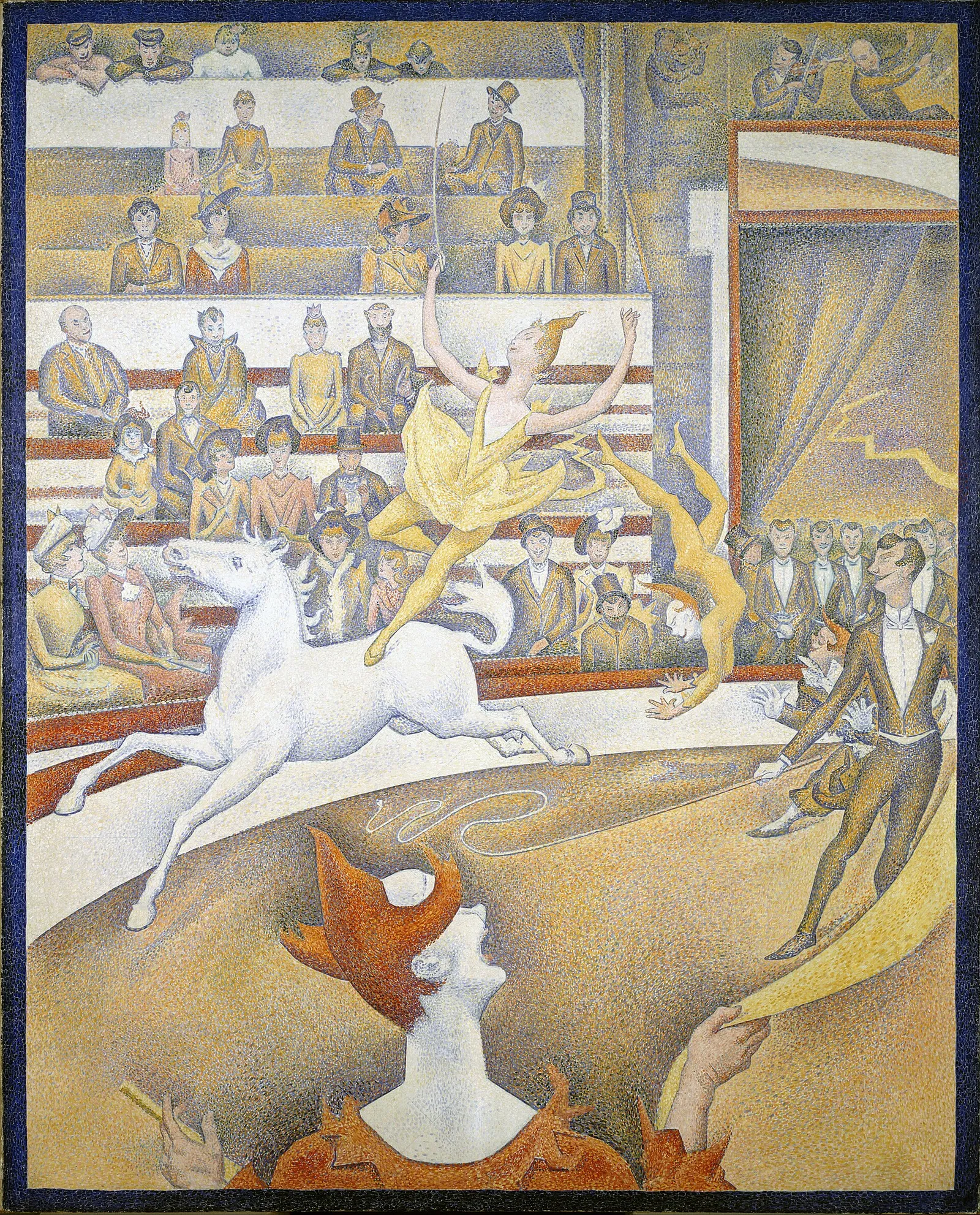
Georges Seurat's The Circus, dated 1891, is held by the Musée d'Orsay. It shows a circus performance built from countless small touches of colour, with a rider, acrobat, clown and ringmaster set against tiers of spectators. It is widely regarded as the artist's final major work, and it was left unfinished.
Where to see it
The Circus belongs to the collection of the Musée d'Orsay, and the museum is listed as its location. Works can be moved, rehung, sent on loan or taken off view for conservation, so check the Musée d'Orsay's official website for the painting's current display status before you visit.
What to look for in person
The rider and the acrobat in mid-motion
Start at the centre of the ring, where a female rider balances on a galloping white horse while an acrobat appears to tumble through the air nearby. Seurat freezes the moment rather than blurring it, so the figures look almost like cut-out shapes. Notice how the horse's legs, the rider's arms and the acrobat's body form sharp, angled lines. The effect is less a snapshot of real movement than a carefully composed design about energy and balance.
The clown seen from behind
In the lower foreground, a clown stands with his back to you, partly cut off by the edge of the picture. He acts as a frame within the frame, placing you just behind him at the ringside. Look at how his figure, together with the curtain held open at the upper right, draws your eye into the scene. It is a useful device to notice: the painting does not simply show the circus, it positions you inside the audience.
Dots, a limited palette and a painted border
Step close and the surface breaks into small dabs of colour; step back and they merge into form and light. This is the divisionist, or pointillist, technique Seurat is known for. The palette here is restrained, dominated by yellows, reds, blues and whites, which gives the scene a warm, artificial glow suited to an indoor show. Also look at the edges: Seurat painted a dotted border directly around the image, treating the frame as part of the composition.
About the painting
The Circus is by Georges Seurat and is dated 1891, the year the artist died. It is generally described as his last major painting, and it remained unfinished at his death, which helps explain why some passages look less resolved than others. For a visitor, this unfinished quality is worth looking for: in places you can see how the composition was laid out before the surface was fully worked up.
The painting belongs to a group of late works in which Seurat turned to modern urban entertainment, such as night-time performances and spectacles. Here the subject is a circus show. The performers occupy the lower and central area of the canvas, while the upper part is filled with rows of seated spectators. Many readers of the painting note that the audience appears arranged in tiers, with differences in dress and posture between the rows, inviting reflection on who watches and how.
Seurat was deeply interested in theories of colour and of line. He applied pure colours in small, separate touches, intending them to combine in the viewer's eye. He also used the direction of lines to suggest mood, and in The Circus many contours rise and curve upward, a choice often linked to ideas of liveliness and gaiety.
When you stand in front of the work, give yourself time at two distances. Up close, study the individual marks and the painted border. From further away, follow the sweep of the ring and the stacked rows of the crowd, and notice how calm and ordered the scene feels despite showing fast action.
Key facts
| Artist | Georges Seurat |
|---|---|
| Date | 1891 |
| Size | 1850 × 1520 cm |
| Medium | oil paint, canvas |
| Collection | Musée d'Orsay |
How to visit: Musée d'Orsay
Paris, France · Museum guide
| Opening hours | Tue–Wed, Fri–Sun 09:30–18:00 (galleries close at 17:30) Thu 09:30–21:45 (late opening; galleries close at 21:15) |
|---|---|
| Closed | Every Monday, 1 May and 25 December. |
| Last entry | 17:00 (exhibitions 17:15); Thursdays 21:00 |
| Admission | Full rate, online EUR 16 Full rate, at the museum EUR 14 Reduced rate (on site only) EUR 11 Enfant & Cie, online EUR 13 Enfant & Cie, at the museum EUR 11 Night rate (Thursday), online EUR 12 Night rate (Thursday), at the museum EUR 10 Under 18s; EEA residents under 26 free |
| Free entry | Free for under 18s and residents of the European Economic Area under 26. Free on the first Sunday of the month, with booking required. |
| Booking | Booking is strongly recommended. Entry is by timed slot. |
The museum stays open and all collections and exhibitions remain accessible, but entrances have changed: timed-ticket holders use Entrance 1 (Quay); priority visitors, reseller voucher holders, visitors without tickets and groups use Entrance 2 (Forecourt). Arrive at least 15 minutes before your time slot.
Official ticket page
Official website
View on map
Hours and prices can change. Please check the official website before you go. (Checked on: 2026-11-11)
More by Georges Seurat
 A Sunday Afternoon on the Island of La Grande Jatte — Art Institute of Chicago
 Bathers at Asnières — National Gallery
 The Eiffel Tower
 The Circus Parade — Metropolitan Museum of Art
 Le Chahut — Kröller-Müller Museum