Art! Art! Art! › Works
A Sunday Afternoon on the Island of La Grande Jatte
 Georges Seurat, 1884
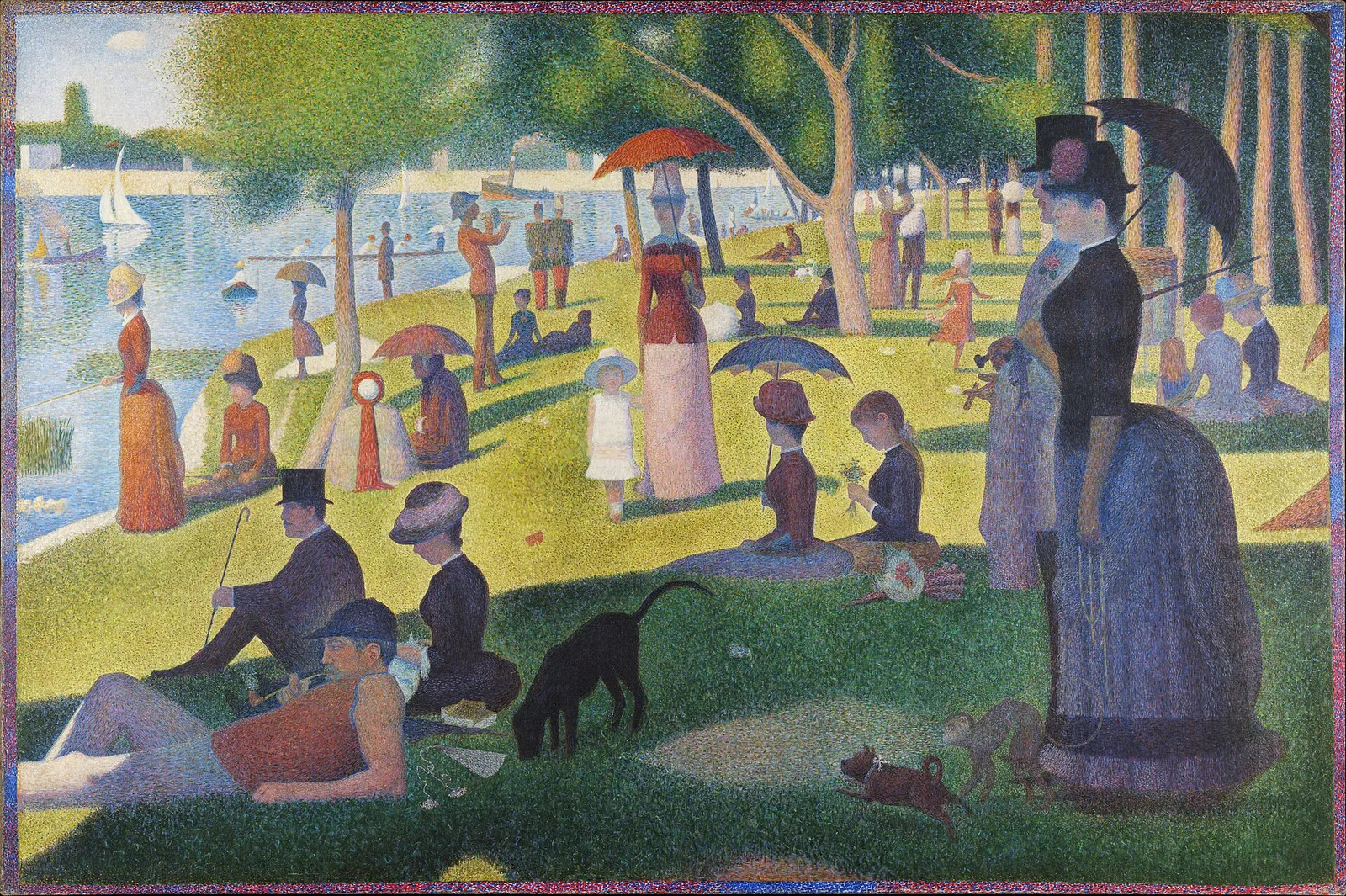
Georges Seurat's A Sunday Afternoon on the Island of La Grande Jatte belongs to the Art Institute of Chicago. Seurat began the large oil on canvas in 1884, worked on it until 1886, and later added a painted border. It is a picture that rewards both a wide view and close inspection.
Where to see it
A Sunday Afternoon on the Island of La Grande Jatte is in the collection of the Art Institute of Chicago, where it is part of the Helen Birch Bartlett Memorial Collection. The canvas measures 207.5 × 308.1 cm (81 3/4 × 121 1/4 in.), so allow room to step back as well as move in close. Display arrangements can change, so check the Art Institute of Chicago's official website for the painting's current display status before you visit.
What to look for in person
The painted border and the new frame
Before stepping close, look at the edges of the canvas. Seurat painted a narrow border directly onto it in 1888–89, a few years after he had finished the main scene. Made of small touches of colour, the border works as a transition between the park and whatever surrounds the picture, showing that Seurat thought about how the painting would meet its frame and the wall. The frame itself is recent: in 2022 a new one was made, designed to follow what conservators judged to be Seurat's most likely intentions.
Small touches of colour, and grass that has changed
Up close, the surface breaks into small, separate strokes and dots of colour that merge into figures, shadows and water as you move back. Try viewing from several distances to watch that shift happen. Then look at the sunlit patches of grass. Seurat used zinc yellow for those highlights, and the pigment has darkened to brown over time, a change that was already noticeable during his lifetime. What reads today as dull, olive-toned grass was meant to look brighter, so picture those patches lighter as you look.
A frieze of Parisians at leisure
The canvas shows Parisians of different ages and classes spending leisure time in a park beside the Seine. Notice how many figures stand or sit in profile, still and evenly spaced, rather than caught in motion. Seurat told the critic Gustave Kahn that he had the Panathenaic procession of the Parthenon frieze in mind as a model, and the measured, processional rhythm becomes easier to see once you know this. On the right, find the couple in the foreground: the woman holds a monkey on a leash, one of the scene's most memorable details.
About the painting
Seurat started A Sunday Afternoon on the Island of La Grande Jatte in 1884 and kept working on it until 1886; the painted border followed in 1888–89. The signature 'Seurat' appears at the lower right, worth looking for once you have taken in the whole scene. The painting was first shown publicly in 1886 at the eighth and final Impressionist exhibition, and later that same year at the second Salon of the Société des Artistes Indépendants. In 1887 it travelled to Brussels for the Salon des XX. The picture stayed in the family: it belonged to the artist's mother until her death in 1899. In 1900 Emile Seurat sold it to Léon-Casimir Bru for 800 francs. Bru's daughter, the artist Lucie Cousturier, sold it in 1924 to the Charles Vildrac gallery, which passed it on that same year to Frederic Clay and Helen Birch Bartlett. The Bartletts gave the painting to the Art Institute of Chicago, and the museum credits it to the Helen Birch Bartlett Memorial Collection. Their gift came with a condition that ruled out outside loans, with a single exception. That one loan took place in 1958, when the painting went to the Museum of Modern Art in New York; during a fire at MoMA on 15 April 1958 it was evacuated to the Whitney Museum. For readers who want to follow the scholarship, the work is catalogued as no. 139 in Dorra and Rewald (1959) and no. 162 in de Hauke (1961).
Key facts
| Artist | Georges Seurat |
|---|---|
| Date | 1884 |
| Size | 207.5 × 308.1 cm |
| Medium | oil paint, canvas |
| Collection | Art Institute of Chicago |
| Gallery | Gallery 240 Checked in the museum's open data on 2026-11-12 (galleries can change) Source |
How to visit: Art Institute of Chicago
Chicago, United States · Museum guide
| Opening hours | Mon, Wed, Fri, Sat, Sun 11:00–17:00 (10:00–11:00 members only) Thu 11:00–20:00 (10:00–11:00 members only) |
|---|---|
| Closed | Closed on Tuesdays, Thanksgiving, Christmas and New Year's Day. |
| Admission | General adult USD 32 (seniors 65+, students, teens 14–17: USD 26) Chicago residents adult USD 20 (seniors/students: USD 14; teens 14–17: free; proof of residence required) Illinois residents adult USD 27 (seniors/students/teens: USD 21; proof of residence required) Fast Pass adult USD 40 (seniors/students/teens: USD 34; skips general admission lines, expedited access to ticketed exhibitions) Children under 14 free Special exhibition add-on (Mary Cassatt: After Impressionism, through 3 Jan) USD 7 (in addition to general admission) |
| Free entry | Free every day for children under 14, Chicago teens under 18, LINK and WIC cardholders, Illinois educators and University Partner students; active-duty military and families from Armed Services Day to Labor Day. Free for Illinois residents on the third Thursday of each month 17:00–20:00, Wed 11 Nov 11:00–17:00, and weekdays 2–18 Dec 11:00–17:00 (Thu until 20:00). |
| Booking | Booking is recommended; there is no timed entry. |
Arts of the Americas galleries 162–179, 265 and 271 are closed during construction of the Grainger Center for Conservation and Science (the Nighthawks and American Gothic galleries remain open). Galleries 136–137 are now Regenstein Hall (Zurbarán: Divine Light from 28 Feb 2027). Currently off view include Monet's Water Lilies (1906) and Water Lily Pond (1900) and Picasso's The Old Guitarist.
Official ticket page
Official website
View on map
Hours and prices can change. Please check the official website before you go. (Checked on: 2026-11-09)
More by Georges Seurat
 Bathers at Asnières — National Gallery
 The Circus — Musée d'Orsay
 The Eiffel Tower
 The Circus Parade — Metropolitan Museum of Art
 Le Chahut — Kröller-Müller Museum
Sources
- Wikidata Q1044742
- Wikipedia (en) (CC BY-SA 4.0)
- Wikipedia (fr) (CC BY-SA 4.0)
- Art Institute of Chicago (CC0 (description: CC BY 4.0))
- www.artic.edu