Art! Art! Art! › Works
The Circus Parade
 Georges Seurat, 1887
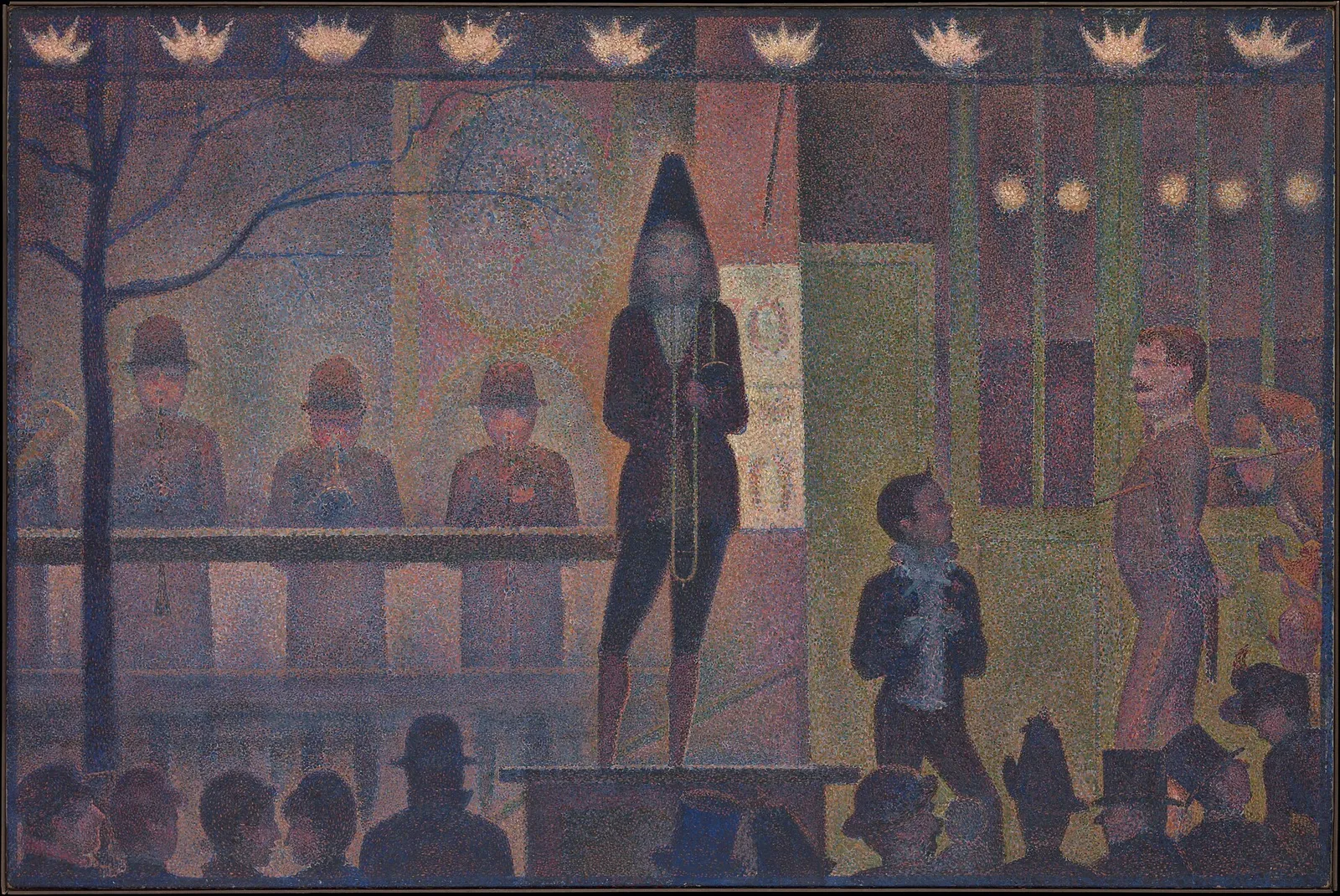
Georges Seurat's The Circus Parade, dated 1887, is in the collection of the Metropolitan Museum of Art. This large night scene shows performers on a platform outside a circus, playing to the crowd to draw people inside. Seurat painted it in his method of tiny, separate touches of color.
Where to see it
The Circus Parade is held by the Metropolitan Museum of Art. Display arrangements can change because of rehanging, conservation or loans, so check the museum's official website for current display status before you visit. The canvas measures 99.7 by 149.9 cm, so it reads clearly from across a room. Look at it from a distance first to see the overall scene, then step closer to see how the image breaks into individual dots of color.
What to look for in person
A scene lit by gaslight
This is one of Seurat's few night scenes. Look along the top of the picture for the small gas jets that light the stage. Rather than strong contrasts, the light spreads into a hazy glow of violets, blues and muted oranges. From a distance the surface seems to shimmer. Up close, you can see that the glow is built from countless small strokes placed side by side, not blended on the palette. Moving back and forth between these two viewing distances is the best way to understand what Seurat was attempting.
The trombonist and the stage
At the center stands a trombone player on a raised platform, facing outward and set within the strict geometry of the setting. Other performers line up beside him, and a ringmaster-like figure appears at the right. The figures are stiff and simplified, almost like silhouettes, instead of caught in lively movement. This gives the scene a still, ceremonial mood that contrasts with the noise you might expect from a fairground. Notice how little the faces reveal, which leaves the mood of the scene to the viewer.
Lines, verticals and the painted border
Seurat planned the composition with care. Trace the strong horizontals of the platform and railing against the repeated verticals of figures, posts and lights. The result is a flat, frieze-like arrangement, almost like a stage set seen head-on. Along the lower edge, the dark heads of spectators lead your eye into the picture. Also look at the edges of the canvas: Seurat painted a band of dots around the image, so the border becomes part of the work instead of being left to the frame alone.
About the painting
Georges Seurat developed a way of painting in which color is applied in small, distinct touches of pure or nearly pure pigment. Seen from a distance, these touches combine in the viewer's eye. The method is often called pointillism or divisionism, and it grew out of Seurat's study of contemporary writing on color and perception. Neo-Impressionism is the usual name for the movement he led alongside artists such as Paul Signac. The Circus Parade, dated 1887, belongs to Seurat's mature years, after he had established this method with large figure paintings. The subject is a "parade" in the French sense: a free outdoor performance staged at the entrance to a circus or fairground show to tempt passersby to buy tickets. Seurat turns this lively event into something calm and formal. The performers stand in rigid poses, the architecture is reduced to flat bands and grids, and the gaslight softens everything into a muted haze. Many viewers find the scene oddly melancholy, as if the entertainment were being watched from a quiet distance. Seurat returned to popular entertainment in later works, including scenes of the music hall and the circus ring, and this painting is often seen as an early step in that direction. He died young, in 1891, leaving a relatively small number of large finished paintings, which is one reason works of this scale are of particular interest to visitors. Its size, 99.7 by 149.9 cm, makes it a substantial canvas. When you visit, give yourself time to look both from across the room and from close up, since the painting changes noticeably depending on where you stand.
Key facts
| Artist | Georges Seurat |
|---|---|
| Date | 1887 |
| Size | 99.7 × 149.9 cm |
| Medium | oil paint, canvas |
| Collection | Metropolitan Museum of Art |
| Gallery | Gallery 825 Checked in the museum's open data on 2026-11-12 (galleries can change) Source |
How to visit: Metropolitan Museum of Art
New York City, United States · Museum guide
| Opening hours | Sun, Mon, Tue, Thu 10:00–17:00 Fri, Sat 10:00–21:00 |
|---|---|
| Closed | Wednesdays; Thanksgiving Day, 25 December, 1 January and the first Monday in May |
| Admission | Adults USD 30 Seniors (65 and over) USD 22 Visitors with a disability (in person only) USD 22 Students USD 17 Children (12 and under) free Care partners of visitors with a disability (in person only) free New York State residents; NY, NJ and CT students: pay what you wish (minimum USD 0.01). Online requires a NY State billing address; NJ/CT students in person with student ID |
| Free entry | Free for children 12 and under, Members and Patrons, and care partners of visitors with a disability. Pay what you wish for New York State residents and NY/NJ/CT students. |
| Booking | No reservation is required and there is no timed entry. |
The Cantor Roof Garden, the Modern and Contemporary Galleries, and the Ancient West Asia and Ancient Cyprus Galleries are closed for renovation.
Official ticket page
Official website
View on map
Hours and prices can change. Please check the official website before you go. (Checked on: 2026-11-09)
More by Georges Seurat
 A Sunday Afternoon on the Island of La Grande Jatte — Art Institute of Chicago
 Bathers at Asnières — National Gallery
 The Circus — Musée d'Orsay
 The Eiffel Tower
 Le Chahut — Kröller-Müller Museum