Art! Art! Art! › Works
Le Chahut
 Georges Seurat, 1889
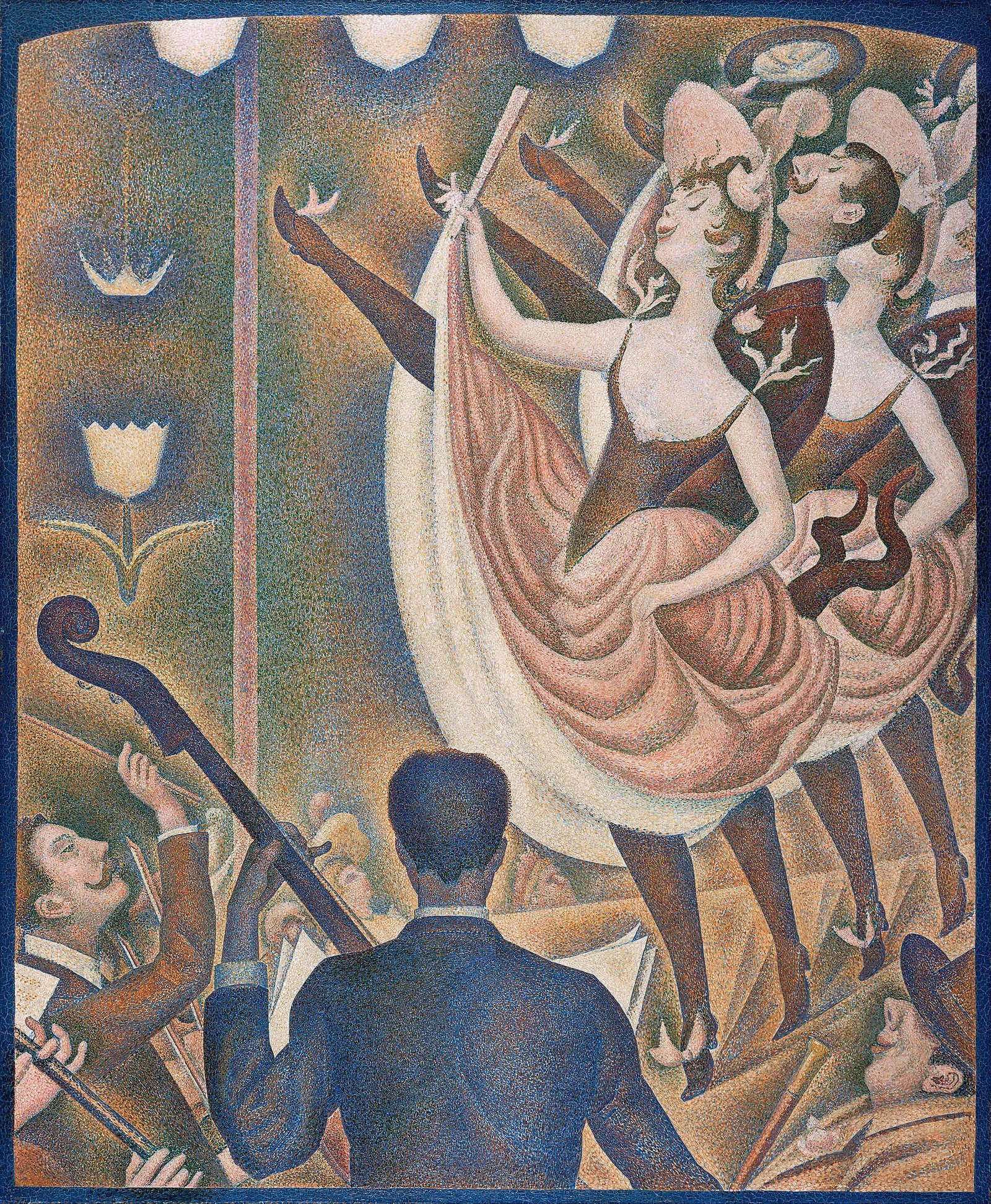
Le Chahut is Georges Seurat's painting of a high-kicking dance performed on a Paris café-concert stage, dated 1889 and held in the collection of the Kröller-Müller Museum. Built from small touches of colour and a framework of rising diagonals, it shows how Seurat tried to turn the energy of popular entertainment into a carefully calculated composition.
Where to see it
Le Chahut is in the collection of the Kröller-Müller Museum. Works in a permanent collection are not always on display, as paintings can be moved, lent or taken off view for conservation. Before you travel, check the Kröller-Müller Museum's official website for the painting's current display status, along with opening hours, ticketing and directions.
What to look for in person
The rising diagonals
Stand back first and follow the lines. The dancers' raised legs, the tilted skirts, the upturned moustache and the angled bows and lamps all point upward and to the right. Seurat was interested in theories that linked upward-moving lines with cheerfulness and lively feeling, and this picture is often read as an attempt to put that idea into practice. Notice how repetitive the shapes are: the kicking legs fall into a near-mechanical rhythm, which makes the scene feel more like a pattern than a snapshot.
The musician in the foreground
In the lower part of the picture, a double bass player is seen from behind, his dark silhouette and the scroll of his instrument set against the brightly lit stage. He acts as a kind of stand-in for the viewer, placing you in the audience or orchestra pit looking up at the performers. Compare his solid, shadowed form with the lighter, flatter figures of the dancers; the contrast helps separate the space of the stage from the space where you stand.
Dots of colour up close
Move closer and the surface breaks into small, separate touches of paint, the technique often called pointillism or divisionism. Rather than mixing colours on the palette, Seurat placed them side by side so they would combine in the eye. Look at how warm oranges and cool blues sit next to each other to suggest artificial stage light and shadow. Check the edges as well: Seurat painted a dotted border around the image, extending his colour system right up to the frame.
About the painting
Georges Seurat is best known as the leading figure of Neo-Impressionism, a movement that sought to replace the spontaneous brushwork of Impressionism with a more systematic approach to colour and line. Le Chahut belongs to the last years of his short career and is dated 1889 in the museum's records. Its subject is the chahut, a boisterous, high-kicking dance related to the cancan that was popular in the café-concerts of Montmartre and other Parisian nightspots of the period. Seurat shows a line of performers on stage, a male dancer, the musician in the foreground and, at the lower right, a spectator gazing up at the show. The scene is lit by gas lamps, and the colour scheme leans toward warm tones that suggest artificial light rather than daylight. What makes the painting distinctive is the contrast between subject and method. The dance was associated with noise, spontaneity and a certain disreputable glamour, yet Seurat renders it with stiff, stylised figures, repeated angles and a highly controlled surface. Many viewers find the result both comic and slightly unsettling, as though the performers were parts of a machine. The work reflects Seurat's interest in contemporary ideas about how line direction and colour could produce specific emotional effects, and it is often discussed alongside his other late scenes of popular entertainment. Le Chahut is now part of the Kröller-Müller Museum's collection, which makes it one of the key places to study Seurat's mature technique in person. Seeing the painting directly is especially rewarding, because the effect of the dots and the painted border is difficult to appreciate in reproduction.
Key facts
| Artist | Georges Seurat |
|---|---|
| Date | 1889 |
| Size | 1700 × 1410 cm |
| Medium | oil paint, canvas |
| Collection | Kröller-Müller Museum |
How to visit: Kröller-Müller Museum
Ede, Netherlands · Museum guide
| Opening hours | Tue–Sun and public holidays 10:00–17:00 (museum and sculpture garden) Mon 21 Dec and Mon 28 Dec 2026 10:00–17:00 (special Christmas openings) |
|---|---|
| Closed | Mondays (except public holidays and announced exceptions); 1 January. Public holidays: Easter, Ascension Day, Pentecost, 25 and 26 December, King's Day 27 April, Liberation Day 5 May. |
| Admission | Adult (combined day ticket, museum + De Hoge Veluwe National Park) EUR 27.75 Youth 13–18 (combined day ticket) EUR 20.8 Child 6–12 (combined day ticket) EUR 6.95 Museumkaart / VriendenLoterij VIP-KAART holders (park only; museum free) EUR 13.85 (bring the card) Students / CJP / Cultuurkaart / EYCA (discounted museum ticket) EUR 6.95 (park ticket bought separately at the park entrance) Car / motorcycle in the park EUR 9.8 (parking at park entrance EUR 4.90) Audio tour (Podcatcher) EUR 2.5 (collection presentation only; max 90 minutes) |
| Free entry | Museum entry is free with a Museumkaart or VriendenLoterij VIP-KAART (park ticket still needed). Free with an ICOM or Vereniging Rembrandt card. One companion of a disabled-parking-permit holder enters the museum free. Park admission is required to reach the museum. |
| Booking | Booking is recommended; there is no timed entry. |
The exhibition “Van Gogh, All Our Paintings” (15 Sep 2026 – 3 Jan 2027) requires an additional free exhibition ticket with a start time. From 4 October the collection tour follows a different route. No closure has been announced.
Official ticket page
Official website
View on map
Hours and prices can change. Please check the official website before you go. (Checked on: 2026-11-09)
More by Georges Seurat
 A Sunday Afternoon on the Island of La Grande Jatte — Art Institute of Chicago
 Bathers at Asnières — National Gallery
 The Circus — Musée d'Orsay
 The Eiffel Tower
 The Circus Parade — Metropolitan Museum of Art