Art! Art! Art! › Works
Venus of Urbino
 Tiziano Vecellio, 1538
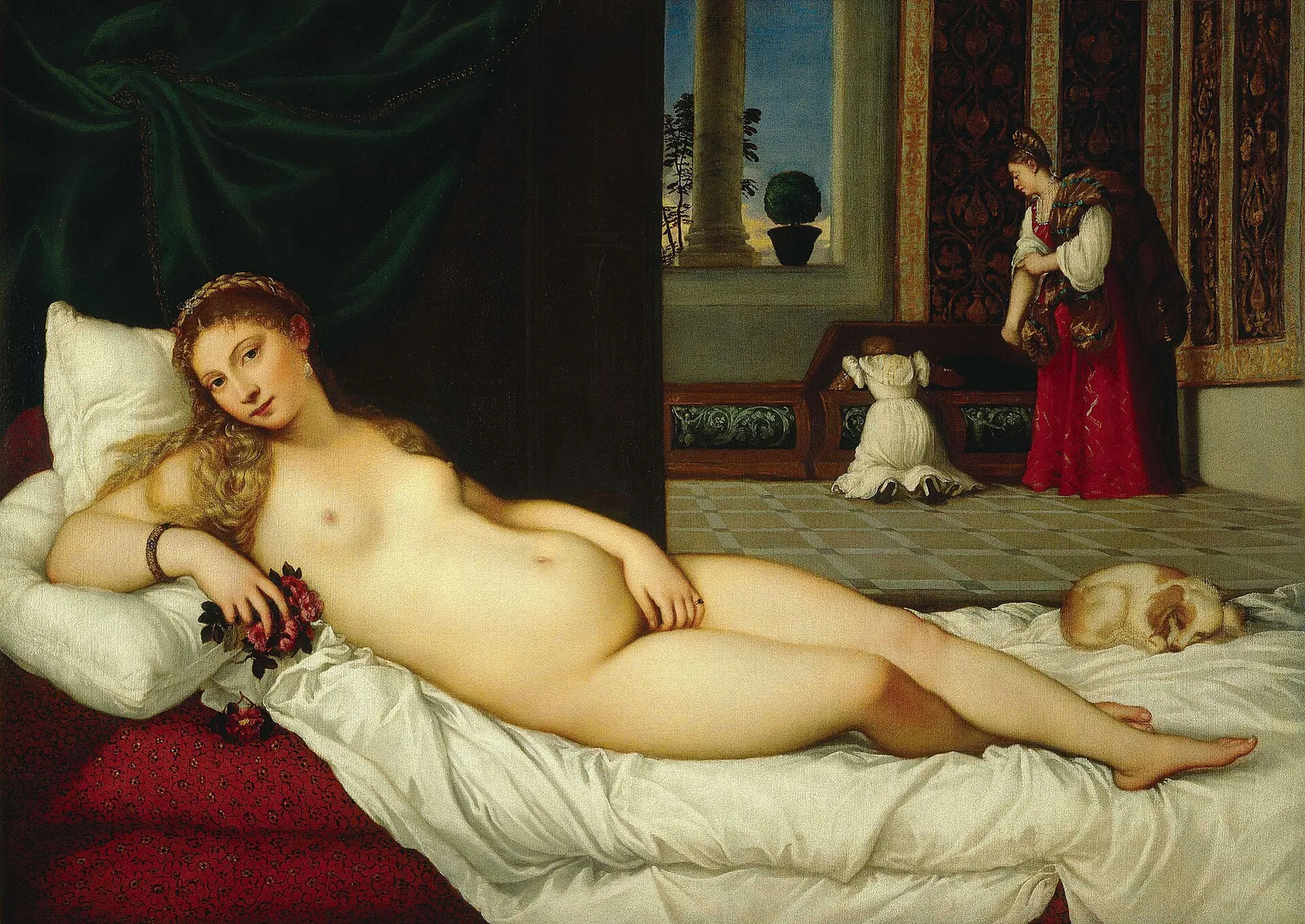
Tiziano Vecellio, known in English as Titian, painted the Venus of Urbino in 1538. The painting is in the collection of the Uffizi Gallery. It shows a reclining nude woman who meets the viewer's gaze, set in a domestic interior where two servants are at work in the background.
Where to see it
The Venus of Urbino is held by the Uffizi Gallery, which is listed as both its collection and its location. Works in major museums are sometimes moved, lent or temporarily taken off view for conservation, so check the Uffizi Gallery's official website for current display status, opening hours and ticketing before you visit. The canvas measures 119 cm high by 165.5 cm wide. It is large enough to read clearly from across a room but rewards a closer look at its details.
What to look for in person
The direct gaze
Start with the woman's eyes. Unlike many reclining nudes, which show a sleeping or turned-away figure, she looks straight out at the viewer. This steady, calm gaze is a big part of why the painting feels so immediate. Then follow the long diagonal of her body across the white sheets and the reddish cushions. Notice how Titian builds the figure with soft transitions of warm flesh tones rather than hard outlines. Her right hand loosely holds a small bunch of roses, a detail that is easy to miss at first glance.
The room behind her
The painting is split into two zones. On the left, a dark curtain or screen frames the woman against shadow. On the right, the space opens into a brighter room with a patterned floor. There, two maidservants busy themselves at a large chest: one kneels to search inside it while the other stands nearby. A plant sits on the windowsill beyond them. This everyday setting turns a mythological title into something that looks like a real household, and it gives the picture depth beyond the bed.
The sleeping dog
Look down near the woman's feet, where a small dog lies curled up asleep on the bed. It is a modest detail but an important one for reading the painting. Dogs in Renaissance pictures are often understood as signs of loyalty, and the dog here adds to the domestic calm of the scene. Compare its relaxed pose with the alert, outward-looking woman above it. Small contrasts like this one are part of how Titian balances intimacy and composure across the canvas.
About the painting
Tiziano Vecellio was the leading painter of sixteenth-century Venice, celebrated for his handling of colour and the way his paint seems to describe skin, fabric and light. The Venus of Urbino dates from 1538 and measures 119 by 165.5 cm. It belongs to the Uffizi Gallery, where it is one of the best-known works associated with Venetian painting.
The picture belongs to a tradition of reclining female nudes in Venetian art. Its pose is widely compared with the Sleeping Venus attributed to Giorgione, a painting Titian is generally thought to have helped complete. Titian made a decisive change, however. Instead of placing a sleeping goddess in an open landscape, he moved the figure indoors and had her look directly at the viewer. The result feels less like a distant myth and more like a scene set in a contemporary home.
The name connects the painting to the court of Urbino, whose ruling family is traditionally linked to its commission. The roses, the sleeping dog and the servants at the chest have encouraged many readings, including ideas about marriage, fidelity and domestic life. These readings are interpretations, and scholars continue to discuss them.
The painting has had a long afterlife. Later artists studied and responded to it, and Edouard Manet's Olympia of 1863 is commonly cited as a deliberate reworking of its composition. When you stand before the canvas, give yourself time to move between the figure in the foreground and the quieter activity in the room behind her.
Key facts
| Artist | Tiziano Vecellio |
|---|---|
| Date | 1538 |
| Size | 119 × 165.5 cm |
| Medium | oil paint, canvas |
| Collection | Uffizi Gallery |
How to visit: Uffizi Gallery
Florence, Italy · Museum guide
| Opening hours | Tue–Sun 08:15–18:30 (visitors leave by 18:30) |
|---|---|
| Closed | Mondays, 1 January and 25 December. |
| Last entry | Ticket office closes at 17:30. |
| Admission | Regular, bought on the day EUR 25 Regular, bought in advance EUR 29 Regular, entry from 16:00 (from 1 January 2026) EUR 16 Reduced (EU citizens aged 18–25; citizens of Switzerland, Norway, Liechtenstein, Uruguay etc.; ID required) EUR 2 Under 18 free (under 12s must be accompanied) Uffizi + Vasari Corridor EUR 43 on the day / EUR 47 in advance; named ticket, reservation required, non-refundable PassePartout 5 days (Uffizi, Pitti Palace, Boboli) EUR 40 (EUR 58 with Vasari Corridor) Audio guide EUR 6 |
| Free entry | Free for under-18s; disabled visitors plus one companion; tour guides and interpreters, ICOM members, certain journalists, and university teachers/students on the official list. Admission is free on the first Sunday of each month (national museums), when reservations are not possible. |
| Booking | Reservation is not required, except for the Uffizi + Vasari Corridor ticket, which must be reserved. |
Restoration and rearrangement works mean some rooms are temporarily closed and some artworks are not on display. A staff assembly on 11–12 November 2026 may change opening times.
Official ticket page
Official website
View on map
Hours and prices can change. Please check the official website before you go. (Checked on: 2026-11-12)
More by Tiziano Vecellio
 Bacchus and Ariadne — National Gallery
 Portrait of Francis I — Louvre Museum
 Salome with the Head of John the Baptist