Art! Art! Art! › Works
Salome with the Head of John the Baptist
 Tiziano Vecellio, 1515
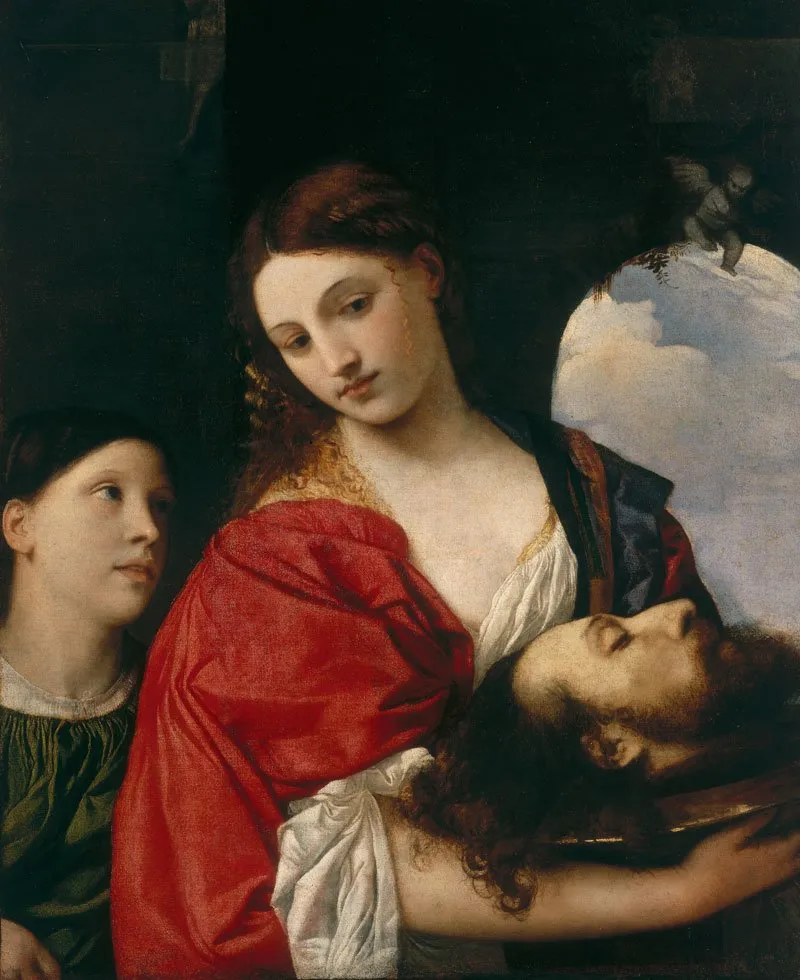
Salome with the Head of John the Baptist is an early work by Tiziano Vecellio (Titian), dated 1515 and held by the Galleria Doria Pamphilj. The painting sets a calm young woman against a grim subject, and that contrast is the heart of what you see in front of it.
Where to see it
The painting belongs to the collection of the Galleria Doria Pamphilj, and its recorded location is the Galleria Doria Pamphilj. Works in historic collections can be moved, rehung or lent, so check the Galleria Doria Pamphilj's official website for current display status, opening hours and ticketing before you plan your visit.
What to look for in person
A quiet face for a violent story
Start with the young woman's expression. Rather than triumph or horror, Titian gives her a composed, almost distant look, with her eyes turned aside from what she carries. The severed head rests on a platter she holds at about waist height, close to her body. Standing in front of the canvas, notice how the gentle modelling of her face and the softness of her hair keep the mood restrained. The tension comes from that gap between her calm and the subject, not from dramatic gesture.
The half-length Venetian format
At 90 by 72 cm, the painting is a manageable size, and the figures fill most of the surface. This close, half-length arrangement, with figures cut off below the waist and pressed toward the viewer, was common in Venetian painting of the early sixteenth century. It brings you near to the faces and hands rather than to a wider narrative scene. Look at how little background space there is: the composition depends on a few figures and objects placed close together.
Colour, light and surface
Titian is known for building form through colour and light rather than hard outlines, and even this early work shows that approach. Look closely at how skin, fabric and hair are distinguished by changes in tone and texture. Light falls on the woman's face, shoulders and arms, while other areas sink into shadow, guiding your eye toward her and the platter. Take a moment at close range and then step back to see how the soft transitions resolve into a clear, balanced image.
About the painting
Tiziano Vecellio, known in English as Titian, was one of the leading painters of the Venetian school, and this canvas, dated 1515, belongs to the early part of his long career. In these years Venetian painting was moving toward softer, more atmospheric effects, and Titian's work from this period is often discussed alongside the legacy of his older contemporary Giorgione. That context helps explain the painting's gentle handling and its emphasis on mood over action.
The subject comes from the Gospel account of the death of John the Baptist, in which Salome receives the prophet's head on a platter. Renaissance painters often treated this story, and the related Old Testament story of Judith and Holofernes, in similar ways: a young woman shown with a severed head. Because the two subjects look alike in painting, scholars have long debated which one Titian intended here. The platter is the traditional attribute of Salome, which supports the title used by the collection, while Judith is usually shown with a sword.
The work measures 90 by 72 cm and is today in the collection of the Galleria Doria Pamphilj, a historic private collection open to visitors. When you view it, it rewards slow looking: compare the treatment of the living faces with the head on the platter, and notice how the figures are arranged close to the picture surface. The painting offers a clear example of how the young Titian combined a dark narrative theme with a calm, carefully lit composition.
Key facts
| Artist | Tiziano Vecellio |
|---|---|
| Date | 1515 |
| Size | 90 × 72 cm |
| Medium | oil paint, canvas |
| Collection | Galleria Doria Pamphilj |
How to visit: Galleria Doria Pamphilj
Rome, Italy
Hours and prices can change. Please check the official website before you go.
More by Tiziano Vecellio
 Bacchus and Ariadne — National Gallery
 Portrait of Francis I — Louvre Museum
 Venus of Urbino — Uffizi Gallery