Art! Art! Art! › Works
Bacchus and Ariadne
 Tiziano Vecellio, 1520s
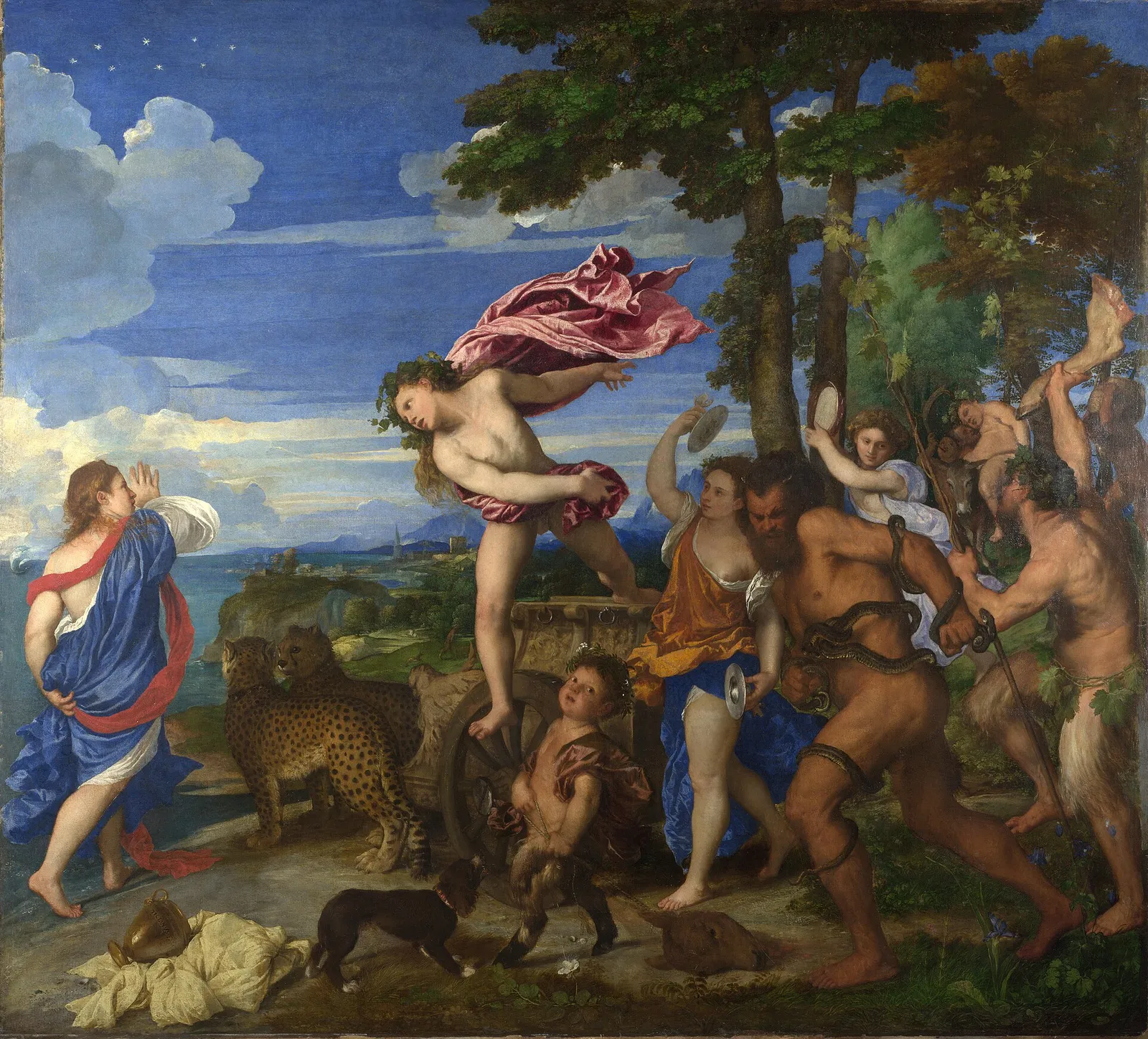
Titian's Bacchus and Ariadne belongs to the National Gallery in London, which acquired it in 1826. Painted between 1520 and 1523 for the Duke of Ferrara, it captures the god Bacchus leaping from his chariot towards Ariadne, abandoned on the island of Naxos. It rewards slow looking: colour, story and small details all repay a second glance.
Where to see it
Bacchus and Ariadne is in the collection of the National Gallery, London. The canvas measures 176.5 x 191 cm, so it is a substantial work to stand in front of. Display arrangements can change, so check the National Gallery's official website for the painting's current display status before you plan your visit.
What to look for in person
The leap at the centre
Look first at Bacchus, caught in mid-air as he jumps down from his chariot towards Ariadne. The chariot is drawn by two cheetahs, an unexpected detail worth pausing on. Ariadne turns towards the sea, and if you follow the shoreline to the far left you will find the small ship of Theseus, the hero who left her behind on Naxos. The painting places her abandonment and the god's arrival side by side, so the story unfolds as your eye travels across the canvas from left to right.
Colour and the starry crown
Titian's palette here rewards a close look. Technical study has identified ultramarine, azurite, malachite, green earth, verdigris, copper resinate, vermilion and realgar, which helps explain the intensity of the blues and the warm reds and oranges across the scene. Above Ariadne, look for a ring of stars: this is the constellation Corona Borealis, linked in the myth to the crown associated with her. Keep in mind that parts of the sky were repainted after paint losses during the 1967-1968 restoration, so not every area shows Titian's original surface.
Details in the procession
Bacchus's noisy followers crowd in from the right. One of them, a muscular figure entangled with snakes coiled around his body, has been linked to the ancient Laocoon sculpture group, a celebrated antique that Renaissance artists studied closely. Then lower your eyes to the bottom left of the canvas: on a gold urn you can find the artist's signature, TICIANVS. It is easy to overlook among the figures and objects, but it is worth seeking out, as it marks the work as Titian's own contribution to a prestigious ducal commission.
About the painting
Bacchus and Ariadne was painted by Titian between 1520 and 1523, in oil on canvas. It was one of a series of mythological pictures commissioned by Alfonso I d'Este, Duke of Ferrara, to decorate the Camerino d'Alabastro, a private room in his palace in Ferrara. The commission for a Triumph of Bacchus had originally gone to Raphael, but he had produced only a preliminary drawing by the time of his death in 1520, and the project then passed to Titian. Once finished, the canvas travelled to Ferrara by boat along the river Po, with the transport arranged on 30 January 1523.
The painting's later history explains some of what visitors see today. When Ferrara came under the Papal States in 1598, the work passed to the Aldobrandini family, who sold it in 1796 to Vincenzo Camuccini. It reached Britain in 1806 or 1807 and entered the National Gallery in 1826. During its first century the canvas was rolled up twice, which caused damage to the paint. Between 1967 and 1968 the National Gallery carried out a restoration that removed discoloured varnish and revealed the brightness of the colours; it proved controversial, partly because paint losses had to be repainted, particularly in the sky.
The composition also attracted later artists. A copy by Nicolas Poussin is held at Alnwick Castle, a reminder of how closely painters studied Titian's handling of movement and colour. Standing in front of the original, it is worth stepping back to take in the whole diagonal sweep of the scene, then moving closer to examine the figures, the sky and the signed urn.
Key facts
| Artist | Tiziano Vecellio |
|---|---|
| Date | 1520s |
| Size | 176.5 × 191 cm |
| Medium | oil paint, canvas |
| Collection | National Gallery |
How to visit: National Gallery
London, United Kingdom · Museum guide
| Opening hours | Mon–Thu, Sat, Sun 10:00–18:00 Fri 10:00–21:00 (Friday late) |
|---|---|
| Closed | 24–26 December and 1 January. |
| Admission | General admission (collection) free; donations invited Some exhibitions are charged (e.g. Renoir and Love, until 31 Jan 2027) |
| Free entry | General admission is always free. |
| Booking | No reservation or timed entry is required. Free timed booking gives fast-track entry. |
Building work and improvements are under way: some rooms are closed and some paintings have moved, so check the floorplans or collection search before visiting. A new Research Centre is due to open in 2028. On 17 November only, some east wing rooms and the Espresso Bar close from 16:00.
Official ticket page
Official website
View on map
Hours and prices can change. Please check the official website before you go. (Checked on: 2026-11-11)
More by Tiziano Vecellio
 Portrait of Francis I — Louvre Museum
 Salome with the Head of John the Baptist
 Venus of Urbino — Uffizi Gallery
Sources
- Wikidata Q1206860
- Wikipedia (en) (CC BY-SA 4.0)
- Wikipedia (it) (CC BY-SA 4.0)
- Wikipedia (fr) (CC BY-SA 4.0)
- www.nationalgallery.org.uk