Art! Art! Art! › Works
The Tub
 Edgar Degas, 1886
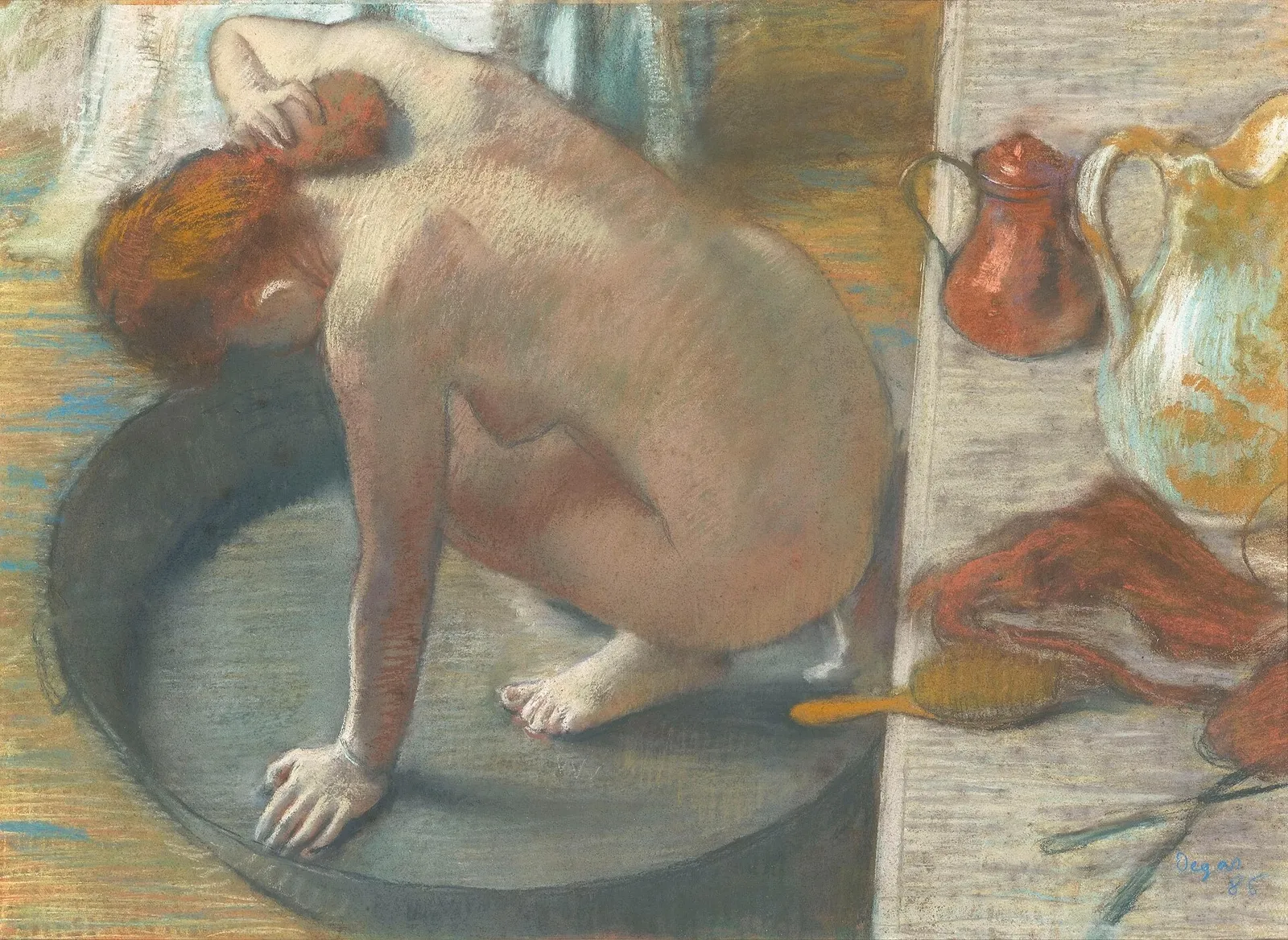
Edgar Degas's The Tub, dated 1886, shows a woman crouched in a shallow basin, seen from above as she washes. It belongs to the collection of the Musée d'Orsay. At 60 by 83 cm, it rewards close, unhurried looking at its unusual viewpoint and bold composition.
Where to see it
The Tub is in the collection of the Musée d'Orsay. The location record for this work lists both the Louvre Palace and the Musée d'Orsay. Works made on paper or similar supports are often shown only for limited periods to protect them from light, so check the Musée d'Orsay's official website for current display status before you visit.
What to look for in person
Look down from above
Notice where Degas places you. Instead of meeting the figure at eye level, you look down steeply into the scene, as if standing over the tub. The woman is folded into a compact shape, her back curved and one arm reaching down into the basin. The round tub and the curve of her body echo each other. Spend a moment on how this high angle flattens the floor and pushes the figure into a tight, enclosed space. The view feels observed rather than posed.
The shelf that cuts the picture
On the right, a flat shelf or tabletop runs sharply across the image, cropped by the edge of the picture. It holds everyday bathroom objects, including a jug and other toilet items. This strong diagonal band divides the composition and seems almost to tilt toward you. Compare the hard, straight edge of the shelf with the soft curves of the body and the tub. The contrast between still objects and a figure in motion is one of the work's main pleasures.
Strokes and surface
Step close and look at how the surface is built up. Degas worked in pastel, laying down visible strokes and hatching rather than smoothing everything into a polished finish. Watch how the marks follow the forms: across the back, around the rim of the tub, over the floor. Light seems to fall on the skin through layered colour rather than outline. Then step back to see the strokes resolve into a convincing figure. Moving between near and far views shows how deliberately the marks were placed.
About the painting
Edgar Degas is closely associated with the Impressionist group in Paris, though he preferred to think of himself as a realist and spent much of his career on scenes of modern life: dancers, laundresses, café-goers and women at their toilette. The Tub, dated 1886, belongs to his long-running series of bathers, in which women wash, dry themselves or comb their hair in private interiors. Degas showed a group of these bather pictures at the eighth and final Impressionist exhibition, held in Paris in 1886. The series drew attention because the women were not presented as idealised goddesses or mythological figures, as nudes traditionally were in academic art. Instead they appear absorbed in ordinary, unglamorous actions, often in awkward or twisting poses, and seemingly unaware of the viewer. In The Tub, the elements that make the series distinctive come together: a steep, high viewpoint, a figure compressed into a curled shape, strong cropping at the edges, and a still-life of household objects given equal weight in the design. The diagonal shelf on the right acts almost as a second subject, balancing the figure on the left. Degas worked extensively in pastel in his later career, and the medium let him combine drawing and colour in a single process. The work measures 60 by 83 cm and is held by the Musée d'Orsay, which holds a significant collection of Degas's art. For visitors, it offers a clear example of how Degas rethought the nude through composition and viewpoint.
Key facts
| Artist | Edgar Degas |
|---|---|
| Date | 1886 |
| Size | 60 × 83 cm |
| Medium | pastel, cardboard |
| Collection | Musée d'Orsay |
How to visit: Musée d'Orsay
Paris, France · Museum guide
| Opening hours | Tue–Wed, Fri–Sun 09:30–18:00 (galleries close at 17:30) Thu 09:30–21:45 (late opening; galleries close at 21:15) |
|---|---|
| Closed | Every Monday, 1 May and 25 December. |
| Last entry | 17:00 (exhibitions 17:15); Thursdays 21:00 |
| Admission | Full rate, online EUR 16 Full rate, at the museum EUR 14 Reduced rate (on site only) EUR 11 Enfant & Cie, online EUR 13 Enfant & Cie, at the museum EUR 11 Night rate (Thursday), online EUR 12 Night rate (Thursday), at the museum EUR 10 Under 18s; EEA residents under 26 free |
| Free entry | Free for under 18s and residents of the European Economic Area under 26. Free on the first Sunday of the month, with booking required. |
| Booking | Booking is strongly recommended. Entry is by timed slot. |
The museum stays open and all collections and exhibitions remain accessible, but entrances have changed: timed-ticket holders use Entrance 1 (Quay); priority visitors, reseller voucher holders, visitors without tickets and groups use Entrance 2 (Forecourt). Arrive at least 15 minutes before your time slot.
Official ticket page
Official website
View on map
Hours and prices can change. Please check the official website before you go. (Checked on: 2026-11-11)
More by Edgar Degas
 L'Absinthe — Musée d'Orsay
 The Bellelli Family — Musée d'Orsay
 A Cotton Office in New Orleans
 L'Orchestre de l'Opéra — Musée d'Orsay
 Ballet Rehearsal on Stage — Musée d'Orsay