Art! Art! Art! › Works
Ballet Rehearsal on Stage
 Edgar Degas, 1874
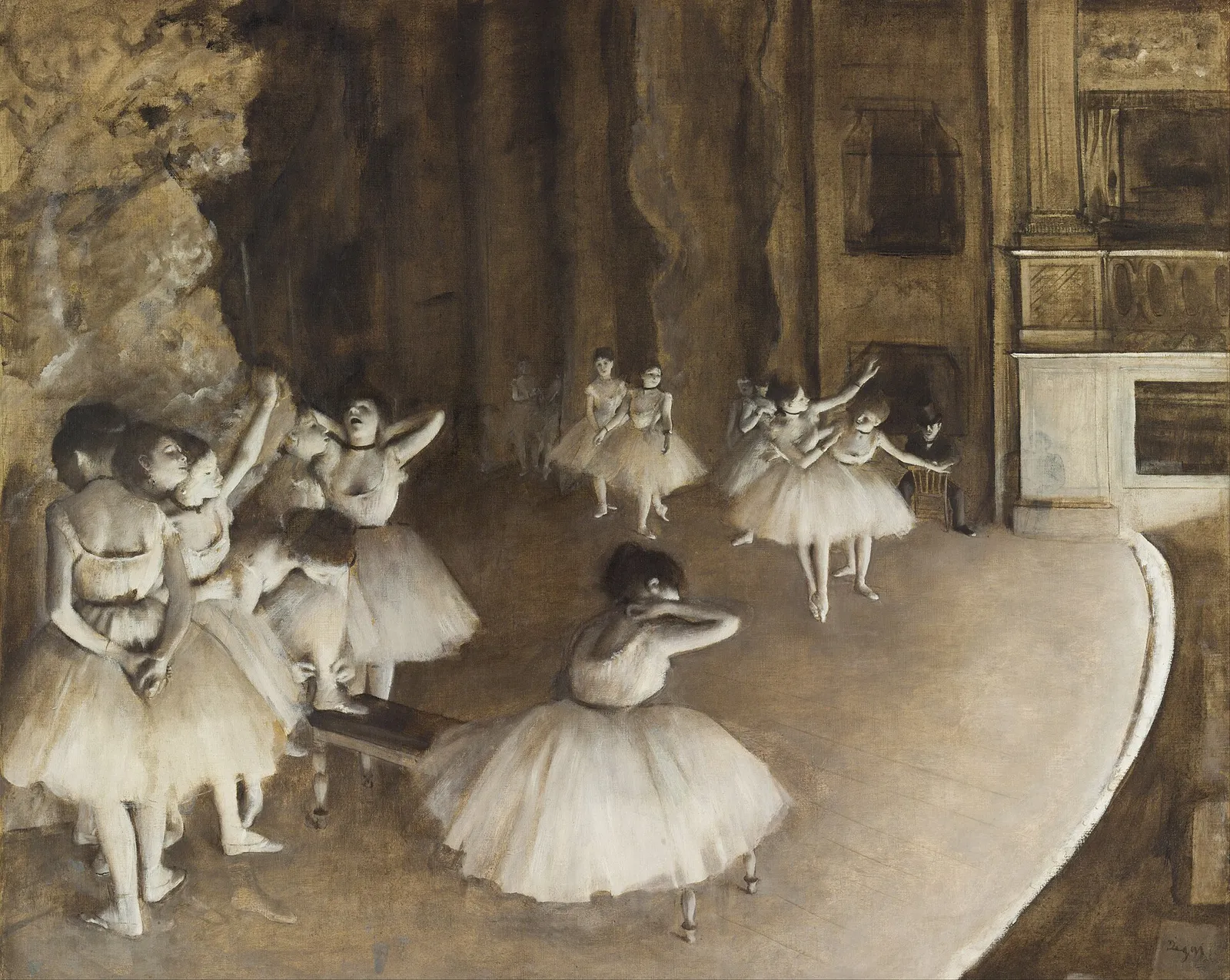
Edgar Degas's Ballet Rehearsal on Stage, dated 1874, is in the collection of the Musée d'Orsay. Rather than a polished performance, it shows the working side of ballet: dancers waiting, stretching and repeating steps under stage light. At 65 by 81.5 cm, it rewards a slow, close look.
Where to see it
Ballet Rehearsal on Stage belongs to the Musée d'Orsay, which is also its listed location. Paintings in large collections can be moved between rooms, lent to other institutions or taken off view for conservation, so check the Musée d'Orsay's official website for the current display status before you visit. At busy times, booking your ticket in advance through the museum's official channels can save time at the entrance.
What to look for in person
A scene built from light and shadow
Before looking for details, notice how little colour Degas uses. Much of the scene is laid out in a narrow range of browns, greys and pale creams, so the picture can feel closer to a drawing than to a brightly coloured stage picture. Stand back first and watch how the light catches the dancers' skirts and arms against the darker stage. Then move closer to see how firmly outlined figures give way to looser brushwork in the background. The restricted palette keeps your attention on gesture, movement and the fall of light.
Looking up from the orchestra pit
Look along the lower edge of the canvas. Degas places you low and close to the stage, as if you were sitting near the musicians, and the tops of instruments break into the bottom of the picture. This is a deliberate, unusual viewpoint. The stage floor tilts toward you, and figures are cut off at the edges of the frame rather than neatly centred. The effect is of a glimpse caught in passing, not a carefully arranged tableau. Notice how the empty floor in the foreground pulls your eye across the stage toward the dancers.
Rehearsal, not performance
Spend time with the dancers who are not dancing. Alongside those practising their steps, others wait their turn, adjust themselves or relax their bodies between efforts. These unguarded poses are central to Degas's interest in ballet: the repetition, fatigue and discipline behind the finished spectacle. Look also at the figures who are watching or directing rather than dancing, and at how they are placed apart from the performers. Comparing the poised dancers with the resting ones is one of the most rewarding ways to read the picture.
About the painting
Edgar Degas returned to the world of ballet again and again, and his paintings, pastels and drawings of dancers are among the works most closely associated with him. He was drawn less to the glamour of the finished performance than to what happened around it: classes, rehearsals, waiting in the wings, and the physical effort of training. Ballet Rehearsal on Stage, dated 1874, belongs to this sustained exploration. The picture reflects several habits that mark Degas's art. He liked unexpected viewpoints, often placing the viewer in the audience, the orchestra or backstage rather than directly in front of the action. He cropped figures at the edge of the frame, giving his compositions a sense of immediacy, and he arranged groups of figures so that open space carries as much weight as the people in it. He also studied posture closely, recording how bodies look when they are tired, bored or concentrating, not only when they are posed gracefully. Degas exhibited with the group of artists now called the Impressionists, yet his methods differed from many of them. Rather than painting landscapes outdoors, he worked largely from interiors and city life, building his scenes from observation, memory and preparatory study. Degas made more than one work on this rehearsal theme, and comparing them shows how he revised compositions over time. In front of this canvas, measuring 65 by 81.5 cm, give yourself time to move between overall effect and small details: the play of light, the slanting stage, and the varied, very human attitudes of the dancers.
Key facts
| Artist | Edgar Degas |
|---|---|
| Date | 1874 |
| Size | 65 × 81.5 cm |
| Medium | oil paint, canvas |
| Collection | Musée d'Orsay |
How to visit: Musée d'Orsay
Paris, France · Museum guide
| Opening hours | Tue–Wed, Fri–Sun 09:30–18:00 (galleries close at 17:30) Thu 09:30–21:45 (late opening; galleries close at 21:15) |
|---|---|
| Closed | Every Monday, 1 May and 25 December. |
| Last entry | 17:00 (exhibitions 17:15); Thursdays 21:00 |
| Admission | Full rate, online EUR 16 Full rate, at the museum EUR 14 Reduced rate (on site only) EUR 11 Enfant & Cie, online EUR 13 Enfant & Cie, at the museum EUR 11 Night rate (Thursday), online EUR 12 Night rate (Thursday), at the museum EUR 10 Under 18s; EEA residents under 26 free |
| Free entry | Free for under 18s and residents of the European Economic Area under 26. Free on the first Sunday of the month, with booking required. |
| Booking | Booking is strongly recommended. Entry is by timed slot. |
The museum stays open and all collections and exhibitions remain accessible, but entrances have changed: timed-ticket holders use Entrance 1 (Quay); priority visitors, reseller voucher holders, visitors without tickets and groups use Entrance 2 (Forecourt). Arrive at least 15 minutes before your time slot.
Official ticket page
Official website
View on map
Hours and prices can change. Please check the official website before you go. (Checked on: 2026-11-11)
More by Edgar Degas
 L'Absinthe — Musée d'Orsay
 The Bellelli Family — Musée d'Orsay
 The Tub — Musée d'Orsay
 A Cotton Office in New Orleans
 L'Orchestre de l'Opéra — Musée d'Orsay