Art! Art! Art! › Works
The Bellelli Family
 Edgar Degas, 19th century
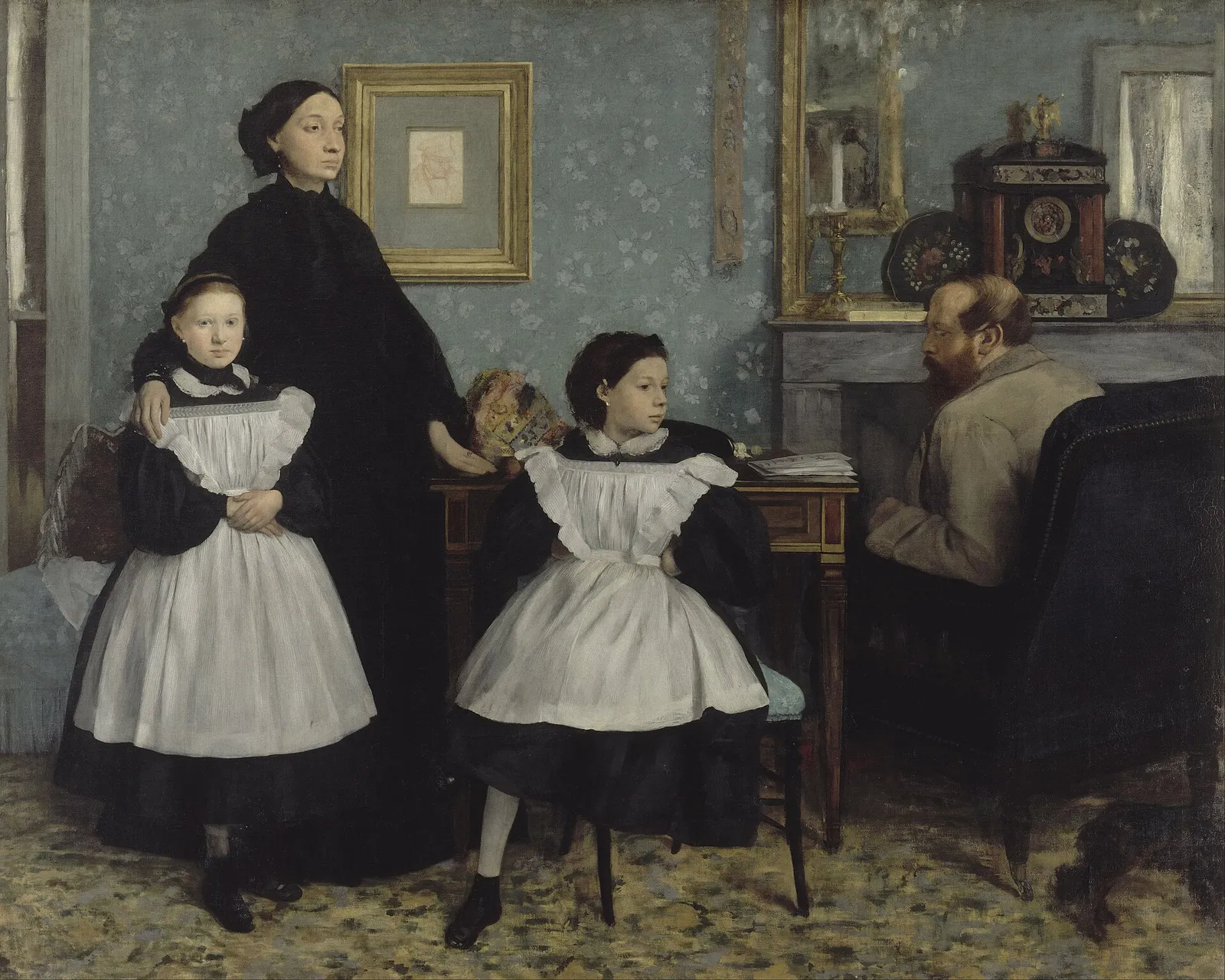
The Bellelli Family is a large group portrait by Edgar Degas, held in the collection of the Musée d'Orsay. It shows the artist's aunt, her husband and their two young daughters in a quiet domestic interior. The longer you look, the more the family seems to stand apart.
Where to see it
The Bellelli Family belongs to the Musée d'Orsay, and the fact sheet gives the Musée d'Orsay as its location. Display arrangements can change because of rehangs, conservation or loans, so check the Musée d'Orsay's official website for current display status before you visit. At 200 cm high and 253 cm wide, the canvas is big enough that it is worth seeing both from across the room and from close up.
What to look for in person
A family arranged in separate zones
Start by noticing where each person sits or stands. The mother is upright on the left, one hand resting on her elder daughter's shoulder. The father sits at the right, turned largely away from the viewer, in an armchair. The younger daughter perches between them, half on a chair, as if belonging to neither side. Table edges, the fireplace and chair backs act as dividers. Rather than a warm, gathered group, Degas presents a household in which distance between people is part of the subject.
Black mourning dress and the portrait on the wall
Look at the contrast between the mother's dark dress and the pale pinafores worn by the girls. The mother, Laura Bellelli, is shown in mourning for her father, Degas's grandfather. Behind her, a small framed portrait of him hangs on the wall, adding a quiet reference to the family member who is absent. The tall, still silhouette of the mother gives the left side of the canvas a weight that the rest of the composition is balanced against.
Small details at the edges
Once you have taken in the figures, scan the room itself. A mirror above the fireplace reflects part of the space, adding depth and a hint of the room beyond the frame. Patterned wallpaper and carpet fill the background with a steady rhythm. At the lower right edge, a dog is cut off by the frame, showing only part of its body. This kind of cropping, which makes a scene feel caught rather than posed, became characteristic of Degas's later work.
About the painting
The Bellelli Family is one of Edgar Degas's early major works, a 19th-century portrait made on a scale usually associated with official or historical subjects. The sitters are members of the artist's own family: his paternal aunt Laura, her husband Baron Gennaro Bellelli, and their daughters Giovanna and Giulia. Degas spent time with the family in Florence, and the painting grew out of that stay and the many studies he made of its members.
What makes the picture rewarding to stand in front of is its restraint. Degas does not flatter the family with a cheerful, unified grouping. Instead the mother and father occupy opposite sides of the canvas, their gazes do not meet, and the children are positioned between them. Art historians widely read the composition as an image of strained domestic relations, built through placement, posture and glance rather than through any dramatic action.
The painting also shows Degas absorbing earlier traditions while pointing toward his own later interests. The careful drawing of the faces and the sober palette recall the portrait traditions he studied, while the off-centre arrangement, the reflected space in the mirror and the cropped dog at the edge suggest the interest in unusual viewpoints and everyday moments that would run through his later depictions of dancers, laundresses and city life.
The canvas measures 200 by 253 centimetres, so the figures appear close to life size. Give yourself time to move from the overall arrangement to the individual faces, especially the two girls, whose expressions differ noticeably from each other.
Key facts
| Artist | Edgar Degas |
|---|---|
| Date | 19th century |
| Size | 200 × 253 cm |
| Medium | oil paint, canvas |
| Collection | Musée d'Orsay |
How to visit: Musée d'Orsay
Paris, France · Museum guide
| Opening hours | Tue–Wed, Fri–Sun 09:30–18:00 (galleries close at 17:30) Thu 09:30–21:45 (late opening; galleries close at 21:15) |
|---|---|
| Closed | Every Monday, 1 May and 25 December. |
| Last entry | 17:00 (exhibitions 17:15); Thursdays 21:00 |
| Admission | Full rate, online EUR 16 Full rate, at the museum EUR 14 Reduced rate (on site only) EUR 11 Enfant & Cie, online EUR 13 Enfant & Cie, at the museum EUR 11 Night rate (Thursday), online EUR 12 Night rate (Thursday), at the museum EUR 10 Under 18s; EEA residents under 26 free |
| Free entry | Free for under 18s and residents of the European Economic Area under 26. Free on the first Sunday of the month, with booking required. |
| Booking | Booking is strongly recommended. Entry is by timed slot. |
The museum stays open and all collections and exhibitions remain accessible, but entrances have changed: timed-ticket holders use Entrance 1 (Quay); priority visitors, reseller voucher holders, visitors without tickets and groups use Entrance 2 (Forecourt). Arrive at least 15 minutes before your time slot.
Official ticket page
Official website
View on map
Hours and prices can change. Please check the official website before you go. (Checked on: 2026-11-11)
More by Edgar Degas
 L'Absinthe — Musée d'Orsay
 The Tub — Musée d'Orsay
 A Cotton Office in New Orleans
 L'Orchestre de l'Opéra — Musée d'Orsay
 Ballet Rehearsal on Stage — Musée d'Orsay