Art! Art! Art! › Works
L'Orchestre de l'Opéra
 Edgar Degas, 1868
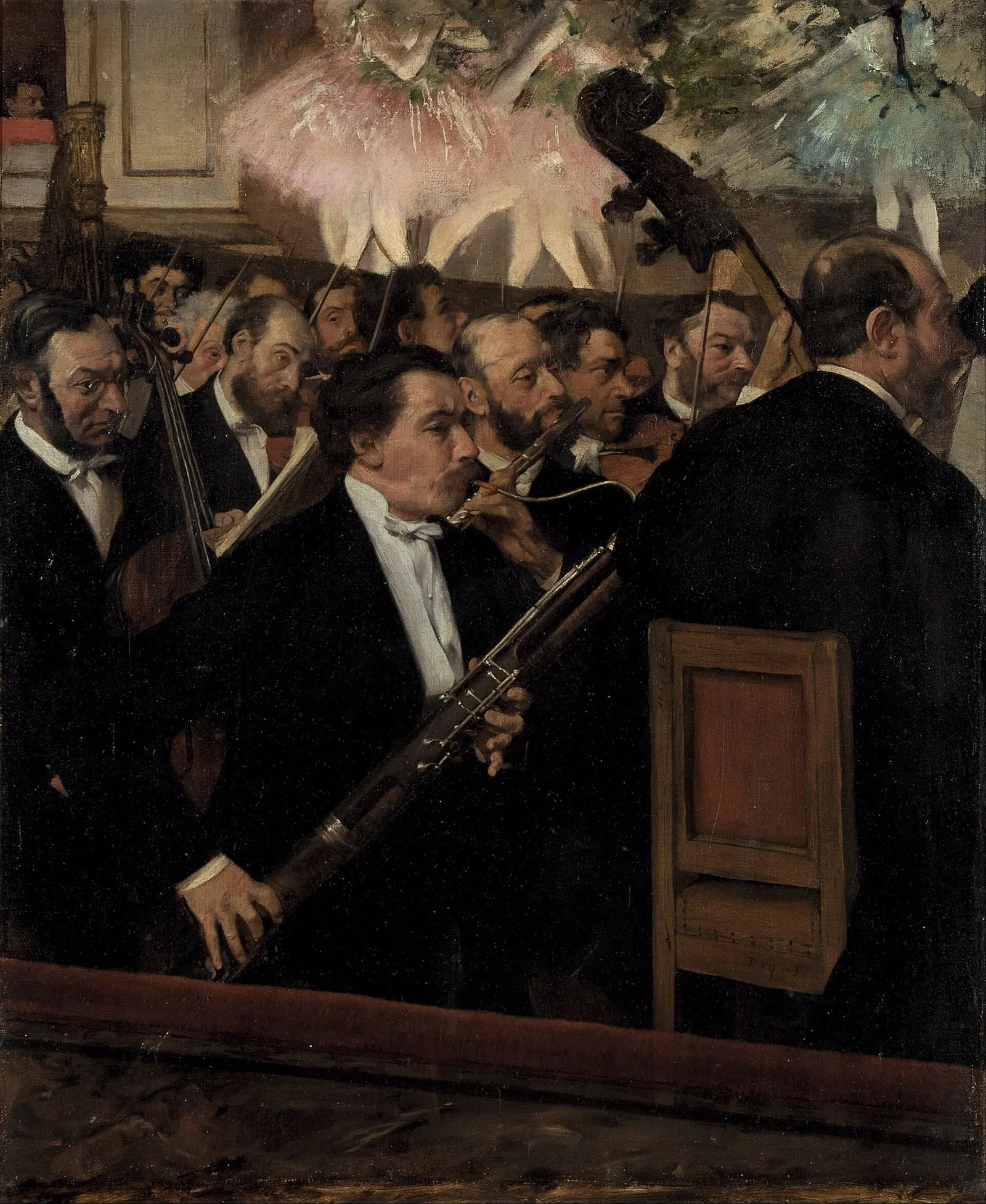
L'Orchestre de l'Opéra is a painting by Edgar Degas, dated 1868 and held by the Musée d'Orsay. It shows musicians in an opera house orchestra pit, packed close to the viewer, while dancers on the stage behind them are sliced off by the top edge of the picture. At 56.5 by 45 cm, it is a modest, upright work that rewards close looking.
Where to see it
L'Orchestre de l'Opéra belongs to the collection of the Musée d'Orsay, and the museum gives its location as the Musée d'Orsay. Works in large collections are sometimes moved, rehung or lent to other institutions, so check the Musée d'Orsay's official website for the painting's current display status before you plan your visit. The picture is fairly small at 56.5 cm high and 45 cm wide, so give yourself time to stand close and study the faces and instruments.
What to look for in person
The musicians as portraits
Look first at the band of faces in the dark lower half. These are not generic players. Degas painted individual people, and the bassoonist at the centre, Désiré Dihau, was a friend of the artist. Notice how each head has its own features, posture and expression, closer to a group portrait than to a crowd scene. The players look in different directions and are absorbed in their work, which gives the pit the feel of a real moment observed from a nearby seat rather than a staged arrangement.
Dancers cut off by the frame
Raise your eyes to the bright strip at the top. The ballet dancers appear only as legs, skirts and arms, their heads cropped by the edge of the painting. This deliberate cut is one of the most discussed features of the picture. It suggests the view of someone sitting low near the pit, where the stage is partly hidden. Compare the loose, glowing colour of the dancers with the darker, more carefully defined musicians below, and you will see how Degas sets two different worlds against each other.
Instruments as structure
Follow the shapes of the instruments across the surface. The bassoon runs diagonally through the centre, and the scroll of a double bass rises upward, linking the pit to the stage above. The rail of the orchestra pit forms a firm horizontal line that divides the composition. These elements work almost like scaffolding, guiding your eye through a crowded space. Standing in front of the work, try tracing how the lines move from the black-clad players up into the light of the performance.
About the painting
Edgar Degas is closely associated with the world of the Paris Opera, and L'Orchestre de l'Opéra, dated 1868, is an early example of that long interest. Instead of placing the performance at the centre, Degas turns the usual view around. The audience normally watches the dancers; here the orchestra fills most of the picture, and the ballet is reduced to a fragment glimpsed over the musicians' heads.
The painting grew out of Degas's friendships with musicians, and the central bassoonist, Désiré Dihau, is the figure around whom the composition is built. Other players around him are also understood to be identifiable people from Degas's circle, which makes the work part portrait, part scene of modern life. This blend of the two genres is characteristic of Degas in these years.
Formally, the picture shows ideas that would remain important to him: an unusual, close viewpoint, figures cut by the frame, and strong contrasts between zones of light and shadow. The crowded, upright format, 56.5 cm high by 45 cm wide, presses the musicians toward the viewer, while the stage floats above in brighter colour. Art historians often connect this kind of cropping to Degas's interest in new ways of seeing, including photography and Japanese prints, though the exact sources are debated.
For visitors, the painting is a useful starting point for understanding Degas's later dance pictures. Here the dancers are still at the margins; in time they would move to the centre of his work.
Key facts
| Artist | Edgar Degas |
|---|---|
| Date | 1868 |
| Size | 56.5 × 45 cm |
| Medium | oil paint, canvas |
| Collection | Musée d'Orsay |
How to visit: Musée d'Orsay
Paris, France · Museum guide
| Opening hours | Tue–Wed, Fri–Sun 09:30–18:00 (galleries close at 17:30) Thu 09:30–21:45 (late opening; galleries close at 21:15) |
|---|---|
| Closed | Every Monday, 1 May and 25 December. |
| Last entry | 17:00 (exhibitions 17:15); Thursdays 21:00 |
| Admission | Full rate, online EUR 16 Full rate, at the museum EUR 14 Reduced rate (on site only) EUR 11 Enfant & Cie, online EUR 13 Enfant & Cie, at the museum EUR 11 Night rate (Thursday), online EUR 12 Night rate (Thursday), at the museum EUR 10 Under 18s; EEA residents under 26 free |
| Free entry | Free for under 18s and residents of the European Economic Area under 26. Free on the first Sunday of the month, with booking required. |
| Booking | Booking is strongly recommended. Entry is by timed slot. |
The museum stays open and all collections and exhibitions remain accessible, but entrances have changed: timed-ticket holders use Entrance 1 (Quay); priority visitors, reseller voucher holders, visitors without tickets and groups use Entrance 2 (Forecourt). Arrive at least 15 minutes before your time slot.
Official ticket page
Official website
View on map
Hours and prices can change. Please check the official website before you go. (Checked on: 2026-11-11)
More by Edgar Degas
 L'Absinthe — Musée d'Orsay
 The Bellelli Family — Musée d'Orsay
 The Tub — Musée d'Orsay
 A Cotton Office in New Orleans
 Ballet Rehearsal on Stage — Musée d'Orsay