Art! Art! Art! › Works
The Last Judgment
 Michelangelo, 16th century
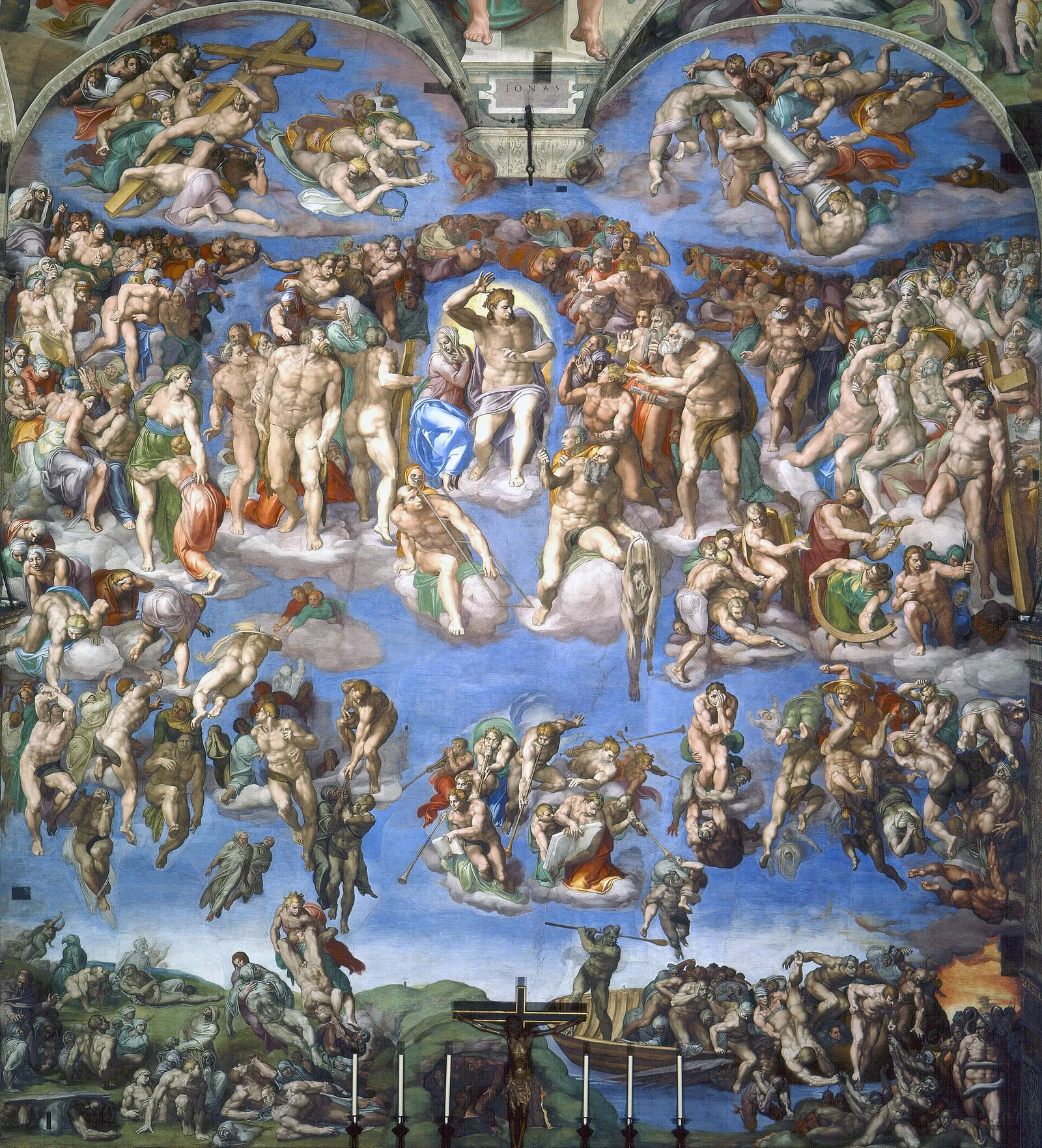
Michelangelo's The Last Judgment covers the altar wall of the Sistine Chapel in Vatican City, a 16th-century fresco that fills the space behind the altar from near floor level to the ceiling. Hundreds of figures rise, fall and gather around a central Christ, so it rewards slow, section-by-section looking.
Where to see it
The Last Judgment is in the Sistine Chapel, Vatican City, and is part of the Vatican Museums. Because it is painted directly onto the chapel's altar wall, it is a permanent part of the building and is not moved for exhibitions. Visitors usually reach the Sistine Chapel through the Vatican Museums. Opening hours, ticketing, closures for religious events and visitor rules can change, so check the Vatican Museums' official website for current access and display information before you go.
What to look for in person
Christ at the centre of the storm
Start in the middle of the upper wall. A muscular, beardless Christ raises his right arm in a gesture of judgment, and the whole composition seems to turn around him: figures on the left rise toward heaven, while those on the right are pulled downward. Close beside him, the Virgin Mary turns inward, drawing her body toward his. Notice that there is no architecture or landscape framing the scene. Bodies alone fill the blue space, and the sense of movement comes from their twisting poses rather than from any fixed setting.
Saints, attributes and a hidden face
Around Christ crowd saints and martyrs, many holding the instruments of their martyrdom so they can be recognised. Look just below and to the right of Christ for Saint Bartholomew, who holds a knife and a flayed human skin. The sagging face on that skin is widely read as a self-portrait of Michelangelo, a personal detail within a vast public image. Nearby, Saint Peter holds out a pair of keys. Taking time to pick out these attributes helps turn the mass of bodies into individual characters.
The resurrection and the descent into hell
Drop your gaze to the bottom of the wall. On the left, the dead climb out of the earth, some still skeletal, others regaining flesh. On the right, Charon, the boatman drawn from classical myth and Dante's Inferno, drives the damned out of his boat with a raised oar toward Minos, whose body is wrapped by a serpent. In the centre, angels blow trumpets and hold open books recording the deeds of souls. The contrast between rising and falling figures reads clearly even from the far end of the chapel.
About the painting
The Last Judgment is a fresco by Michelangelo painted on the altar wall of the Sistine Chapel in Vatican City. It dates from the 16th century and was created years after Michelangelo had completed his famous frescoes on the chapel's ceiling, so visitors standing in the chapel can see two distinct phases of his work in one room. The painting measures 1370 cm in height and 1220 cm in width, making it one of the dominant features of the space. The work was commissioned by the papacy and is associated with Pope Paul III. Its subject is the Second Coming of Christ and the final judgment of humanity, a theme traditionally placed in churches as a reminder of salvation and damnation. Michelangelo treated it in an unusually dynamic way, abandoning the orderly tiers often seen in earlier versions in favour of a swirling arrangement of powerful, largely nude bodies. That nudity drew criticism from some contemporaries. After the Council of Trent, draperies and loincloths were added to a number of figures, work commonly associated with the painter Daniele da Volterra. Many of these additions remain visible today. A major modern restoration cleaned centuries of grime and soot from the surface, revealing stronger colours, including the intense blue of the background. When visiting, it helps to read the wall in zones: the heavenly figures and Christ above, the trumpeting angels in the middle, and the resurrection and hell scenes along the bottom.
Key facts
| Artist | Michelangelo |
|---|---|
| Date | 16th century |
| Size | 1370 × 1220 cm |
| Medium | fresco |
| Collection | Vatican Museums / Sistine Chapel |
How to visit: Vatican Museums
Vatican City, Vatican City · Museum guide
| Opening hours | Mon–Sat 08:00–20:00 (exit from the galleries starts 30 minutes before closing) Last Sunday of the month (free entry) 09:00–14:00 (not when it falls on Easter Sunday, 29 June, 25, 26 or 31 December) 24 and 31 December 08:00–15:00 |
|---|---|
| Closed | Sundays (except the last Sunday of the month). Fixed closures: 1 and 6 January, 11 February, 19 March, Easter Monday, 1 May, 29 June, 14 and 15 August, 1 November, 8, 25 and 26 December. Official calendar: remaining 2026 closures 8, 25 and 26 December; 2027 closures 1 and 6 January, 11 February, 19 March, 29 March (Easter Monday), 1 May, 29 June, 14 and 16 August, 1 November, 8 and 25 December (plus Sundays). |
| Last entry | 18:00 Mon–Sat; 12:30 on free last Sundays; 13:00 on 24 and 31 December. |
| Admission | Adult EUR 20 (ticket office) Adult, booked online (Skip the Line) EUR 25 (EUR 20 + EUR 5 booking fee) Reduced (students, pilgrimages, university institutes, etc.) EUR 10 (EUR 10 + EUR 5 online) Reduced, schools, seminaries and religious colleges EUR 5 (EUR 5 + EUR 2 online) Children under 7 free Audio guide (rental) EUR 8 (on site at the Courtyard of the Cuirasses or with online booking) |
| Free entry | Free on the last Sunday of the month 09:00–14:00 (last entry 12:30), subject to the museum calendar; also for children under 7, disabled visitors (invalidity of 67% or more) plus a companion if not self-sufficient (issued on site, not bookable online), ICOM/ICOMOS card holders, directors of museum or heritage institutions, and certain university teachers with Directorate permission. |
| Booking | Booking is not required. Online Skip the Line tickets are available on the official site for a booking fee. |
Partial temporary closures: 17 Nov, Chiaramonti Museum 16:30–20:00 (last entrance 16:00); 4 and 18 Dec, Sistine Chapel 18:00–20:00 (last entrance 17:30); 7 Dec, Castel Gandolfo complex 14:30–17:30 (last entrance 13:00). Dress code: no sleeveless or low-cut garments, shorts above the knee, miniskirts or hats.
Official ticket page
Official website
View on map
Hours and prices can change. Please check the official website before you go. (Checked on: 2026-11-11)
More by Michelangelo
 The Entombment — National Gallery
 Doni Tondo — Uffizi Gallery
 Manchester Madonna — National Gallery
 Sistine Chapel ceiling — Vatican Museums