Art! Art! Art! › Works
The Entombment
 Michelangelo, 1500s
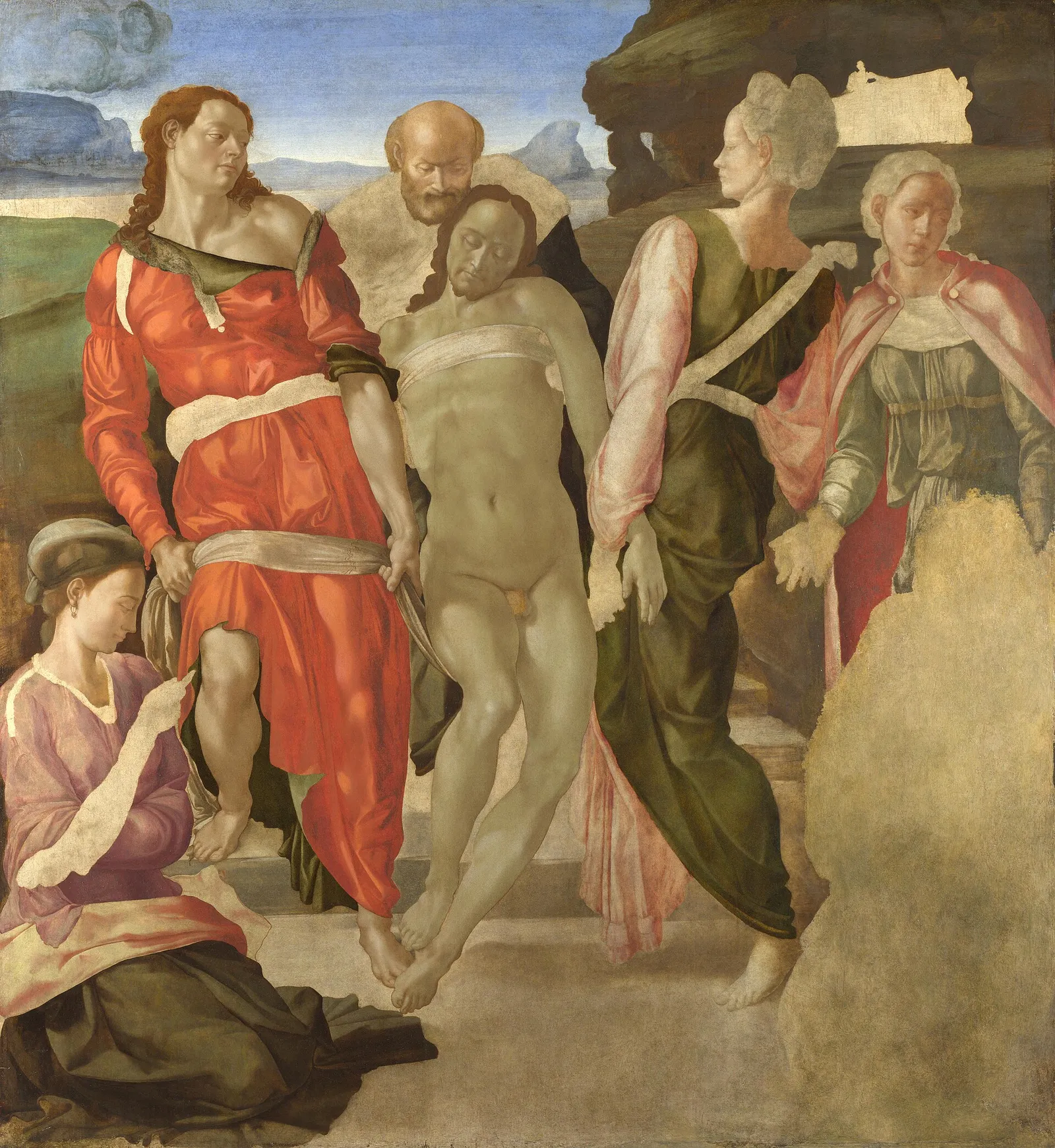
The Entombment is an unfinished panel painting showing the dead Christ being carried to his tomb, generally attributed to Michelangelo and dated to around 1500 or 1501. It belongs to the National Gallery in London, where its bare, unpainted patches let visitors see how the picture was being built up, section by section.
Where to see it
The Entombment is in the collection of the National Gallery, London. The panel measures 161.7 x 149.9 cm. Display arrangements can change, so check the National Gallery's official website for current display status before you visit.
What to look for in person
The dead Christ on the steps
Start at the centre of the panel. The naked body of Christ is being lifted and carried up a flight of steps towards the tomb, supported by the figures around him. Notice how the weight of the body is conveyed: the limp limbs and the effort of those carrying him give the scene its tension. Because the central group is among the most worked-up parts of the panel, it is the best place to judge the modelling of the figures before turning to the unfinished edges.
The empty spaces: a tomb and a missing Virgin
Two areas of the picture were never completed, and knowing what they were meant to hold changes how you read the scene. The plain stretch of rock at upper right is where the tomb itself was to be painted, the destination of the procession. The large unpainted area at lower right was reserved for a kneeling Virgin Mary. A preparatory drawing now in the Louvre shows a kneeling woman, drawn nude, with the crown of thorns and three nails, giving a sense of what this corner might have contained.
Clues to how it was painted
Look closely at the contrast between finished and bare passages. Rather than laying out the whole composition first and then adding colour everywhere, the painter appears to have completed one zone at a time, a method associated with fresco and tempera. The panel is described as tempera with later oil retouching. In some places, such as the rocks, you can also make out where paint was scratched away, small traces of revision that remain visible on the surface and reward a slow, close look.
About the painting
For a long time this panel had no secure history, and its authorship was disputed. A key piece of evidence came to light only in 1981, when documents were found showing that Michelangelo had been commissioned in 1500 to paint a panel for a funerary chapel in the church of Sant'Agostino in Rome. The commission was probably arranged through the banker Jacopo Galli. Michelangelo did not deliver the work and later returned the payment, which fits well with the incomplete state of the painting now in London, generally dated to around 1500 or 1501.
The panel's later travels can be traced in part. By the 1650s it was in the Farnese collection, and it subsequently moved through other Roman collections before being acquired by Robert Macpherson, a Scottish photographer living in Rome. The National Gallery bought it from him in 1868.
Attribution has not always been settled. The German painters Peter von Cornelius and Friedrich Overbeck put forward Michelangelo's name, but this view was at first rejected, and the painting was instead assigned to an anonymous artist known as the Master of the Manchester Madonna. Today it is generally attributed to Michelangelo.
For visitors, the painting's unfinished condition is part of its interest. It shows a large-scale religious composition partway through its making: a central group carried towards completion, a tomb that exists only as blank rock, and an empty corner where the mourning Virgin was to kneel. Standing in front of it, you can follow the painter's working sequence across the surface.
Key facts
| Artist | Michelangelo |
|---|---|
| Date | 1500s |
| Size | 161.7 × 149.9 cm |
| Medium | tempera, oil paint, panel |
| Collection | National Gallery |
How to visit: National Gallery
London, United Kingdom · Museum guide
| Opening hours | Mon–Thu, Sat, Sun 10:00–18:00 Fri 10:00–21:00 (Friday late) |
|---|---|
| Closed | 24–26 December and 1 January. |
| Admission | General admission (collection) free; donations invited Some exhibitions are charged (e.g. Renoir and Love, until 31 Jan 2027) |
| Free entry | General admission is always free. |
| Booking | No reservation or timed entry is required. Free timed booking gives fast-track entry. |
Building work and improvements are under way: some rooms are closed and some paintings have moved, so check the floorplans or collection search before visiting. A new Research Centre is due to open in 2028. On 17 November only, some east wing rooms and the Espresso Bar close from 16:00.
Official ticket page
Official website
View on map
Hours and prices can change. Please check the official website before you go. (Checked on: 2026-11-11)
More by Michelangelo
 Doni Tondo — Uffizi Gallery
 Manchester Madonna — National Gallery
 The Last Judgment — Vatican Museums
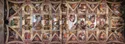 Sistine Chapel ceiling — Vatican Museums
Sources
- Wikidata Q1213160
- Wikipedia (en) (CC BY-SA 4.0)
- Wikipedia (it) (CC BY-SA 4.0)
- www.nationalgallery.org.uk