Art! Art! Art! › Works
Doni Tondo
 Michelangelo, 1500s
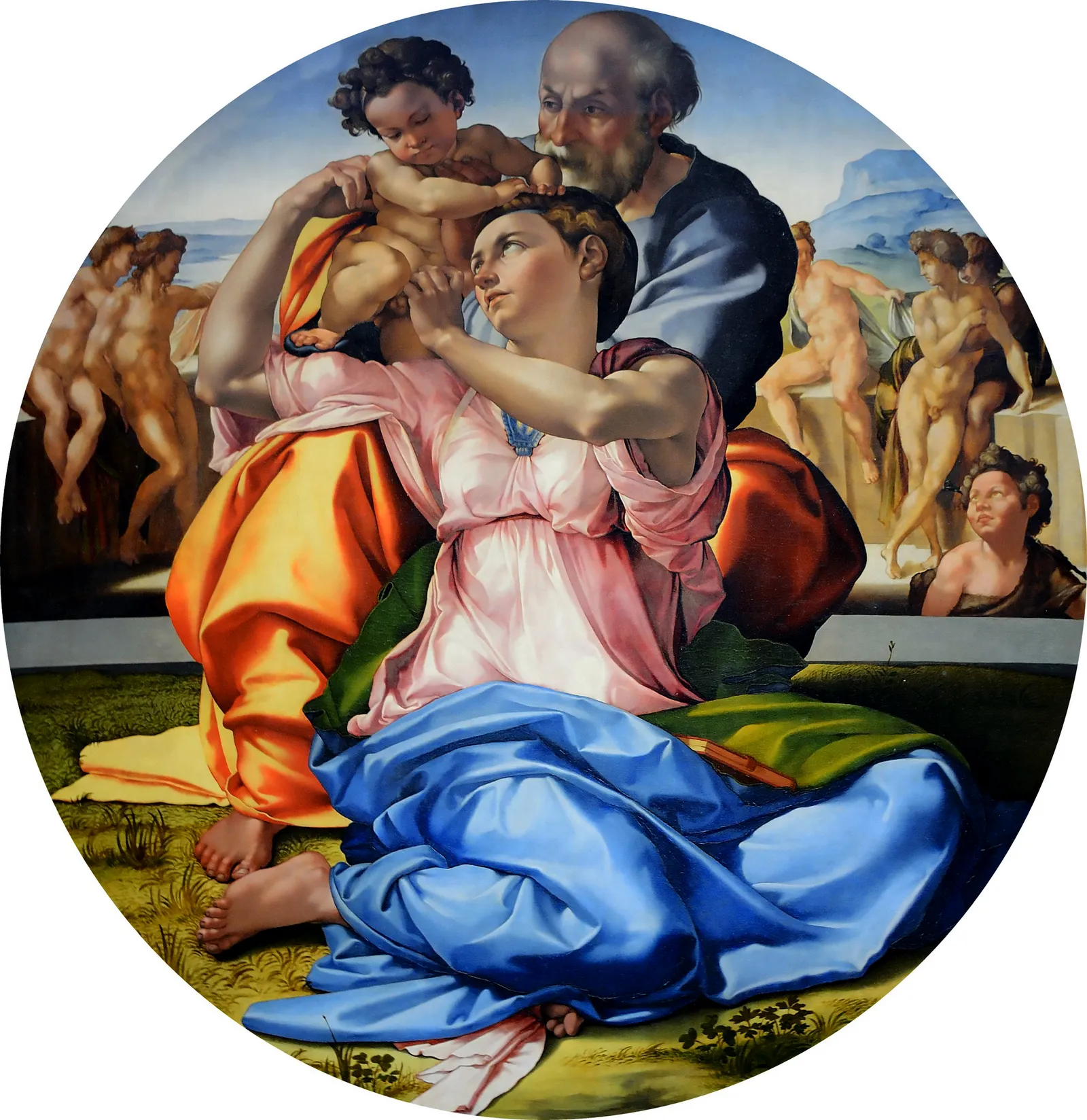
The Doni Tondo is a round painting of the Holy Family by Michelangelo, held in the collection of the Uffizi Gallery. Dating from the 1500s and measuring 120 cm across, it is a rare chance to see the sculptor's approach to the human body expressed in paint.
Where to see it
The Doni Tondo belongs to the Uffizi Gallery, which is also its recorded location. Displays in large museums change for conservation, rehanging and loans, so check the Uffizi Gallery's official website for current display status, opening hours and ticketing before you visit. Booking ahead is sensible, as the museum is a popular destination.
What to look for in person
A Holy Family built like sculpture
Stand back first and notice how the three main figures, Mary, Joseph and the infant Christ, lock together into one compact, twisting group. Mary sits on the ground in the foreground and turns back over her shoulder to receive or pass the child, while Joseph looms behind her. The figures read almost like a carved block of marble: solid, weighty and turning in space. Follow the spiral of movement from Mary's knees up through her raised arms to the child at the top of the group.
Clear, hard-edged colour
Move closer and look at the colour. Instead of soft, smoky transitions, the drapery is painted in crisp, saturated hues with sharp outlines, and the folds shift tone as they turn, so that highlights and shadows can appear in surprisingly different shades. Mary's rose and blue garments and Joseph's golden-orange cloak stand out strongly against the pale background. The effect is bright and precise, giving the surfaces a polished, almost metallic quality that rewards slow looking at the edges of each fold.
The background figures and the young Saint John
Behind the Holy Family, beyond a low wall, a group of nude young men lean, sit and recline in varied poses. Their meaning has been much debated, and the painting offers no single explanation. Between them and the main group, look for a small figure of the young Saint John the Baptist, who gazes toward Christ. Notice how the background is divided from the foreground in distinct bands, separating the sacred family from the open landscape and the figures beyond.
About the painting
The Doni Tondo is a tondo, a circular painting, a format associated with domestic devotional images in Renaissance Italy. Its name comes from the Doni family, for whom it is widely understood to have been made, with Agnolo Doni generally identified as the patron. The painting dates from the 1500s and measures 120 cm in height and width, matching its round shape.
Michelangelo is best known today as a sculptor and as the painter of large fresco cycles, so a finished panel painting by him is unusual, and this is a key reason visitors seek it out. The work shows how he translated a sculptor's thinking into paint. The bodies are muscular and firmly modelled, even Mary's, whose bare arms and powerful pose differ from gentler devotional images of the Virgin. The twisting arrangement of the figures and the strong, clear colour are often seen as anticipating the style later called Mannerism, in which artists favoured complex poses and bold, unnatural colour.
The subject is the Holy Family, accompanied by the young Saint John the Baptist. The nude figures in the background have prompted many interpretations, and scholars have proposed different readings of their role in the composition.
When you visit, give yourself time to look at the painting from several distances: from afar to take in the circular composition and the spiral of the central group, and closer up to study the sharp drawing, the colour shifts in the drapery and the details of the background. The painting is also presented in an elaborately carved round frame, which is worth examining in its own right.
Key facts
| Artist | Michelangelo |
|---|---|
| Date | 1500s |
| Size | 120 × 120 cm |
| Medium | oil paint, panel |
| Collection | Uffizi Gallery |
How to visit: Uffizi Gallery
Florence, Italy · Museum guide
| Opening hours | Tue–Sun 08:15–18:30 (visitors leave by 18:30) |
|---|---|
| Closed | Mondays, 1 January and 25 December. |
| Last entry | Ticket office closes at 17:30. |
| Admission | Regular, bought on the day EUR 25 Regular, bought in advance EUR 29 Regular, entry from 16:00 (from 1 January 2026) EUR 16 Reduced (EU citizens aged 18–25; citizens of Switzerland, Norway, Liechtenstein, Uruguay etc.; ID required) EUR 2 Under 18 free (under 12s must be accompanied) Uffizi + Vasari Corridor EUR 43 on the day / EUR 47 in advance; named ticket, reservation required, non-refundable PassePartout 5 days (Uffizi, Pitti Palace, Boboli) EUR 40 (EUR 58 with Vasari Corridor) Audio guide EUR 6 |
| Free entry | Free for under-18s; disabled visitors plus one companion; tour guides and interpreters, ICOM members, certain journalists, and university teachers/students on the official list. Admission is free on the first Sunday of each month (national museums), when reservations are not possible. |
| Booking | Reservation is not required, except for the Uffizi + Vasari Corridor ticket, which must be reserved. |
Restoration and rearrangement works mean some rooms are temporarily closed and some artworks are not on display. A staff assembly on 11–12 November 2026 may change opening times.
Official ticket page
Official website
View on map
Hours and prices can change. Please check the official website before you go. (Checked on: 2026-11-12)
More by Michelangelo
 The Entombment — National Gallery
 Manchester Madonna — National Gallery
 The Last Judgment — Vatican Museums
 Sistine Chapel ceiling — Vatican Museums