Art! Art! Art! › Works
Sistine Chapel ceiling
 Michelangelo, 1508
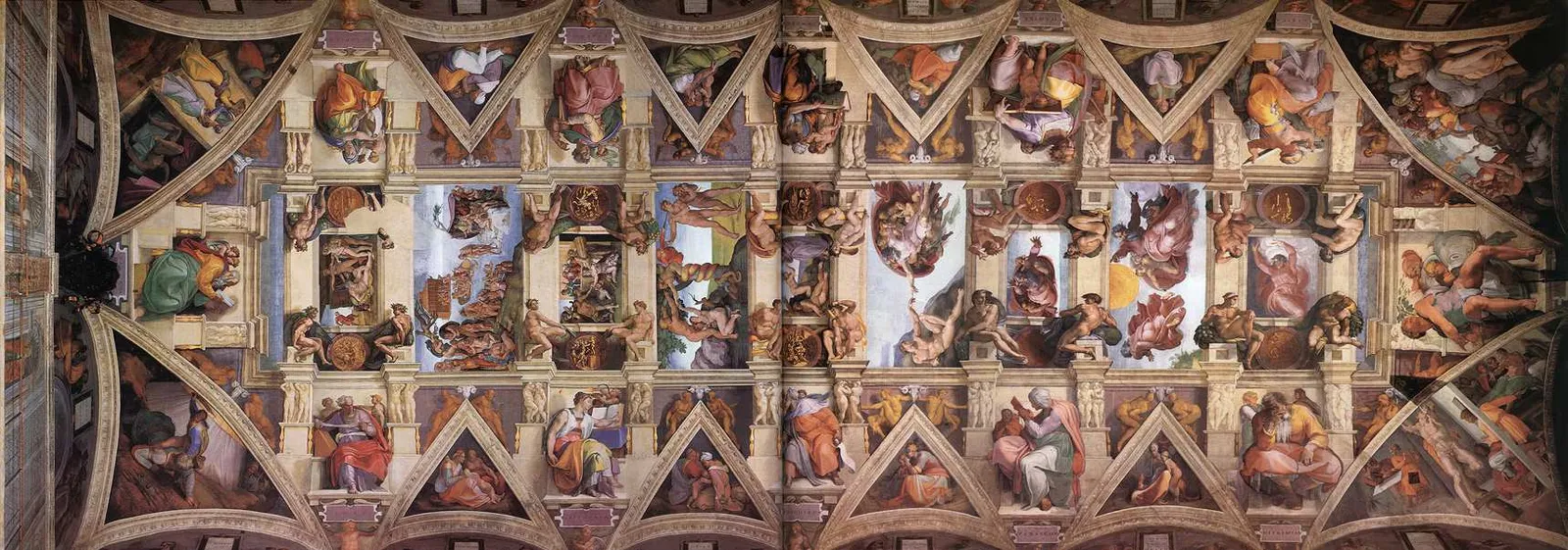
Michelangelo's Sistine Chapel ceiling, begun in 1508, covers the vault of the Sistine Chapel and is part of the Vatican Museums. Rather than a single picture, it is a whole painted system of scenes, figures and illusionistic architecture meant to be read from the floor below. Knowing where to look turns a crowded first glance into a clear, rewarding visit.
Where to see it
The Sistine Chapel ceiling is in the Sistine Chapel, held by the Vatican Museums. Because it is painted directly onto the chapel's vault, it cannot travel and is seen where it was made. Access, opening hours, ticketing and visitor rules are set by the Vatican Museums, and the chapel is also a working religious space that may close for ceremonies. Check the Vatican Museums' official website for current display status, opening times and visiting conditions before you go.
What to look for in person
The Genesis scenes down the centre
Look straight up along the spine of the vault for nine scenes from the Book of Genesis, from God separating light from darkness to the Drunkenness of Noah. The story runs from the altar end towards the entrance, though Michelangelo is generally understood to have begun painting at the entrance end. Find the Creation of Adam, where the nearly touching hands of God and Adam sit in an open gap of space. Compare the early Noah scenes, crowded with small figures, with the later, larger and simpler compositions nearer the altar.
Prophets and Sibyls on their thrones
Around the edges of the vault, seven Old Testament prophets alternate with five sibyls, the prophetesses of the classical world, each seated on a painted throne. These are among the largest figures on the ceiling and are easier to study than the central scenes. Above the altar, look for Jonah, leaning backwards so dramatically that he seems to tip out of the architecture. Along the sides, note the twisting pose of the Libyan Sibyl lifting her heavy book and the alert, wide-eyed Delphic Sibyl turning towards the viewer.
Painted architecture, nudes and corners
Much of what looks like carved stone is painted: ribs, cornices and pedestals create a framework that organises the whole ceiling. Seated on this fictive architecture are the ignudi, muscular nude youths in varied poses, many holding ribbons and painted medallions. In the four corner spandrels, find Old Testament scenes of deliverance, including David and Goliath and Judith with the head of Holofernes. Lower down, in the lunettes and triangular spaces above the windows, are the ancestors of Christ, quieter family groups that reward a slower look.
About the painting
The Sistine Chapel ceiling was commissioned by Pope Julius II, and the fact sheet gives 1508 as the year the project began. Michelangelo, who thought of himself first as a sculptor, accepted the commission and painted the vault in fresco, applying pigment to fresh plaster in daily sections. Art historians widely agree that the original plan was far simpler, centred on figures of the Twelve Apostles, and that it grew into the much larger scheme seen today. Contrary to popular belief, Michelangelo is generally understood to have worked standing on a raised scaffold, bending backwards to paint overhead, rather than lying flat. The ceiling is only one part of the chapel's decoration. Before Michelangelo began, the side walls had already been painted with scenes from the lives of Moses and Christ by artists including Botticelli, Perugino and Ghirlandaio, so look at the walls as well as the vault. Michelangelo later returned to paint the Last Judgment on the altar wall, a separate work you will see behind the altar. The ceiling's figures draw heavily on sculpture: bodies are modelled as solid, turning forms, and the painted architecture gives them a stage to sit, lean and twist upon. A major cleaning and restoration in the late twentieth century removed layers of grime and earlier interventions, revealing bright, often unexpected colours that changed how many people understood Michelangelo as a painter. As you stand in the chapel, remember that it remains a consecrated space, used among other things for the conclave that elects a new pope. The fact sheet lists the ceiling's measurements as 4093 cm by 1341 cm, which helps explain why binoculars or a patient, slow look are useful.
Key facts
| Artist | Michelangelo |
|---|---|
| Date | 1508 |
| Size | 4093 × 1341 cm |
| Medium | fresco |
| Collection | Vatican Museums |
How to visit: Vatican Museums
Vatican City, Vatican City · Museum guide
| Opening hours | Mon–Sat 08:00–20:00 (exit from the galleries starts 30 minutes before closing) Last Sunday of the month (free entry) 09:00–14:00 (not when it falls on Easter Sunday, 29 June, 25, 26 or 31 December) 24 and 31 December 08:00–15:00 |
|---|---|
| Closed | Sundays (except the last Sunday of the month). Fixed closures: 1 and 6 January, 11 February, 19 March, Easter Monday, 1 May, 29 June, 14 and 15 August, 1 November, 8, 25 and 26 December. Official calendar: remaining 2026 closures 8, 25 and 26 December; 2027 closures 1 and 6 January, 11 February, 19 March, 29 March (Easter Monday), 1 May, 29 June, 14 and 16 August, 1 November, 8 and 25 December (plus Sundays). |
| Last entry | 18:00 Mon–Sat; 12:30 on free last Sundays; 13:00 on 24 and 31 December. |
| Admission | Adult EUR 20 (ticket office) Adult, booked online (Skip the Line) EUR 25 (EUR 20 + EUR 5 booking fee) Reduced (students, pilgrimages, university institutes, etc.) EUR 10 (EUR 10 + EUR 5 online) Reduced, schools, seminaries and religious colleges EUR 5 (EUR 5 + EUR 2 online) Children under 7 free Audio guide (rental) EUR 8 (on site at the Courtyard of the Cuirasses or with online booking) |
| Free entry | Free on the last Sunday of the month 09:00–14:00 (last entry 12:30), subject to the museum calendar; also for children under 7, disabled visitors (invalidity of 67% or more) plus a companion if not self-sufficient (issued on site, not bookable online), ICOM/ICOMOS card holders, directors of museum or heritage institutions, and certain university teachers with Directorate permission. |
| Booking | Booking is not required. Online Skip the Line tickets are available on the official site for a booking fee. |
Partial temporary closures: 17 Nov, Chiaramonti Museum 16:30–20:00 (last entrance 16:00); 4 and 18 Dec, Sistine Chapel 18:00–20:00 (last entrance 17:30); 7 Dec, Castel Gandolfo complex 14:30–17:30 (last entrance 13:00). Dress code: no sleeveless or low-cut garments, shorts above the knee, miniskirts or hats.
Official ticket page
Official website
View on map
Hours and prices can change. Please check the official website before you go. (Checked on: 2026-11-11)
More by Michelangelo
 The Entombment — National Gallery
 Doni Tondo — Uffizi Gallery
 Manchester Madonna — National Gallery
 The Last Judgment — Vatican Museums