Art! Art! Art! › Works
The Wayfarer
 Hieronymus Bosch, 1494
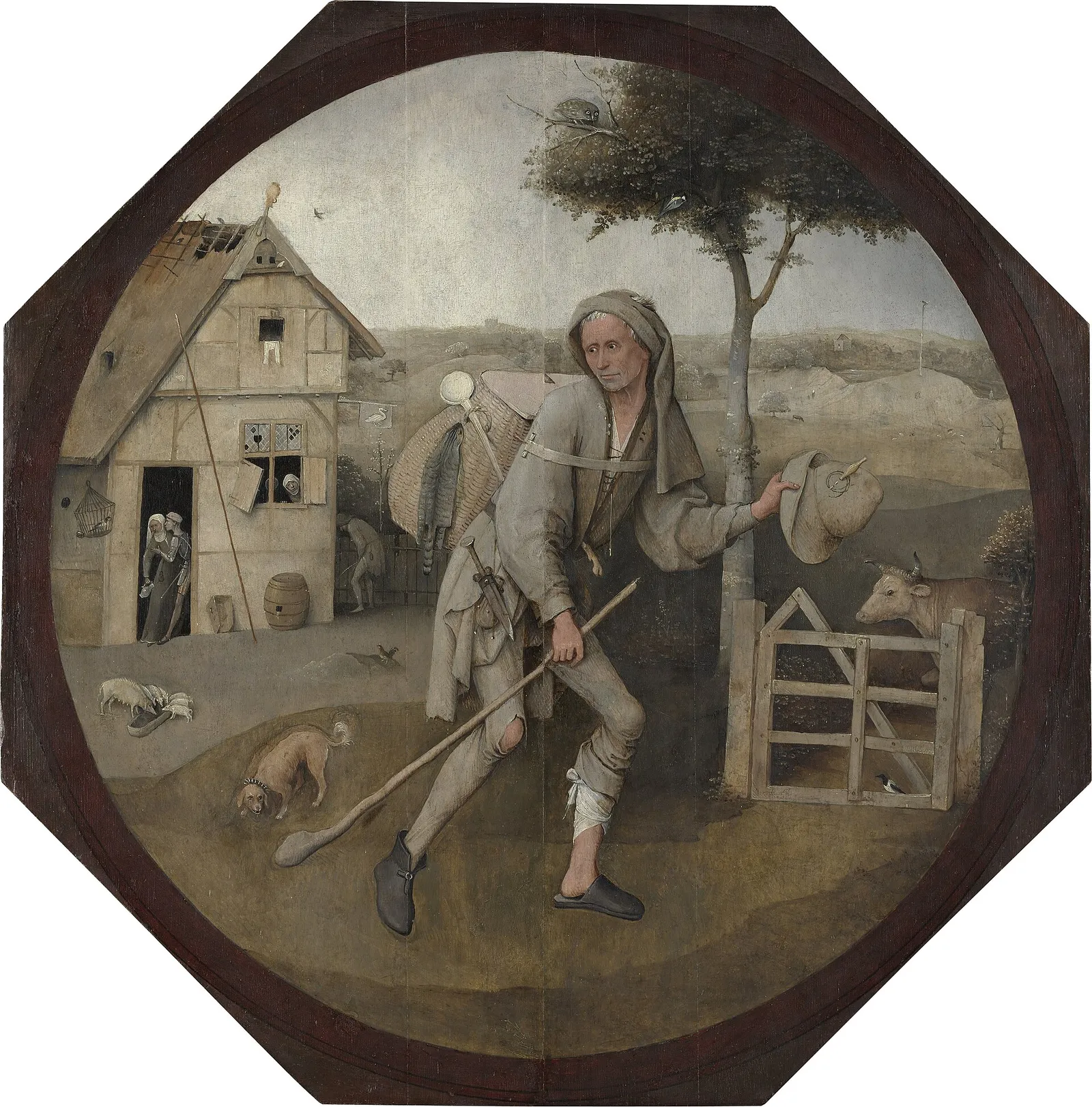
The Wayfarer is a painting by Hieronymus Bosch dated to 1494 and held by Museum Boijmans Van Beuningen. It shows a weary traveller pausing on a country road, looking back over his shoulder at a run-down inn. Up close, its small, sharply observed details reward slow looking.
Where to see it
The Wayfarer belongs to the collection of Museum Boijmans Van Beuningen, which is also its recorded location. Display arrangements can change, so check the museum's official website for current display status, opening hours and ticket information before you plan your visit.
What to look for in person
The traveller himself
Start with the central figure. The thin, grey-haired man carries a large wicker basket on his back and holds a walking stick. Look at his feet: he wears a shoe on one foot and a slipper on the other, and one leg is bandaged. His clothes are patched and worn. Notice, too, how his body moves forward while his head turns back toward the building behind him. That turn of the head is the emotional centre of the picture, and it invites you to ask what he is leaving behind and whether he will keep walking.
The inn on the left
Shift your gaze to the dilapidated building behind the traveller. Its roof is in poor repair, a shutter hangs loose and the windows are broken. In the doorway, a man and a woman stand close together, while another figure peers out from a window. Around the corner of the building, a man relieves himself against the wall. Bosch paints these scenes small and almost casually, so they are easy to miss. Taking time to find each one shows how carefully he built a setting full of disorder and neglect.
The gate and the road ahead
On the right side of the picture, look for the closed gate and the open countryside beyond it, where a cow stands in the field. A dog near the traveller's feet appears to bark or snap at him. Step back and compare the two halves of the composition: the cluttered, decaying inn on one side and the quieter, open landscape on the other. The traveller stands between them. Observing this balance from a short distance helps you see how Bosch uses the layout of the scene itself to tell its story.
About the painting
Hieronymus Bosch was a painter from the Low Countries, known for imaginative and often moralising images filled with small, carefully observed details. The Wayfarer, dated in the museum's records to 1494, is quieter than his famous visions of heaven and hell. There are no monsters here, only a poor traveller, a country road and a shabby inn, yet the painting is just as packed with meaning. The panel measures 71 cm high and 70.6 cm wide, a modest size that suits close viewing. Bring your attention near enough to pick out the broken windows, the figures in and around the inn and the objects hanging from the traveller's basket, then step back to see how they fit into the whole. Art historians widely read the picture as a moral image: a man on the journey of life, pausing between a place associated with vice and a road leading onward. Many scholars also connect the work with other Bosch panels as surviving parts of a larger, dismantled ensemble, which is why the figure is sometimes discussed alongside his other moral subjects. Whatever the exact arrangement, the painting works on its own as a study of hesitation and choice. For visitors, the pleasure lies in reading it slowly. Look first at the traveller's face and posture, then move outward to the building, the animals and the landscape. Notice how muted browns and greys dominate, with the light falling softly across the scene. The painting rewards a second look after you have explored the rest of the gallery, when the small details may stand out in new ways.
Key facts
| Artist | Hieronymus Bosch |
|---|---|
| Date | 1494 |
| Size | 71 × 70.6 cm |
| Medium | oil paint, panel |
| Collection | Museum Boijmans Van Beuningen |
How to visit: Museum Boijmans Van Beuningen
Rotterdam, Netherlands
Hours and prices can change. Please check the official website before you go.

