Art! Art! Art! › Works
Temptation of Saint Anthony
 Hieronymus Bosch, 1501
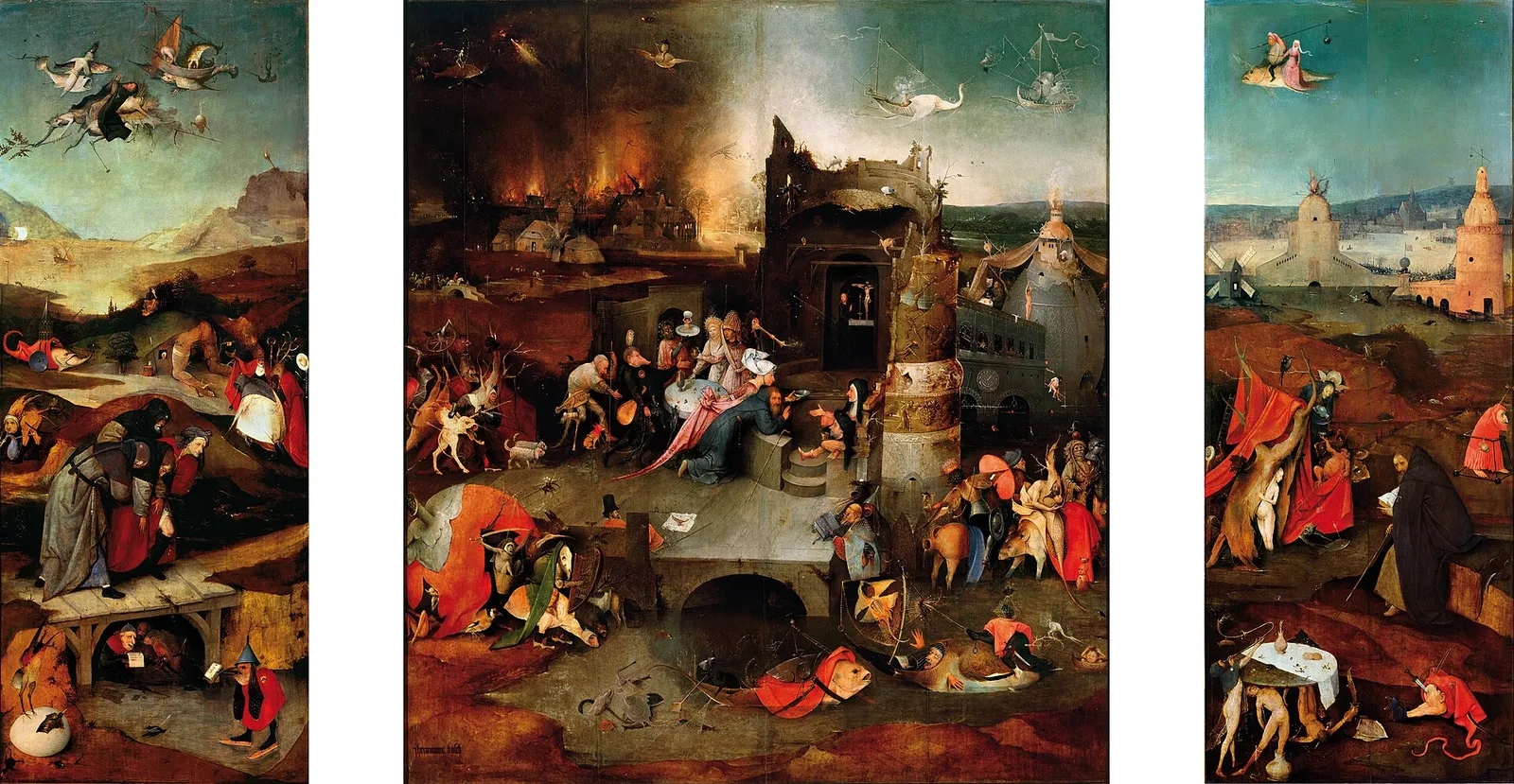
Hieronymus Bosch's Temptation of Saint Anthony is an oil-on-panel triptych dated 1501 and held by the National Museum of Ancient Art (Museu Nacional de Arte Antiga) in Lisbon. Across its three inner panels it follows the saint from assault to temptation to contemplation, while the outer wings carry scenes from Christ's Passion painted in shades of grey.
Where to see it
The triptych belongs to the National Museum of Ancient Art (Museu Nacional de Arte Antiga) in Lisbon, Portugal, which is also its listed location. Open, it measures 131.5 cm high and 238 cm wide, so give yourself room to step back for the whole composition before moving in close for detail. Display arrangements can change, so check the museum's official website for current display status, opening hours and ticketing before you visit.
What to look for in person
Reading the three panels as one story
Read the triptych from left to right as a sequence. The left wing shows Anthony's flight and fall, the central panel his temptation, and the right wing his contemplation. Each wing is less than half the width of the centre, so the eye is pulled inward to the crowded middle panel before settling on the right. Comparing the saint's situation across the three scenes is an easy way to follow the narrative without a guidebook, and to notice how the mood moves from turmoil towards stillness.
The central temptation
The middle panel, 131.5 by 119 cm, carries the main subject: the saint beset by temptation. Bosch drew on two written sources well known in his time, Athanasius's Life of St. Anthony and Jacobus de Voragine's Golden Legend, and turned their accounts of the hermit's trials into a densely populated painted world. This panel rewards slow looking, section by section, rather than a single glance. Near its left side, look for the artist's signature, a small detail that is easy to miss among the surrounding activity.
The grey scenes on the outer wings
Do not overlook the outer faces of the wings. When the triptych is closed, they show scenes painted in grisaille, a technique using tones of grey that suggests carved relief rather than colour. The left shutter depicts the Arrest of Christ and the right shows Christ Carrying the Cross. Their restrained palette contrasts strongly with the colour inside, and their Passion subjects place the hermit's ordeal beside Christ's own suffering. Whether you can see the reverse depends on how the museum displays the work, so check in advance if this matters to you.
About the painting
Saint Anthony the Abbot, an early Christian hermit of the Egyptian desert, was known to medieval readers through Athanasius's biography of him and through the Golden Legend compiled by Jacobus de Voragine. Both texts describe the trials and temptations he endured in solitude, and Bosch built this large triptych around that story, painting in oil on wooden panels.
The work is dated 1501 on the basis of dendrochronology, the analysis of tree rings in the wooden supports. Before that study, it had generally been placed somewhat earlier, in the last decade of the fifteenth century. The date matters to visitors mainly as a reminder that this is a work from the turn of the sixteenth century, made at a time when Bosch's imagery was already circulating widely.
Its later history connects it with the Iberian Peninsula. The painting is recorded in Lisbon in the mid-nineteenth century at the Palácio das Necessidades, and in 1872 it was listed among the collections of the Royal Palace of Lisbon, having arrived from Spain. It subsequently passed into the collection of the National Museum of Ancient Art, where it is held today.
The composition was copied many times. Around fifteen full or partial copies are known, including a workshop version in the Royal Museums of Fine Arts of Belgium in Brussels and a later copy in the Gemäldegalerie in Berlin. Standing in front of the Lisbon panels gives you the chance to see the painted surface that those versions set out to reproduce, and to compare the three inner scenes with the sober grey exterior that frames them when the wings are closed.
Key facts
| Artist | Hieronymus Bosch |
|---|---|
| Date | 1501 |
| Size | 131.5 × 238 cm |
| Medium | oil paint |
| Collection | National Museum of Ancient Art |
How to visit: National Museum of Ancient Art
Lisbon, Portugal
Hours and prices can change. Please check the official website before you go.
More by Hieronymus Bosch


Sources
- Wikidata Q1217288
- Wikipedia (en) (CC BY-SA 4.0)
- Wikipedia (it) (CC BY-SA 4.0)