Art! Art! Art! › Works
The Garden of Earthly Delights
 Hieronymus Bosch, 15th century
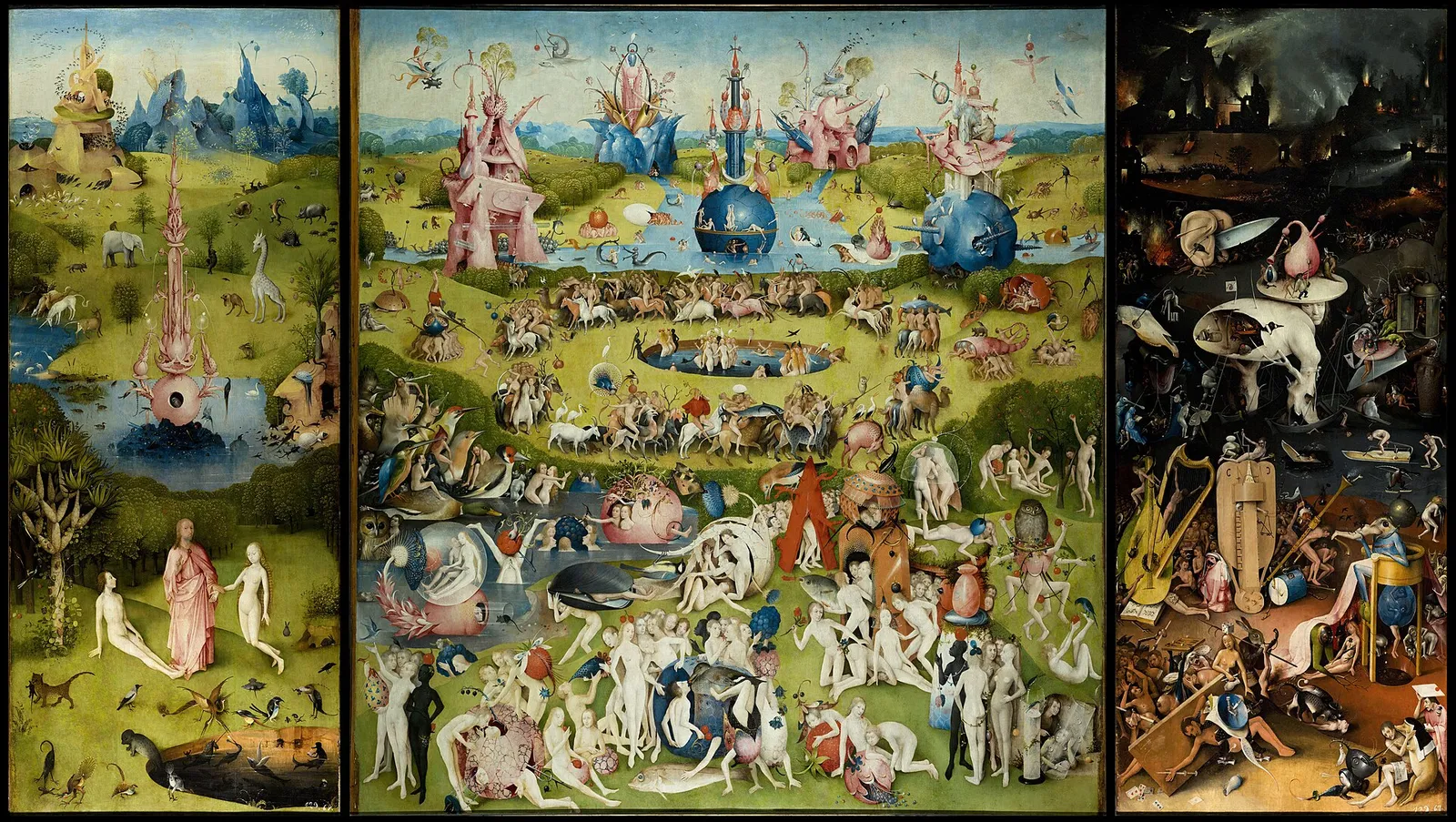
The Garden of Earthly Delights by Hieronymus Bosch is in the collection of the Museo del Prado. Dated to the 15th century and measuring 205.5 by 384.9 cm, this crowded, minutely detailed triptych rewards slow looking, panel by panel.
Where to see it
The Garden of Earthly Delights is held by the Museo del Prado, and that is where you go to see it. Display arrangements can change because of conservation work, rehangings or temporary closures, so check the Museo del Prado's official website for current display status, opening hours and ticketing before you visit. Expect other visitors to gather in front of it; arriving early or late in the day may give you more time to study the details at close range.
What to look for in person
Left panel: a calm, strange Paradise
Start on the left, where the scene is generally read as the Garden of Eden. Look for the figure of God presenting Eve to a seated Adam in the foreground. The landscape seems peaceful at first, but look more closely. Unusual hybrid animals and creatures feeding on one another appear near the water, and a pale, fountain-like structure rises in the middle distance. These details hint that trouble is already present in this garden. Compare the open, quiet space here with the crowded centre panel next to it.
Centre panel: the garden itself
The wide central panel is filled with small nude figures in a fantastical landscape. Look for oversized fruits such as strawberries and cherries, giant birds, shells and transparent spheres that hold figures inside. In the middle ground, riders on horses, camels and other animals circle a pool of bathers. In the background, odd organic towers stand in water. Many viewers find it useful to stand back for the overall pattern, then move closer to pick out individual vignettes, which are painted with great delicacy.
Right panel and closed wings: Hell and the world
The right panel turns dark and is widely read as Hell. Look for giant musical instruments used as tools of torment and a pale 'tree-man' whose hollow body holds a tavern scene. In the lower right, a bird-headed creature on a high seat swallows people. If the outer wings are visible, they show a muted, nearly monochrome painting of a globe enclosed in a transparent sphere. This is usually read as the world during its creation, a quiet opening before the colour inside.
About the painting
The Garden of Earthly Delights is a triptych, a work made of a central panel and two hinged side wings, painted by the Netherlandish artist Hieronymus Bosch. The fact sheet dates it to the 15th century, and its overall size is 205.5 by 384.9 cm. That is large enough to fill your field of view when you stand in front of it, yet most of its content is tiny. The panels are painted in oil on wood, and their surfaces are packed with hundreds of small figures, animals and invented objects. When opened, the triptych is usually read from left to right. The left wing shows Paradise, the centre shows a vast garden of human pleasures, and the right wing shows Hell. When closed, the outer wings show a subdued image of the world, commonly understood as the Creation. The meaning of the central panel has been debated for a long time. Some see it as a warning about sin and the fleeting nature of earthly pleasure. Others have proposed different readings, and no single interpretation is universally accepted. Bosch's imagery mixes careful observation of nature with pure invention. He draws on proverbs, symbols and religious ideas familiar to viewers of his time, many of which are now hard to decode. For a visitor, the practical advice is simple. Give the work time, look at each panel on its own, and then step back to see how the three relate. Bring patience rather than a fixed theory, and let the details lead you.
Key facts
| Artist | Hieronymus Bosch |
|---|---|
| Date | 15th century |
| Size | 205.5 × 384.9 cm |
| Medium | oil paint, panel |
| Collection | Museo del Prado |
How to visit: Museo del Prado
Madrid, Spain · Museum guide
| Opening hours | Mon–Sat 10:00–20:00 Sun and public holidays 10:00–19:00 6 Jan, 24 Dec, 31 Dec 10:00–14:00 (limited opening) |
|---|---|
| Closed | Closed on 1 January, 1 May and 25 December. |
| Last entry | Last entry 30 minutes before closing; visitors are asked to leave the galleries 10 minutes before closing. |
| Admission | General EUR 15 (includes the Collection and temporary exhibitions) Reduced (over 65, youth card holders, members of large families) EUR 7.5 Under 18, students aged 18–25, people with a disability of 33% or more, and other listed groups: free (official proof required at the ticket office on the day) Audio guide EUR 5 (added to the ticket; over 250 works in 15 languages) |
| Free entry | The Collection is free during the last two hours before closing (tickets at the ticket office, subject to capacity; 50% off temporary exhibitions). Always free for under-18s, students aged 18–25 and other listed groups with official proof at the ticket office. |
| Booking | Entry is by timed ticket. |
Official ticket page
Official website
View on map
Hours and prices can change. Please check the official website before you go. (Checked on: 2026-11-11)

