Art! Art! Art! › Works
The Vision of Saint Bernard
 Pietro Perugino, 1490s
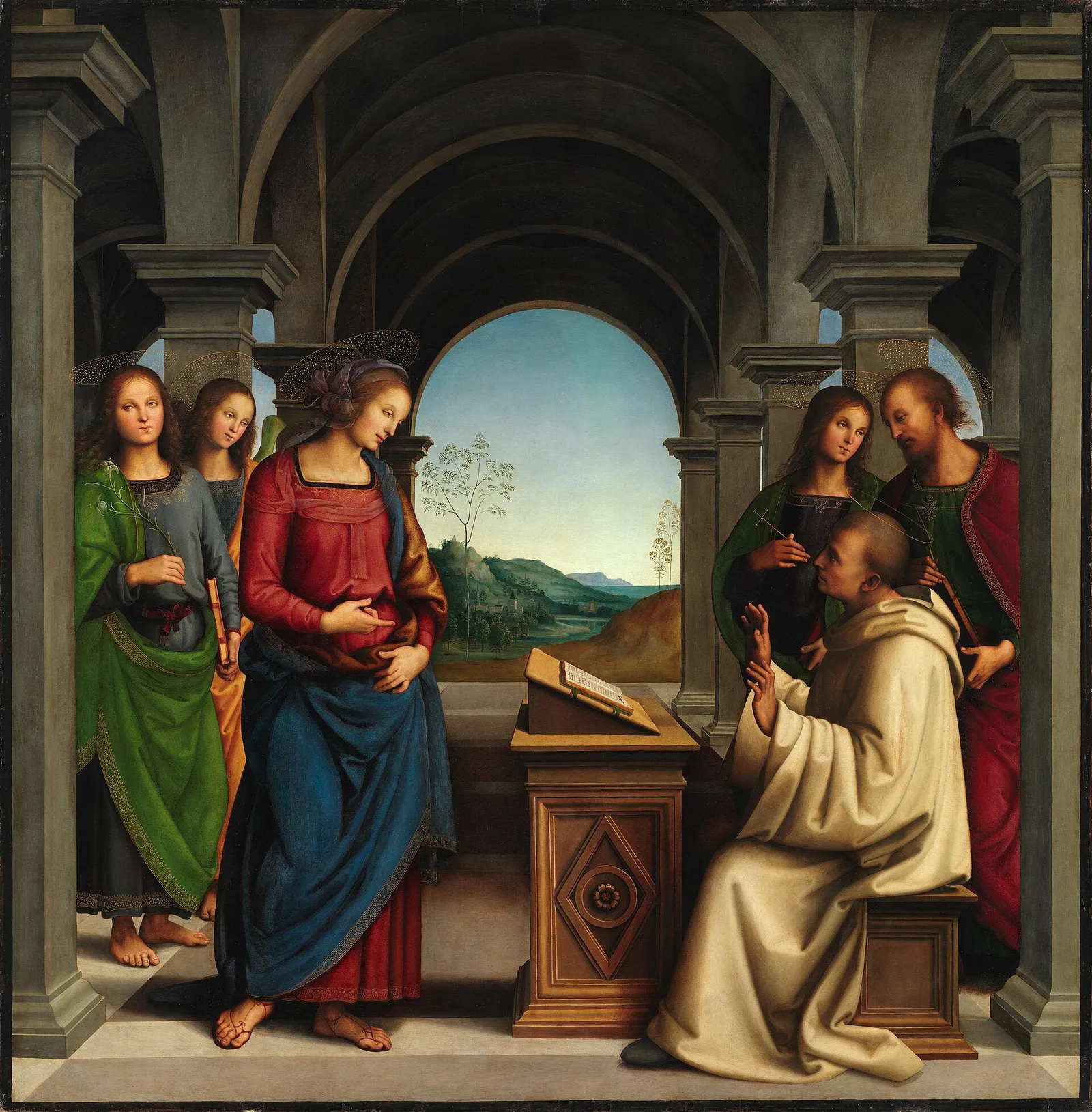
Pietro Perugino's The Vision of Saint Bernard is a Florentine altarpiece from the 1490s, now in the Bavarian State Painting Collections at the Alte Pinakothek in Munich. It shows Saint Bernard of Clairvaux looking up from his reading as the Virgin Mary appears before him, watched by four saints beneath an open arcade.
Where to see it
The painting belongs to the Bavarian State Painting Collections and is recorded at the Alte Pinakothek in Munich, on the upper floor in gallery IV. Hangs and loans can change, so check the Alte Pinakothek's official website for current display status before you visit.
What to look for in person
The vision at the lectern
Start with the encounter at the centre. Saint Bernard of Clairvaux, dressed in white, has been interrupted at his studies. Facing him, the Virgin Mary in red and blue points toward a book resting on a carved lectern in front of him, linking his reading to her appearance. Notice how the two figures turn toward each other across the book, which becomes the meeting point of the scene. The contrast between Bernard's pale habit and the Virgin's strong colours helps you find the main exchange quickly, even from a distance in the gallery.
Saints as quiet witnesses
Four further saints surround the meeting. Behind Bernard stand Saint John the Evangelist and Saint Bartholomew, observing rather than taking part in the action. Step back and look at how the figures are spaced so the composition feels calm and balanced, with no one crowding the central pair. Try picking out each saint by position and gesture, and compare their stillness with the sudden, momentary nature of the vision itself. The result is a scene of reflection rather than drama, suited to its original role as an altarpiece.
Arcade and distant landscape
The whole scene is set beneath a symmetrical arcade of round arches resting on piers. Through the openings you can see a hilly landscape with a river and a town marked by a bell tower. Move closer to study these small distant details, then move back to see how the arches divide the nearly square panel into ordered sections. The architecture gives the composition its steady structure, while the open view behind the figures adds a sense of air and depth to what is otherwise an enclosed, intimate moment.
About the painting
The Vision of Saint Bernard was painted by Pietro Perugino as an altarpiece for a church in Florence. According to the English and Japanese Wikipedia accounts, it was made for the chapel of the Nasi family in Santa Maria Maddalena dei Pazzi. It is painted in oil on panel and measures 173 by 170.7 cm, giving it an almost square format, and it is dated to the 1490s. The subject is a devotional one: Saint Bernard of Clairvaux, the medieval abbot and writer, is shown at his studies when the Virgin Mary appears to him. Perugino places the moment in an orderly architectural setting that opens onto a landscape, an arrangement that lets the viewer take in both the intimate exchange and a wider world beyond. The painting is often discussed alongside an earlier version of the same subject by Filippino Lippi, which shares its general composition; looking at the two together helps show how Perugino favoured symmetry and calm over movement. The altarpiece left Florence in the nineteenth century. In 1829/30 it was acquired from the Capponi family in Florence for King Ludwig I of Bavaria, a major collector whose purchases helped form the Munich collections. Today it belongs to the Bavarian State Painting Collections and is housed in the Alte Pinakothek in Munich, where it can be seen among other Italian paintings of the period. Check the museum's website before visiting to confirm it is on view.
Key facts
| Artist | Pietro Perugino |
|---|---|
| Date | 1490s |
| Size | 173 × 170.7 cm |
| Medium | oil paint, poplar panel |
| Collection | Bavarian State Painting Collections |
How to visit: Alte Pinakothek
Munich, Germany · Museum guide
| Opening hours | Thu–Sun 10:00–18:00 Tue–Wed 10:00–20:00 |
|---|---|
| Closed | Closed on Mondays. Also closed on Shrove Tuesday (17.02.2026), Labour Day (01.05.), Christmas Eve (24.12.), Christmas Day (25.12.) and New Year's Eve (31.12.). Open until 18:00 on Epiphany, Easter (Good Friday to Easter Monday), Whitsun, Boxing Day, New Year's Day and, in 2026, on Ascension Day, Assumption Day, German Unity Day and All Saints' Day. |
| Admission | Adult (permanent collection) EUR 9 Reduced (students, visitors 65+, severely disabled visitors, groups of 15+) EUR 6 (ID required) Under 18 free Sundays (all visitors) EUR 1 Combined ticket (Alte Pinakothek, Pinakothek der Moderne, Museum Brandhorst, Sammlung Schack, one day) EUR 12 (museum ticket office only; excludes paid special exhibitions) Annual ticket EUR 90 (reduced EUR 60) |
| Free entry | Free for under-18s. Sundays cost EUR 1. Special exhibitions may be priced separately. |
| Booking | No reservation is needed and there is no timed entry. |
The Neue Pinakothek is closed for renovation, with reopening planned for 2029; a selection of its 19th-century main works is shown on the ground floor of the Alte Pinakothek (East Wing) and in Sammlung Schack. No closure of the Alte Pinakothek itself has been announced.
Official ticket page
Official website
View on map
Hours and prices can change. Please check the official website before you go. (Checked on: 2026-11-09)
More by Pietro Perugino


Sources
- Wikidata Q11129389
- Wikipedia (en) (CC BY-SA 4.0)
- Wikipedia (ja) (CC BY-SA 4.0)
- Wikipedia (it) (CC BY-SA 4.0)
- Wikipedia (fr) (CC BY-SA 4.0)
- www.pinakothek.de