Art! Art! Art! › Works
Pietà
 Pietro Perugino, 1483
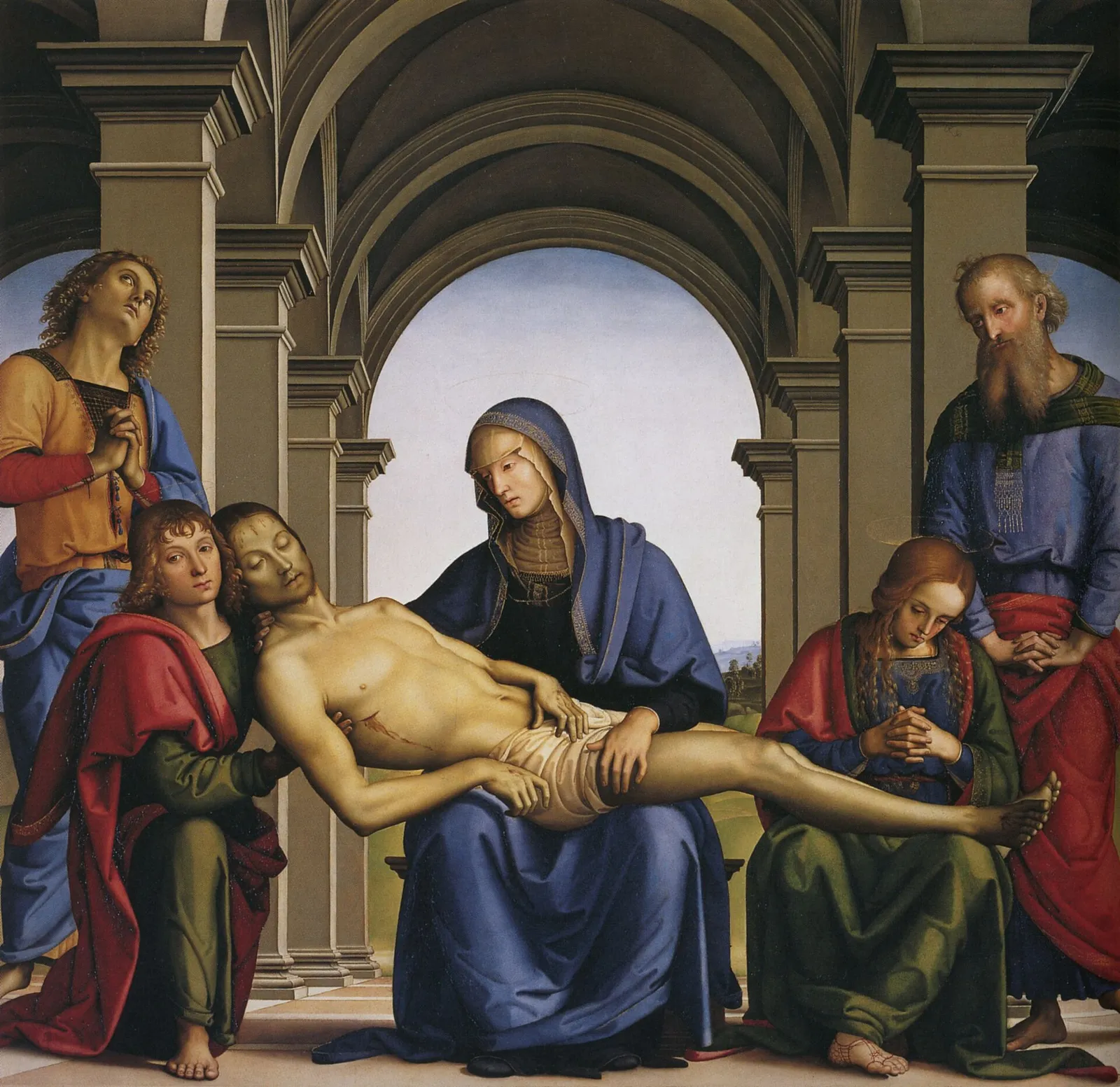
Pietro Perugino's Pietà is held by the Uffizi Gallery. The fact sheet dates it to 1483, and it measures 168 × 176 cm. It presents the mourning over the dead Christ as a quiet, carefully balanced scene rather than a dramatic outburst of grief.
Where to see it
The Pietà by Pietro Perugino is in the collection of the Uffizi Gallery. Paintings can be moved within the building, sent on loan, or taken off view for conservation, so check the Uffizi Gallery's official website for current display status before you visit.
What to look for in person
The architectural setting
Before looking at the figures, notice the space they occupy. Perugino sets the group beneath an arched, open architectural structure, and the receding lines of the building pull your eye toward the center of the panel. Through the openings you can see sky and distant landscape, which keeps the scene from feeling enclosed. Step back a little: from a few metres away the geometry becomes clear, and you can see how the setting acts as a stage that frames and steadies the mourners in front of it.
Christ laid across the Virgin's lap
The body of the dead Christ stretches horizontally across the lap of the seated Virgin Mary, creating a long, calm line through the middle of the picture. Mourners at either end support his head and his feet, so the composition reads almost like a balanced scale. The panel is nearly square, at 168 by 176 cm, and this format suits the wide, level arrangement. Follow the line of the body from one end to the other and notice how the figures around it mirror one another.
Grief shown with restraint
Look closely at the faces and hands. Instead of open weeping or violent gestures, the figures bow their heads, lower their eyes and hold themselves still. This gentle, contemplative mood is characteristic of Perugino, whose figures are often recognised by their soft expressions and graceful tilted heads. Spend a moment with each face in turn. The emotional effect builds slowly, through stillness and repetition, and invites the viewer to pause and reflect rather than react, as a devotional image of this subject was meant to do.
About the painting
A Pietà, from the Italian word for pity or compassion, shows the dead Christ after his removal from the cross, mourned by his mother and his followers. It was among the most familiar devotional subjects in Renaissance Italy. Painters used it to invite viewers to share in the sorrow of the scene and to meditate on Christ's sacrifice. Pietro Perugino was one of the leading painters in central Italy in the late fifteenth century. He was trained in the Florentine artistic world and took part in the fresco decoration of the Sistine Chapel walls in Rome, where his best-known contribution is Christ Giving the Keys to Saint Peter. He is also often described as the teacher of the young Raphael, whose early work shows a clear debt to Perugino's calm figures and orderly compositions. This Pietà shows the qualities for which Perugino became known. The composition is symmetrical and clear, the architecture is drawn with careful perspective, and the emotion is expressed through quiet gestures rather than drama. The fact sheet gives the date as 1483. The panel measures 168 cm high by 176 cm wide, a substantial size that would have made it legible from a distance in a church or chapel setting. When you visit, allow time to view it both from up close, for the faces and hands, and from further back, for the overall geometry. The painting belongs to the Uffizi Gallery, which holds one of the most important collections of Italian Renaissance art.
Key facts
| Artist | Pietro Perugino |
|---|---|
| Date | 1483 |
| Size | 168 × 176 cm |
| Medium | oil paint, panel |
| Collection | Uffizi Gallery |
How to visit: Uffizi Gallery
Florence, Italy · Museum guide
| Opening hours | Tue–Sun 08:15–18:30 (visitors leave by 18:30) |
|---|---|
| Closed | Mondays, 1 January and 25 December. |
| Last entry | Ticket office closes at 17:30. |
| Admission | Regular, bought on the day EUR 25 Regular, bought in advance EUR 29 Regular, entry from 16:00 (from 1 January 2026) EUR 16 Reduced (EU citizens aged 18–25; citizens of Switzerland, Norway, Liechtenstein, Uruguay etc.; ID required) EUR 2 Under 18 free (under 12s must be accompanied) Uffizi + Vasari Corridor EUR 43 on the day / EUR 47 in advance; named ticket, reservation required, non-refundable PassePartout 5 days (Uffizi, Pitti Palace, Boboli) EUR 40 (EUR 58 with Vasari Corridor) Audio guide EUR 6 |
| Free entry | Free for under-18s; disabled visitors plus one companion; tour guides and interpreters, ICOM members, certain journalists, and university teachers/students on the official list. Admission is free on the first Sunday of each month (national museums), when reservations are not possible. |
| Booking | Reservation is not required, except for the Uffizi + Vasari Corridor ticket, which must be reserved. |
Restoration and rearrangement works mean some rooms are temporarily closed and some artworks are not on display. A staff assembly on 11–12 November 2026 may change opening times.
Official ticket page
Official website
View on map
Hours and prices can change. Please check the official website before you go. (Checked on: 2026-11-12)

