Art! Art! Art! › Works
The Swing
 Jean-Honoré Fragonard, 1760s
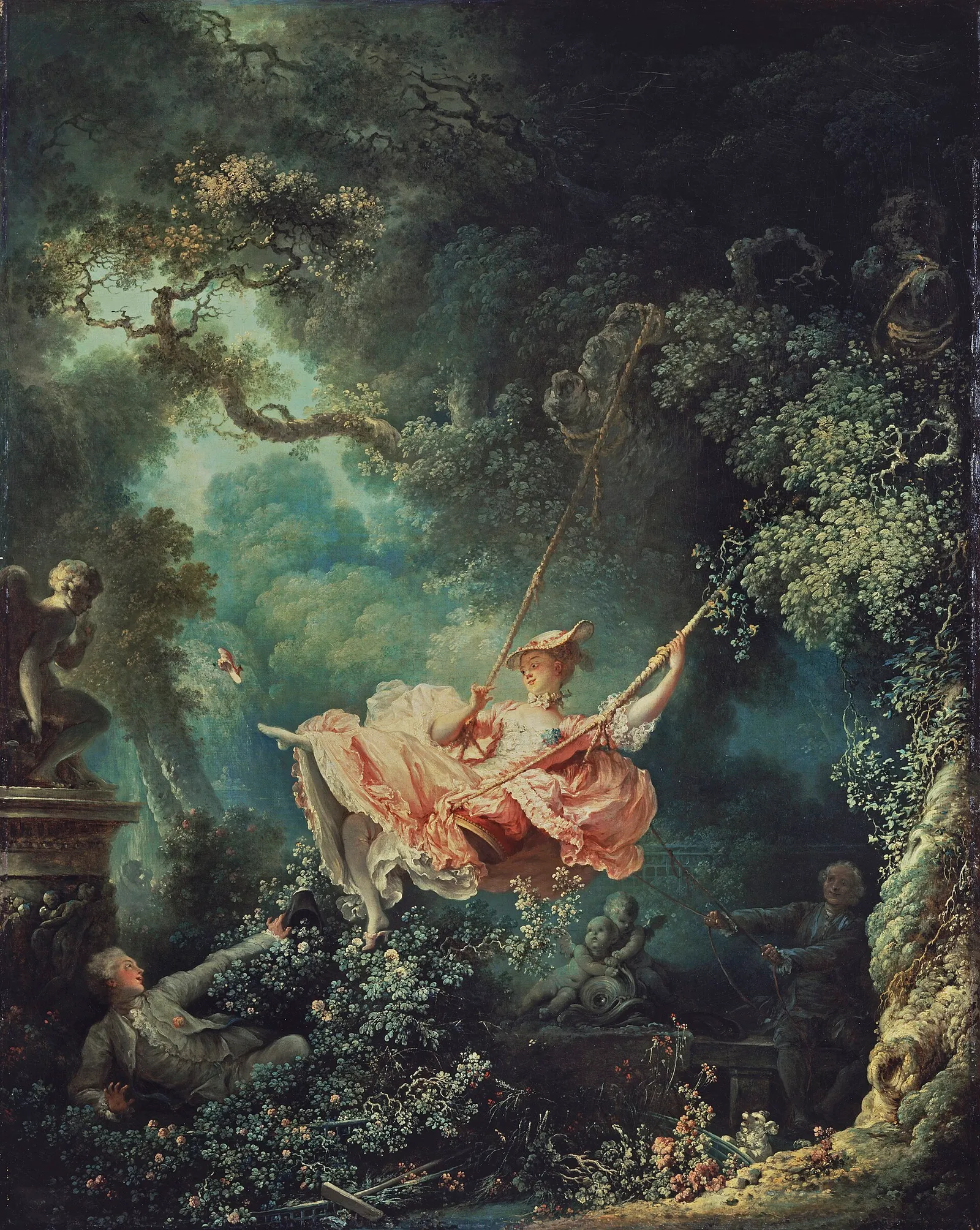
Jean-Honoré Fragonard's The Swing, painted in the 1760s, belongs to the Wallace Collection. It shows a young woman flying through a sunlit garden while a hidden admirer watches from below. At 81 by 64.2 cm, it rewards close, unhurried looking.
Where to see it
The Swing is held by the Wallace Collection, which is also listed as its location. Display arrangements can change, so check the Wallace Collection's official website for current display status, opening hours and visitor information before you go.
What to look for in person
The flying slipper
Start at the centre of the canvas, where a young woman in a frothy pink dress swings upward through a shaft of light. Her leg kicks out, and a small pink slipper has just left her foot, caught in mid-air against the dark foliage. Fragonard makes the slipper seem to pause for an instant, and that suspended moment gives the whole picture its sense of movement. Follow the line of her body and billowing skirts to see how the composition tilts and sweeps diagonally across the scene.
The figures in the shadows
Look down to the lower left. A young man reclines among roses, half hidden by shrubbery, one arm raised toward the swinging woman, his gaze directed up beneath her skirts. On the opposite side, in deeper shade, an older man holds the ropes that set the swing in motion, apparently unaware of the younger admirer. The contrast between the brightly lit woman and these two men in the shadows creates the painting's playful, flirtatious story, which unfolds as your eye moves between them.
Statues and a stage-like garden
Near the hidden young man stands a statue of Cupid raising a finger to his lips, as if asking for secrecy. Close to the swing, sculpted cherubs look on. Around them, the garden is painted with loose, feathery brushwork: towering trees, filtered light and soft greens that dissolve into the distance. Step close to see how freely the leaves, lace and fabric are handled, then step back to see how they combine into a theatrical setting typical of French Rococo painting.
About the painting
The Swing is one of the best-known images associated with French Rococo art, a style that favoured lightness, pastel colour, graceful movement and themes of love and leisure. Fragonard painted it in the 1760s, and the picture is also widely known by a longer French title, Les Hasards heureux de l'escarpolette, often translated as The Happy Accidents of the Swing. That title points to the scene's wit: a seemingly innocent garden pastime becomes an occasion for flirtation and concealed glances.
The canvas measures 81 cm high by 64.2 cm wide, a modest, intimate size. This scale suits the subject, which feels like a private moment glimpsed rather than a public spectacle. Standing in front of it, you can take in the whole composition at once, then move closer to study the details: the ruffles of the dress, the flowers around the reclining young man, and the gestures of the sculpted figures that seem to comment on the action.
Fragonard builds the picture around contrasts. The woman is bathed in light, while the two men sit in shade at either side. The dark, dense trees frame a brighter opening in the centre, drawing the eye straight to the swing and the airborne slipper. The brushwork is quick and fluid, especially in the foliage, giving the garden a soft, almost dreamlike quality.
Today the painting is in the Wallace Collection. For many visitors it sums up the elegance and playfulness of eighteenth-century French painting, and it is worth allowing time to trace the glances and gestures that tie its small cast of characters together.
Key facts
| Artist | Jean-Honoré Fragonard |
|---|---|
| Date | 1760s |
| Size | 81 × 64.2 cm |
| Medium | oil paint, canvas |
| Collection | Wallace Collection |
How to visit: Wallace Collection
London, United Kingdom
Hours and prices can change. Please check the official website before you go.
More by Jean-Honoré Fragonard
 The See-Saw — Thyssen-Bornemisza Museum
 A Young Girl Reading — National Gallery of Art
 The Lock — Louvre Museum