Art! Art! Art! › Works
The See-Saw
 Jean-Honoré Fragonard, 1750s
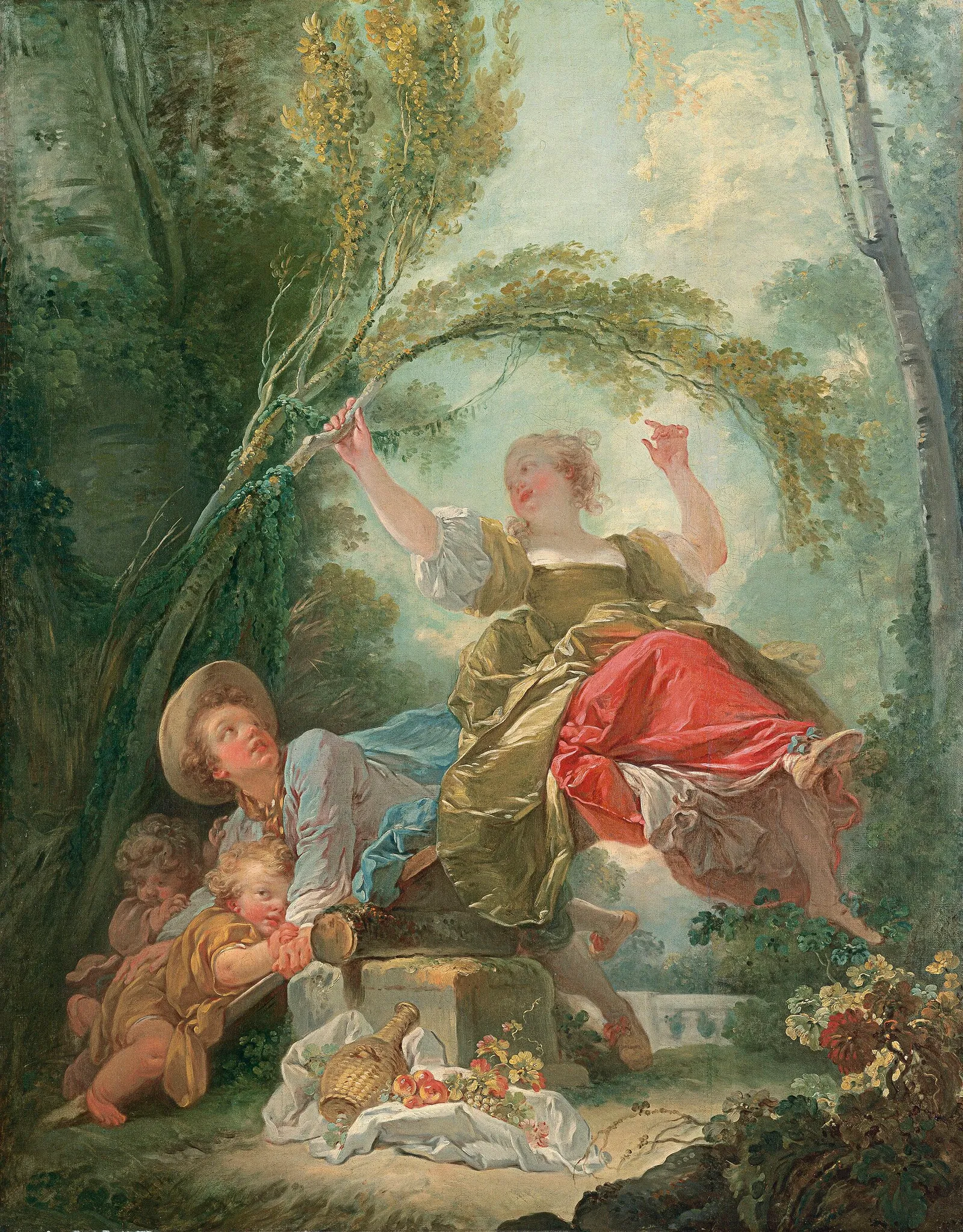
The See-Saw is an early oil on canvas by Jean-Honoré Fragonard, painted in the 1750s, around 1750–1752, before the artist first travelled to Italy. It belongs to the Thyssen-Bornemisza Museum in Madrid, where it is one half of a pair whose partner, Blind Man's Buff, is now in the United States.
Where to see it
The See-Saw is in the collection of the Thyssen-Bornemisza Museum (Museo Nacional Thyssen-Bornemisza) in Madrid, under inventory number 148 (1956.13). Display arrangements can change, so check the museum's official website for current display status before you visit.
What to look for in person
Children at play in a grove
The subject is simple: four children enjoying a seesaw in a wooded clearing. Take a moment to follow how the figures are arranged around the plank and how the trees enclose them, creating a sheltered outdoor stage. This kind of light-hearted outdoor pastime was a favourite theme of eighteenth-century French painting. Rather than looking for a story, look at how the young Fragonard captures movement and balance, with the seesaw itself setting up an up-and-down rhythm across the canvas.
A picture with a missing partner
Fragonard conceived this canvas as one of a matching pair. Its companion, Blind Man's Buff, shows another children's game and now belongs to the Toledo Museum of Art in Ohio. The two travelled together through several French and Rothschild collections before they were split up on the American art market. Standing in Madrid, it helps to imagine the absent pendant beside it: the pair was designed to be seen together, each game answering the other.
An edge that was once higher
Look at the upper part of the composition. When the pair was sold in 1784, the canvases were described as larger than they are now, and one explanation is that they were trimmed along the top between 1784 and 1786. Engravings of the pair by Jacques-Firmin Beauvarlet show more foliage and a wider stretch of sky than the paintings show today. What you see is therefore a slightly tighter view than the one the engraver recorded.
About the painting
Jean-Honoré Fragonard painted The See-Saw early in his career, in about 1750–1752, before his first trip to Italy. The oil on canvas measures 120 x 94 cm and shows four children playing on a seesaw in a wooded setting. It was made as a pendant to Blind Man's Buff, another scene of children's games, which is now in the Toledo Museum of Art.
The pair has a well-documented history of ownership. Both canvases belonged to Baron Saint-Julien in Paris and were sold after his death in 1784 for 500 livres. Two years later they appeared at the posthumous sale of the collector Morel, where the dealer Joubert bought them for 852 livres. They then passed to Count Sinéty, and later to Baron Nathaniel de Rothschild in Vienna and Baron Maurice de Rothschild in Pregny. Eventually the two paintings were separated on the art market in the United States.
The records of the 1784 sale describe the canvases as larger than they are today. A likely explanation is that they were reduced along the top edge between the Saint-Julien and Morel sales. Engravings by Jacques-Firmin Beauvarlet support the idea of a fuller original composition, since they show more leaves and more sky than the paintings now do.
Baron Hans Heinrich Thyssen-Bornemisza bought The See-Saw in 1956 for the Villa Favorita, and the painting has appeared in the collection's catalogues since Rudolf Heinemann's edition of 1958. It is now part of the Thyssen-Bornemisza Museum in Madrid.
Key facts
| Artist | Jean-Honoré Fragonard |
|---|---|
| Date | 1750s |
| Size | 120 × 94 cm |
| Medium | oil paint, canvas |
| Collection | Thyssen-Bornemisza Museum |
How to visit: Thyssen-Bornemisza Museum
Madrid, Spain · Museum guide
| Opening hours | Mon 12:00–16:00 (1 Sep–30 Jun, collection only, free) Tue, Wed, Thu, Fri, Sun 10:00–19:00 (1 Sep–30 Jun) Sat 10:00–23:00 (all year; 21:00–23:00 free for temporary exhibitions on level -1 and ground floor) Mon 12:00–16:00 (1 Jul–31 Aug, collection only, free) Tue–Fri 10:00–21:00 (1 Jul–31 Aug) Sun 10:00–19:00 (1 Jul–31 Aug) 24 and 31 December 10:00–15:00 (special hours) |
|---|---|
| Closed | Closed 1 January, 1 May and 25 December. Temporary exhibition hours vary (e.g. “The Freudian Universe of Dalí” is closed on Mondays). |
| Last entry | 30 minutes before closing |
| Admission | General EUR 14 (Permanent Collection, Carmen Thyssen Collection and current temporary exhibitions) Over 65s and pensioners EUR 10 (proof required) Students EUR 10 Groups (7 or more) EUR 12 per person Under 18s, unemployed, disability of 33% or more, Friends of the Museum: free Audio guide: ticket price + EUR 5.5 Paseo del Arte Pass (Thyssen + Prado + Reina Sofía) EUR 32.8 (one visit to each within 1 year) |
| Free entry | Free entry to the collection on Mondays 12:00–16:00, and to the temporary exhibitions on level -1 and the ground floor on Saturdays 21:00–23:00; no ticket required for either. “Soy de la Mutua” card holders can get up to two free same-day tickets at the ticket office. |
| Booking | No reservation is required and there is no timed entry. |
Official ticket page
Official website
View on map
Hours and prices can change. Please check the official website before you go. (Checked on: 2026-11-09)


