Art! Art! Art! › Works
The Lock
 Jean-Honoré Fragonard, 1770s
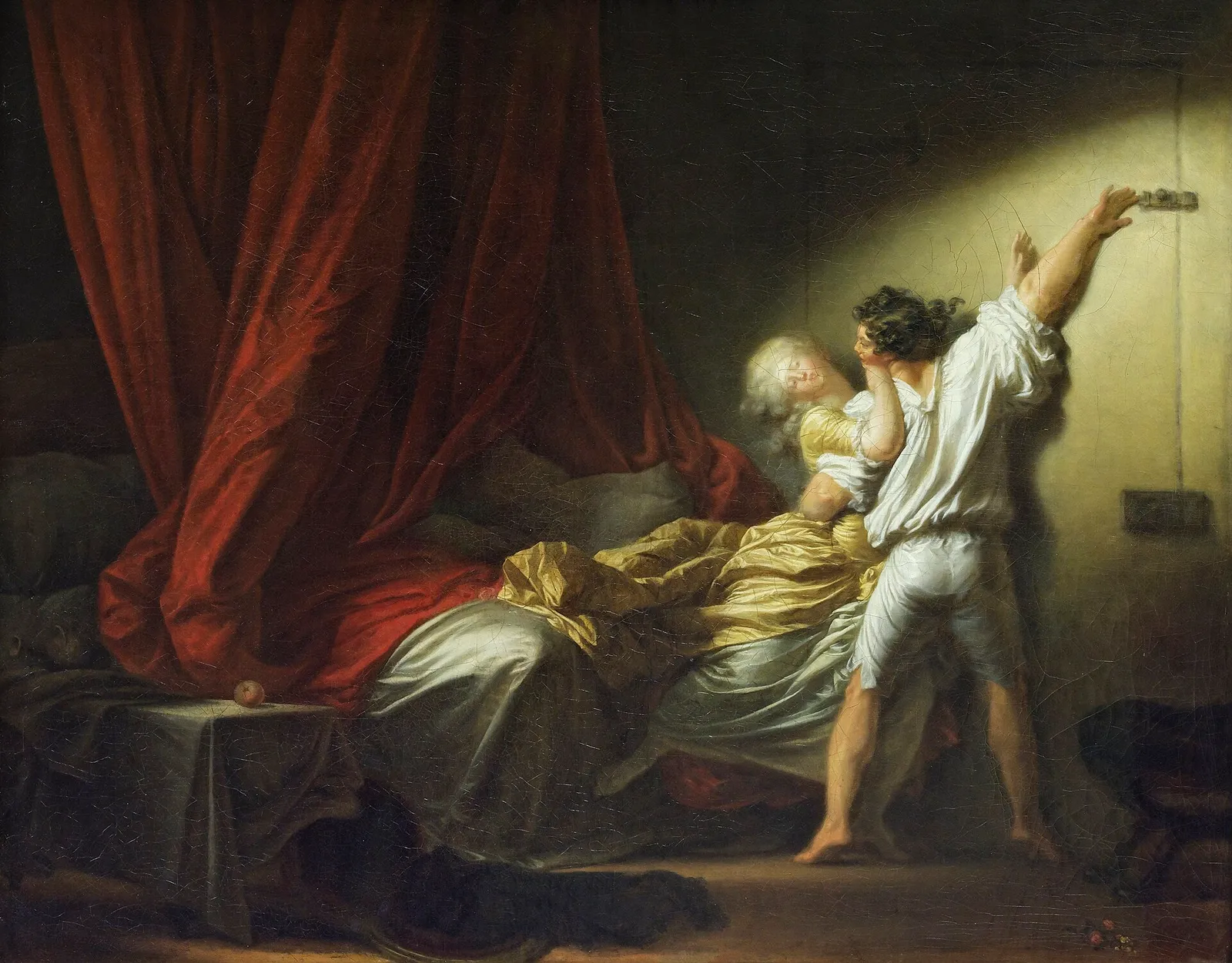
The Lock is a painting by Jean-Honoré Fragonard from the 1770s, held by the Department of Paintings of the Louvre Museum. It shows a couple in a dim bedroom at the moment a man reaches to slide the bolt on the door, a compact drama of movement, light and suggestion.
Where to see it
The Lock belongs to the Department of Paintings of the Louvre and is held at the Louvre Museum. Display arrangements at large museums can change because of rehangs, conservation work or loans, so check the Louvre's official website for the painting's current display status before you visit. At 73.5 cm high and 93.5 cm wide, it is a moderately sized, horizontal picture that rewards a close look, so allow time to step in and study the details as well as the overall scene.
What to look for in person
Follow the diagonal to the bolt
The composition is driven by a strong diagonal that runs from the man's outstretched arm, raised toward the bolt on the door, down across the two leaning figures. Trace that line with your eye and notice how it makes the couple seem caught mid-movement rather than posed. The bolt itself is a small detail near the edge of the picture, yet the title sends you straight to it. Stand back first to take in the full sweep of the gesture, then move closer to find the hand on the lock.
Red drapery and theatrical light
A large part of the canvas is given over to the bed and its heavy, rumpled red drapery, which takes up almost as much space as the figures. Look at how the light picks out the couple, especially the pale, shimmering fabric of the woman's dress, while much of the room falls into shadow. This contrast between brightly lit figures and a darker setting gives the scene a stage-like quality, as if a curtain has just been drawn back on a single dramatic moment.
Clues in the still-life details
Once you have taken in the figures, lower your gaze and look around the room. An apple rests on a table, a piece of furniture lies overturned, and flowers have fallen to the floor. These small objects suggest disorder and haste, and the apple is often read as a traditional allusion to temptation. They are easy to miss at first, but they add to the story the painting tells without words. Take a moment with each before returning to the central pair.
About the painting
Jean-Honoré Fragonard was a French painter closely associated with the Rococo, the light, decorative style that flourished in eighteenth-century France. He is best known for gallant and amorous subjects, often painted with quick, fluid brushwork. The Lock, dated to the 1770s, shows a related theme but in a noticeably different manner. Compared with many of his sketch-like works, its surfaces are smoother and more carefully finished, and its lighting is more dramatic, with strong contrasts between the illuminated figures and the shadowed room.
The subject is intimate and deliberately ambiguous. A man holds a woman close with one arm while reaching with the other to lock the door. Her pose, leaning away from him, has been read in different ways, and the question of how the viewer should interpret the moment has long been part of the discussion around the painting. Rather than settling the matter, Fragonard concentrates on tension: the pull of the bodies, the reach toward the bolt, and the scattered objects that hint at what came just before.
The canvas measures 73.5 by 93.5 centimetres, a horizontal format that allows the bed and drapery to spread across the left side while the action unfolds at the right. Its moderate size means the details reward close viewing, from the folds of fabric to the small still-life elements on the table and floor.
Today the work belongs to the Department of Paintings of the Louvre. Visitors who know Fragonard through his lighter scenes will find here a more concentrated and darker side of his art.
Key facts
| Artist | Jean-Honoré Fragonard |
|---|---|
| Date | 1770s |
| Size | 73.5 × 93.5 cm |
| Medium | oil paint, canvas |
| Collection | Department of Paintings of the Louvre |
| Gallery | Room 929, Sully wing, level 2 Checked in the museum's open data on 2026-11-12 (galleries can change) Source |
How to visit: Louvre Museum
Paris, France · Museum guide
| Opening hours | Mon, Thu, Sat, Sun 09:00–18:00 Wed, Fri 09:00–21:00 (evening opening) Rooms are cleared 30 minutes before closing |
|---|---|
| Closed | Every Tuesday; 1 January, 1 May and 25 December. Other public holidays are open unless they fall on a Tuesday. |
| Last entry | 1 hour before closing |
| Admission | Adult (non-EEA visitors) EUR 32 Adult (EEA citizens and residents) EUR 22 Under 18 free (ID required) EEA citizens/residents under 26 free (photo ID; residents also need a residence permit of over 90 days) Audio guide rental EUR 6 (can be booked in advance online) Rates apply from 14 January 2026 |
| Free entry | Free for under-18s, EEA citizens/residents under 26, all visitors on the first Friday of the month after 18:00 (except July and August) and on 14 July, and disabled visitors plus one carer. Also free with proof for EEA art and art-history teachers, ICOM members, journalists, EEA job seekers and EEA residents on income support. |
| Booking | Entry is by timed slot, and booking in advance is recommended. |
The Cour Carrée entrance is currently closed. On Thursday 12 November 2026 the museum may open later and some exhibition rooms may remain closed.
Official ticket page
Official website
View on map
Hours and prices can change. Please check the official website before you go. (Checked on: 2026-11-11)


