Art! Art! Art! › Works
The Gleaners
 Jean-François Millet, 1857
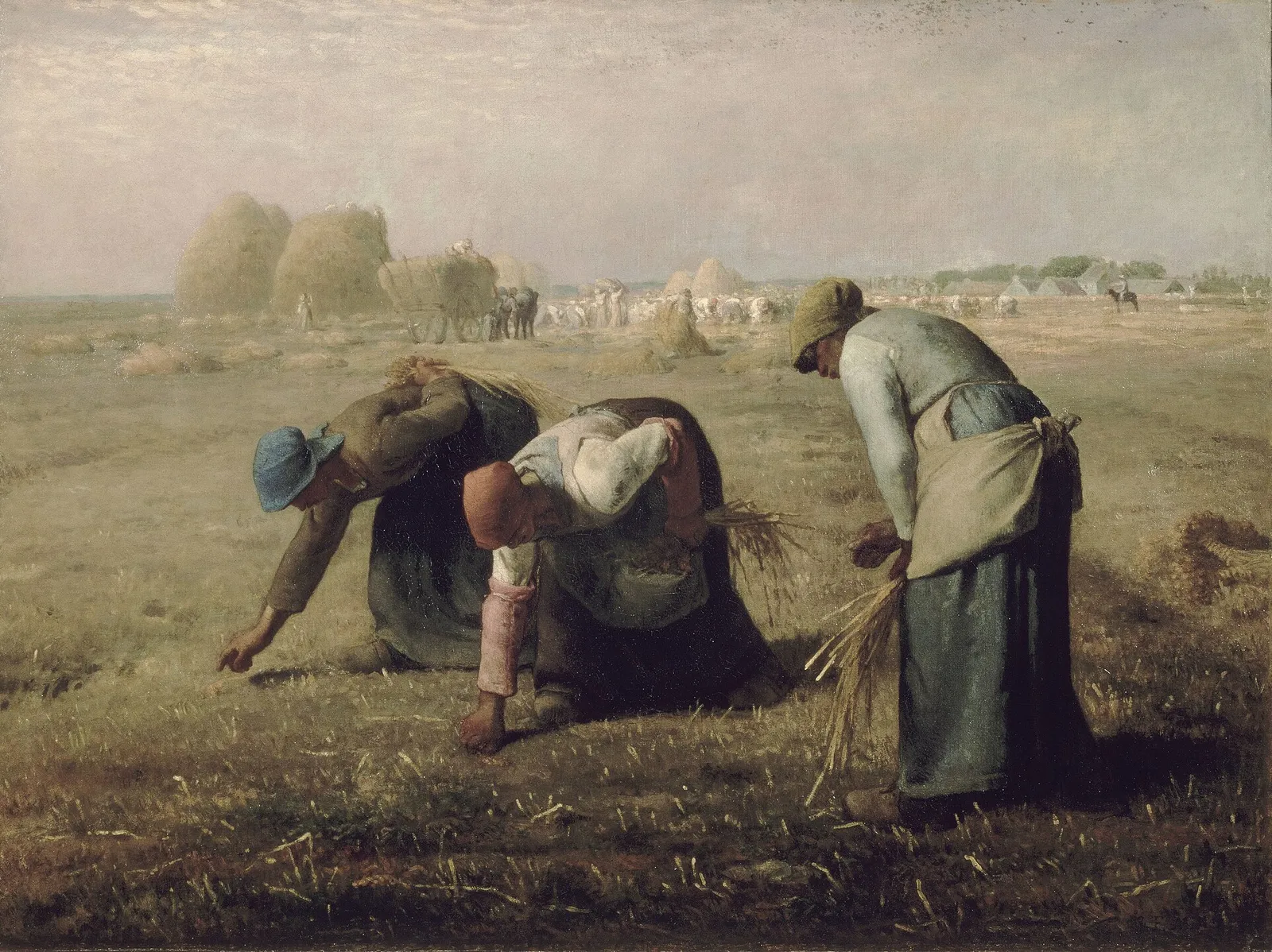
The Gleaners is an 1857 oil painting by Jean-François Millet in the collection of the Musée d'Orsay. It shows three peasant women gathering the stray wheat stalks left in a field after the harvest, set against a wide rural landscape. Standing in front of it, you can follow Millet's contrast between the women's slow labor and the busy harvest in the distance.
Where to see it
The Gleaners belongs to the collection of the Musée d'Orsay, which is also its recorded location. The canvas measures 83.5 cm high by 110 cm wide. Displays can change, so check the Musée d'Orsay's official website for current display status, opening hours and ticket information before you plan your visit.
What to look for in person
The three gleaners in the foreground
Start with the foreground, where three peasant women work across a field that has already been harvested. They are gleaning: picking up the stray wheat stalks left behind once the main crop has been cut and carried away. Notice how Millet gives these figures weight and solidity, placing them close to the viewer so that their repeated, stooping labor becomes the true subject of the picture rather than a small detail within a wider landscape. Take a moment to compare the three figures with one another.
The harvest in the distance
Let your eye travel into the distance. There, harvest workers are stacking grain, and a man on horseback oversees the work. This busy activity sits far behind the gleaners, and the space between the two zones is worth pausing on: the plenty of the harvest in the background, and the women in front collecting only what remains. Many viewers find that this contrast, rather than any single figure, is what gives the scene its quiet force and its social edge.
Sky, birds and the scene's first reception
Look up toward the upper right, where a flock of birds crosses the sky above the field. The open sky and the broad, flat stretch of stubble set the mood of a farm landscape at Chailly, on the edge of the forest of Fontainebleau. When the picture was shown in 1857, the critic Paul de Saint-Victor compared the three women to the Fates of classical myth, recast as figures of poverty. His remark is a reminder that the painting's first audience read pointed meaning into its calm surface.
About the painting
Millet completed The Gleaners, an oil on canvas, in 1857 and exhibited it at the Paris Salon that same year. The composition did not appear out of nowhere: he had already explored the motif in a vertical painted version in 1854 and in an etching in 1855, before settling on the wide horizontal format seen today. The setting is a farm at Chailly, near the forest of Fontainebleau, an area closely tied to Millet's work. The painting did not come easily. In a letter to his friend Alfred Sensier, written while he was working on it in 1856 and 1857, Millet confided that on some days the picture seemed to him to mean nothing at all. At the Salon it drew comment from critics, including Paul de Saint-Victor, who saw in the three women a grim allegory of poverty. After the exhibition the painting was sold to a buyer named Binder. Decades later, in 1889, it belonged to the banker Ferdinand Bischoffsheim, who sold it for 300,000 francs to the champagne producer Jeanne-Alexandrine Louise Pommery. She acquired it with the intention of giving it to the Louvre, and her gift was accepted by the curators' committee on 30 January 1890. From 8 May 1890 the painting was shown in the Louvre's Salle des États. In 1986 it was assigned to the Musée d'Orsay, where it remains part of the collection.
Key facts
| Artist | Jean-François Millet |
|---|---|
| Date | 1857 |
| Size | 83.5 × 110 cm |
| Medium | oil paint, canvas |
| Collection | Musée d'Orsay |
How to visit: Musée d'Orsay
Paris, France · Museum guide
| Opening hours | Tue–Wed, Fri–Sun 09:30–18:00 (galleries close at 17:30) Thu 09:30–21:45 (late opening; galleries close at 21:15) |
|---|---|
| Closed | Every Monday, 1 May and 25 December. |
| Last entry | 17:00 (exhibitions 17:15); Thursdays 21:00 |
| Admission | Full rate, online EUR 16 Full rate, at the museum EUR 14 Reduced rate (on site only) EUR 11 Enfant & Cie, online EUR 13 Enfant & Cie, at the museum EUR 11 Night rate (Thursday), online EUR 12 Night rate (Thursday), at the museum EUR 10 Under 18s; EEA residents under 26 free |
| Free entry | Free for under 18s and residents of the European Economic Area under 26. Free on the first Sunday of the month, with booking required. |
| Booking | Booking is strongly recommended. Entry is by timed slot. |
The museum stays open and all collections and exhibitions remain accessible, but entrances have changed: timed-ticket holders use Entrance 1 (Quay); priority visitors, reseller voucher holders, visitors without tickets and groups use Entrance 2 (Forecourt). Arrive at least 15 minutes before your time slot.
Official ticket page
Official website
View on map
Hours and prices can change. Please check the official website before you go. (Checked on: 2026-11-11)
More by Jean-François Millet


Sources
- Wikidata Q1368055
- Wikipedia (en) (CC BY-SA 4.0)
- Wikipedia (ja) (CC BY-SA 4.0)
- Wikipedia (it) (CC BY-SA 4.0)
- Wikipedia (fr) (CC BY-SA 4.0)
- billetterie.musee-orsay.fr
- www.musee-orsay.fr