Art! Art! Art! › Works
Shepherdess with her Flock
 Jean-François Millet, 1863
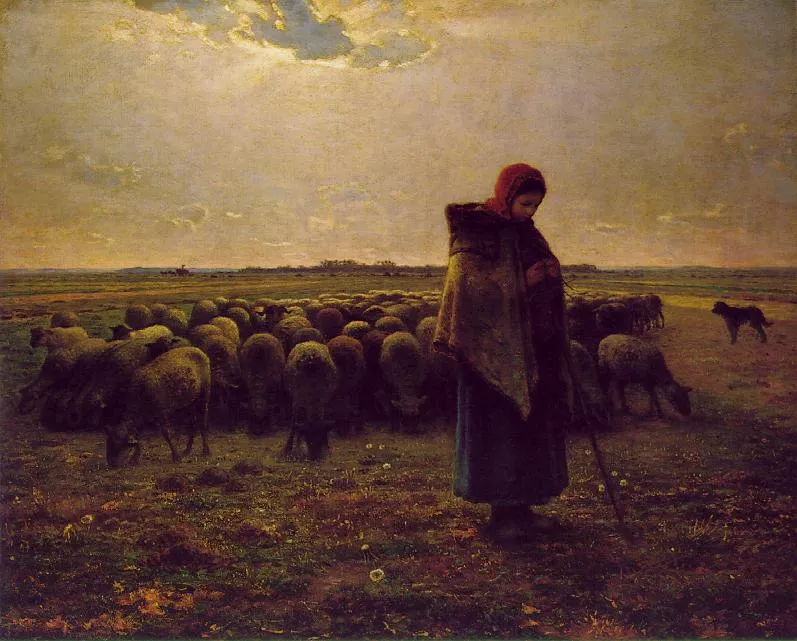
Jean-François Millet's Shepherdess with her Flock, painted in 1863, is in the collection of the Musée d'Orsay. The canvas shows a young shepherdess absorbed in her work while her sheep graze across an open plain, a quiet scene of rural labour typical of Millet's mature art.
Where to see it
Shepherdess with her Flock is held by the Musée d'Orsay, and the fact sheet gives its location as the Musée d'Orsay. Works in large collections can be moved, rehung, lent or temporarily taken off view, so check the Musée d'Orsay's official website for current display status before you visit. The painting measures 81 × 101 cm, a horizontal format you can take in comfortably from a few steps back before moving closer to study the figure.
What to look for in person
A figure absorbed in her task
Start with the shepherdess herself. She does not pose for the viewer or meet our gaze. Her head is lowered and her attention is on the work in her hands, so the mood is one of concentration rather than display. Millet often painted rural workers this way, caught in the middle of an ordinary task. Notice how the simplified shapes of her clothing give her a solid, almost sculptural presence, and how her stillness contrasts with the loosely scattered flock behind her.
The open plain and the flock
Step back and look at the setting. Behind the shepherdess the flat land runs into the distance, and her sheep spread out across it as they graze. The landscape carries few incidents or landmarks, which is part of its effect: the emptiness of the plain makes the single standing figure stand out clearly against it. Follow the line of the flock across the canvas and notice how it leads your eye from the foreground figure into the depth of the scene.
Muted colour and simplified form
Move closer to look at the paint. Millet works largely in restrained earth tones, avoiding bright, decorative colour, and he reduces forms to broad masses instead of fine detail. This restraint suits his subject: the scene feels calm and unhurried rather than picturesque. Compare the treatment of the figure with that of the sheep and the ground around them, and look at how light falls across the field. At 81 × 101 cm the canvas is large enough to reward both a distant and a close look.
About the painting
Jean-François Millet is best known for his paintings of French peasant life, and he is closely associated with the village of Barbizon on the edge of the Forest of Fontainebleau, where he settled around the middle of the nineteenth century. Alongside the landscape painters of the so-called Barbizon school, he turned away from historical and mythological subjects and looked instead at the countryside and the people who worked it. Shepherdess with her Flock, dated 1863, belongs to his mature period, after works such as The Gleaners had already made rural labour the central theme of his art. What distinguishes Millet's approach is his seriousness. He does not present peasants as quaint figures in a charming landscape, nor does he dramatise them. Instead he gives ordinary work a quiet dignity through simple compositions, solid figures and a sober palette. In this painting, a lone young shepherdess stands in the foreground, occupied with her task, while her flock grazes on the plain behind her. The scene has no narrative event; its interest lies in mood, balance and the relationship between the figure and the land. For visitors, the painting offers a good introduction to Millet's way of seeing. Look at how much he leaves out, how the figure is set against the open landscape, and how the restrained colour supports the calm atmosphere. The work is in the collection of the Musée d'Orsay, and its moderate size, 81 by 101 centimetres, makes it an image to approach slowly rather than one that overwhelms at first sight.
Key facts
| Artist | Jean-François Millet |
|---|---|
| Date | 1863 |
| Size | 81 × 101 cm |
| Medium | oil paint, canvas |
| Collection | Musée d'Orsay |
How to visit: Musée d'Orsay
Paris, France · Museum guide
| Opening hours | Tue–Wed, Fri–Sun 09:30–18:00 (galleries close at 17:30) Thu 09:30–21:45 (late opening; galleries close at 21:15) |
|---|---|
| Closed | Every Monday, 1 May and 25 December. |
| Last entry | 17:00 (exhibitions 17:15); Thursdays 21:00 |
| Admission | Full rate, online EUR 16 Full rate, at the museum EUR 14 Reduced rate (on site only) EUR 11 Enfant & Cie, online EUR 13 Enfant & Cie, at the museum EUR 11 Night rate (Thursday), online EUR 12 Night rate (Thursday), at the museum EUR 10 Under 18s; EEA residents under 26 free |
| Free entry | Free for under 18s and residents of the European Economic Area under 26. Free on the first Sunday of the month, with booking required. |
| Booking | Booking is strongly recommended. Entry is by timed slot. |
The museum stays open and all collections and exhibitions remain accessible, but entrances have changed: timed-ticket holders use Entrance 1 (Quay); priority visitors, reseller voucher holders, visitors without tickets and groups use Entrance 2 (Forecourt). Arrive at least 15 minutes before your time slot.
Official ticket page
Official website
View on map
Hours and prices can change. Please check the official website before you go. (Checked on: 2026-11-11)

