Art! Art! Art! › Works
The Blind Girl
 John Everett Millais, 1856
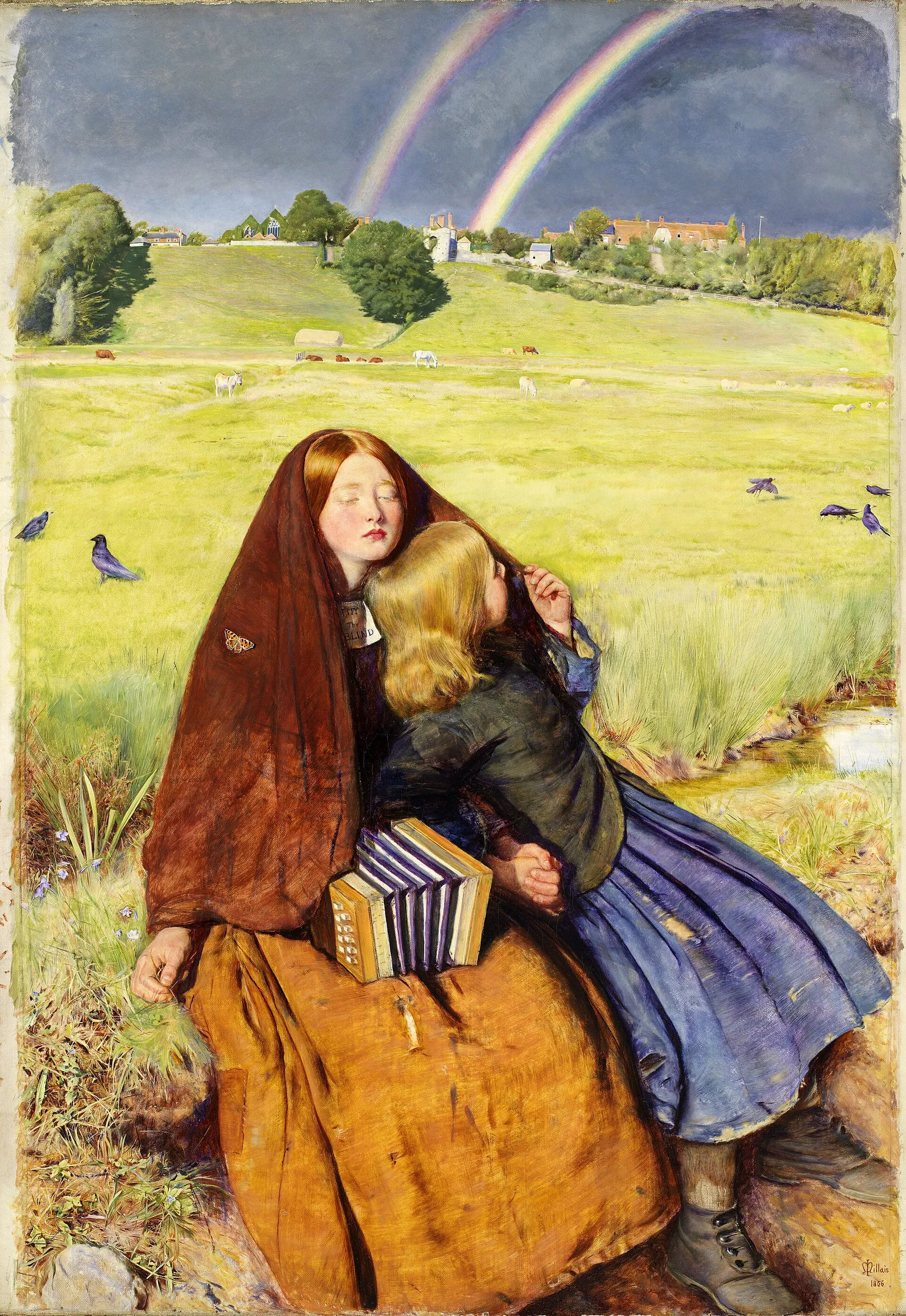
The Blind Girl, painted by John Everett Millais in 1856, shows two travelling girls resting by a roadside after a storm while a double rainbow fills the sky behind them. The painting is held by Birmingham Museums Trust and belongs to Birmingham Museum and Art Gallery. At 82.6 by 62.2 cm, it rewards close, unhurried looking.
Where to see it
The Blind Girl is in the collection of Birmingham Museums Trust and is associated with Birmingham Museum and Art Gallery in Birmingham, England. Works can be moved, lent or taken off view for conservation, so please check the museum's official website for the painting's current display status before you plan your visit.
What to look for in person
The rainbow she cannot see
Start with the contrast at the heart of the picture. The younger girl twists round to gaze at the double rainbow arching across the dark storm clouds, while the older girl faces forward with her eyes closed, unaware of it. Millais places the most vivid colour in the scene directly behind the one figure who cannot see it. Step back to take in how the bright bands stand out against the heavy sky, then move closer to compare the two faces: one turned towards the view, the other turned up to feel the light.
A world experienced by touch and sound
Look at the blind girl's hands. One rests on the grass beside her, as if feeling the damp blades, while the other holds the hand of her younger companion. A concertina lies in her lap, suggesting she earns a living as a travelling musician, and a small sign hangs at her neck asking passers-by to pity the blind. These details tell you about her hard circumstances without drama. Notice too her calm expression: Millais presents her sensing the warmth and stillness after the rain rather than simply as an object of sympathy.
Pre-Raphaelite close detail
Millais was a founder of the Pre-Raphaelite Brotherhood, and the painting shows the group's commitment to precise observation of nature. Look for the butterfly resting on the blind girl's shawl, another sight she cannot share. Study the grass and wild flowers in the foreground, painted blade by blade, and the meadow and buildings stretching into the distance, lit by sunshine breaking through after the storm. The fine detail works best viewed up close, while the colour contrasts of sky, rainbow and field read most clearly from a few steps back.
About the painting
John Everett Millais painted The Blind Girl in 1856, when he was one of the best-known members of the Pre-Raphaelite Brotherhood, the group of young artists founded in 1848 who rejected academic convention in favour of bright colour, sharp detail and direct study from nature. The canvas measures 82.6 by 62.2 cm, a moderate size that draws the viewer close to its carefully worked surface.
The subject is simple: two poor girls, apparently wandering musicians, sit at the edge of a road after a rain shower. The older girl is blind; the younger looks back at the double rainbow that has appeared over the landscape. From this everyday moment Millais builds a meditation on perception. The viewer, like the younger child, can see the glowing sky, the butterfly on the shawl and the sunlit meadow, while the central figure knows the scene only through touch, sound and the warmth of the sun on her face.
Many viewers have read the rainbow, a traditional symbol of hope and promise, as giving the painting a quietly religious or consoling tone, while the begging sign and worn clothing ground it in the real poverty of Victorian rural life. Millais avoids heavy sentiment by giving the blind girl dignity and composure.
The painting is part of the collection of Birmingham Museums Trust and is associated with Birmingham Museum and Art Gallery, which holds a significant body of Pre-Raphaelite art. Seeing it in person lets you appreciate the intensity of the colour and the fine detail of the grasses and sky, qualities that reproductions often flatten.
Key facts
| Artist | John Everett Millais |
|---|---|
| Date | 1856 |
| Size | 82.6 × 62.2 cm |
| Medium | oil paint, canvas |
| Collection | Birmingham Museums Trust |
How to visit: Birmingham Museums Trust
Birmingham, United Kingdom
Hours and prices can change. Please check the official website before you go.
More by John Everett Millais
 Ophelia — Tate Britain
 The Black Brunswicker
 Autumn Leaves
 The Return of the Dove to the Ark
 Christ in the House of His Parents — Tate Britain