Art! Art! Art! › Works
Christ in the House of His Parents
 John Everett Millais, 1849
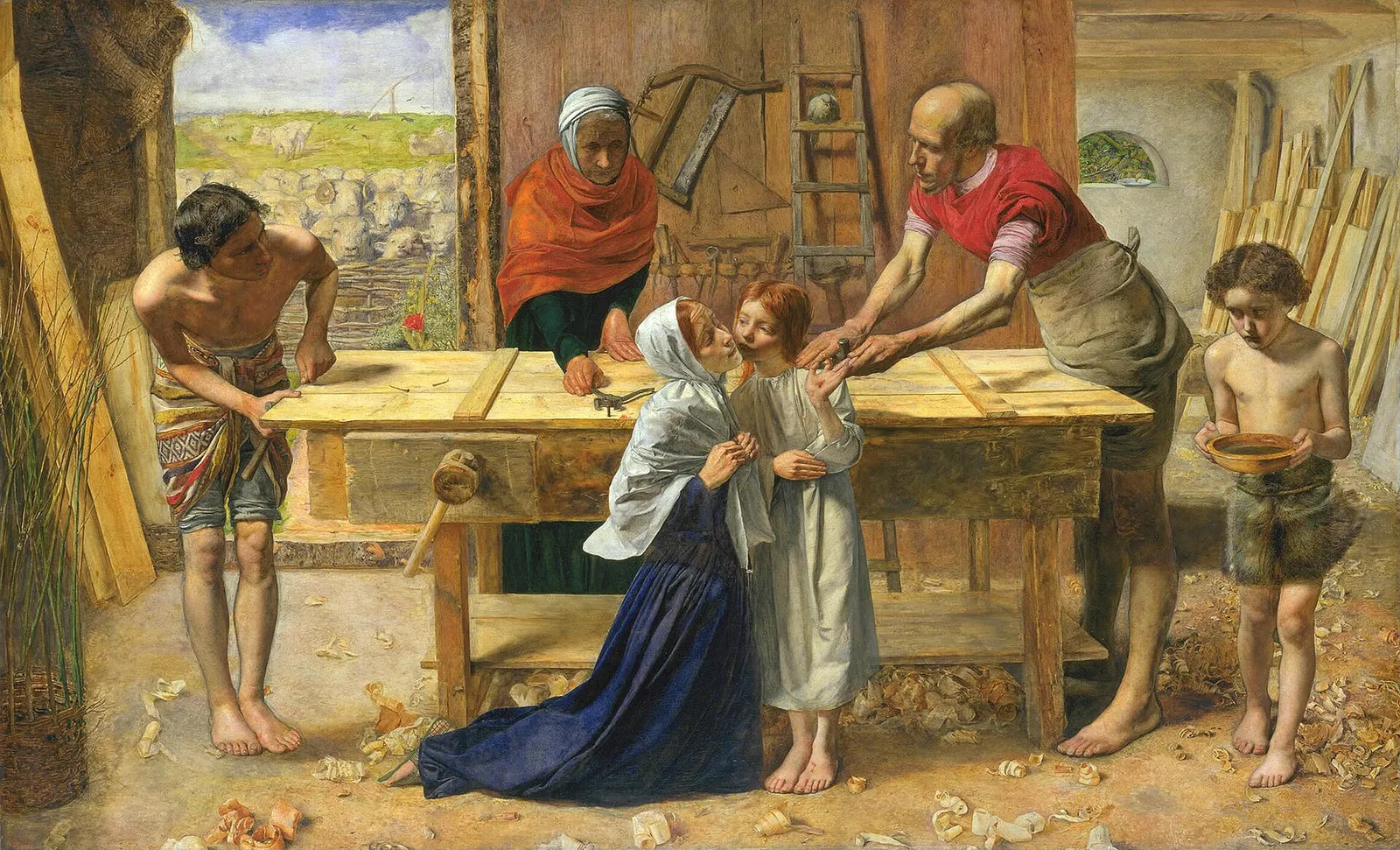
John Everett Millais's Christ in the House of His Parents, dated 1849, imagines the young Jesus in Joseph's carpenter's workshop as an ordinary, crowded working space. The painting is in the Tate collection and is located at Tate Britain. It is an early Pre-Raphaelite work, and its domestic scene is full of symbols that reward slow looking.
Where to see it
The painting is held by Tate and is located at Tate Britain. Its collection record also lists the National Gallery. Display arrangements can change, so check Tate's official website for current display status before you visit. The canvas measures 86.4 x 139.7 cm, a wide, moderate-sized picture. Step close to see the small details, then step back to read the whole frieze-like group of figures.
What to look for in person
The wounded hand
Start at the centre. The boy Jesus holds up his palm, cut on a nail, and a drop of blood has fallen onto his foot. Mary kneels to comfort him and offers her cheek for a kiss, while Joseph examines the injured hand. Look at how plainly the moment is staged: a child's workshop accident. The placement of the wounds on palm and foot is generally read as a foreshadowing of the Crucifixion, so an everyday mishap carries the story of the Passion.
Symbols hidden in the workshop
Scan the background and edges for objects that carry meaning. A dove perches on the ladder at the back, commonly read as the Holy Spirit. Through the opening, a flock of sheep presses against a pen, an image linked to Christ as the Good Shepherd and to his followers. On the right, the young John the Baptist carefully carries a bowl of water, pointing to his later role as baptiser. Tools hanging on the wall, including a triangle, are often read as a reference to the Trinity.
Unidealised detail
Notice the floor covered in wood shavings, the worn workbench, the bare feet, and the sinewy arms and dirty toenails of the figures. Millais painted these with sharp, even focus from edge to edge, a hallmark of the early Pre-Raphaelite approach of close observation over idealised beauty. Rather than an elegant holy family, you see working people in a real trade. Compare the crisp textures of wood, cloth and skin, and consider how this realism changes the feeling of a familiar religious subject.
About the painting
Millais was one of the founders of the Pre-Raphaelite Brotherhood, a group of young artists who rejected what they saw as the stale conventions of academic painting and looked instead to the clarity and sincerity of art before Raphael. Christ in the House of His Parents, dated 1849, belongs to this early, combative phase of the movement. The subject is not taken from a specific Gospel episode. Instead, Millais invented a scene from Jesus's childhood in Joseph's carpenter's shop and loaded it with symbolic foreshadowing. The central figures are Jesus, Mary and Joseph, with an older woman reaching towards the nail, generally identified as Mary's mother, Anne. The young John the Baptist approaches with water, and an assistant works at the bench. When it was first exhibited, the painting drew strong criticism. Many viewers found it shocking to see the Holy Family shown as ordinary, unglamorous working people in a cluttered workshop. The novelist Charles Dickens published a well-known hostile attack on it. The painting is also often called The Carpenter's Shop. Today it is valued as a key early statement of Pre-Raphaelite aims: intense detail, bright, even lighting, and a serious rethinking of how religious stories could be painted. For visitors, the pleasure lies in decoding the picture. Each object, from the nail to the sheep, can be read on two levels, as everyday workshop life and as a pointer to Christ's future. Give yourself time to move from the central group outward and find each sign.
Key facts
| Artist | John Everett Millais |
|---|---|
| Date | 1849 |
| Size | 86.4 × 139.7 cm |
| Medium | oil paint, canvas |
| Collection | Tate / National Gallery |
How to visit: Tate Britain
London, United Kingdom · Museum guide
| Opening hours | Mon–Sun 10:00–18:00 (galleries start closing at 17:50) |
|---|---|
| Closed | 24–26 December (all Tate galleries, festive period). |
| Last entry | 17:30 |
| Admission | Collection (everyone): free, no booking needed Tate Collective (16–25) exhibition ticket: GBP 5 (free Tate Collective sign-up required) Family child ticket, ages 12–18 (exhibitions): GBP 5 Children 11 and under (exhibitions): free (up to four per parent/guardian) |
| Free entry | The collection is free for everyone. Exhibitions are free for Members, and some exhibitions are free for all (listed as FREE). Disabled visitors pay a concessionary rate; companions go free. |
| Booking | No reservation is required and there is no timed entry. |
The Millbank entrance is closed until 2027 for construction of the Clore Garden; use the Manton Entrance on Atterbury Street.
Official ticket page
Official website
View on map
Hours and prices can change. Please check the official website before you go. (Checked on: 2026-11-09)
More by John Everett Millais
 Ophelia — Tate Britain
 The Black Brunswicker
 Autumn Leaves
 The Return of the Dove to the Ark
 The Blind Girl