Art! Art! Art! › Works
Ophelia
 John Everett Millais, 1851
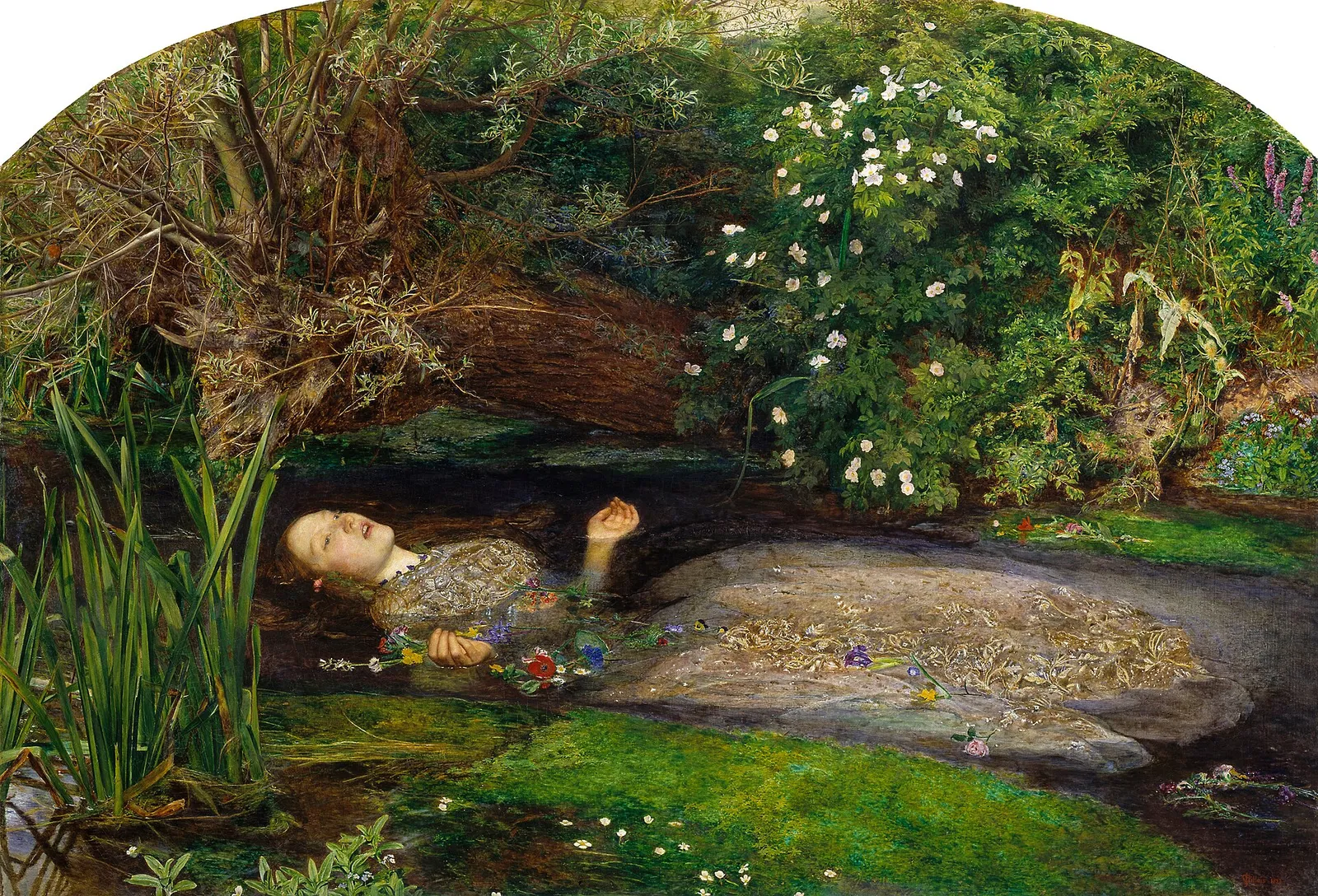
John Everett Millais's Ophelia shows Shakespeare's tragic heroine drifting in a river, still singing, moments before she drowns. The painting is held by Tate and is located at Tate Britain in London, where visitors can study its densely observed riverbank up close.
Where to see it
Ophelia is in the collection of Tate and is located at Tate Britain in London. Display arrangements and loans can change, so check Tate's official website for the painting's current display status before you visit.
What to look for in person
A riverbank painted from life
Look first at the vegetation rather than the figure. Millais worked on the landscape outdoors beside the Hogsmill River in Surrey, near Tolworth, spending roughly five months there in 1851. The result is a bank of leaves, reeds, branches and flowers rendered with close, patient attention. Step near the canvas and you can follow individual stems and the play of light on the water's surface. This direct study of nature, carried out on the spot, is a hallmark of the Pre-Raphaelite approach Millais was associated with.
The figure added afterwards
Millais painted the setting before he painted Ophelia herself, and once you know this you may notice how the figure sits within an already finished world. The model was Elizabeth Siddal, who posed in Millais's London studio at 7 Gower Street, lying fully dressed in a bath of water. Lamps placed beneath the tub were meant to keep the water warm, but they went out and she fell seriously ill with a cold. Watch her parted lips and open hands, which suggest the song described in Shakespeare's text.
A scene from Hamlet
The subject comes from Act 4, Scene 7 of Hamlet, where Queen Gertrude reports how Ophelia fell into a stream and floated for a while, singing, before her waterlogged clothes pulled her under. Millais chose that suspended moment rather than the drowning itself. Notice how her dress spreads across the water and how flowers drift loosely around her, as if just released from her hands. The calm surface and her unguarded expression give the scene its quiet, uneasy stillness.
About the painting
Ophelia is one of the best-known works by John Everett Millais, a founding member of the Pre-Raphaelite Brotherhood, the group of young artists in mid-nineteenth-century Britain who favoured sharp detail and close observation of nature. The painting is recorded with an inception date of 1851; work on it is generally described as extending into 1852, the year it was first exhibited to the public at the Royal Academy in London. It is an oil painting on canvas, and our records give its dimensions as 111.8 cm and 76.2 cm.
The making of the picture was split into two stages. Millais spent months outdoors on the Hogsmill River in Surrey painting the landscape, and only later turned to the figure, using Elizabeth Siddal as his model in his Gower Street studio. Her posing in a bath of water, and the illness that followed when its warming lamps failed, is a well-documented episode: her father afterwards wrote to Millais asking for £50 to cover doctor's bills.
One detail visitors cannot see is a water vole Millais first painted near Ophelia and then removed; a rough trace of it reportedly survives in an upper corner of the canvas, concealed by the frame.
The painting changed hands quickly. Before it was even exhibited, the dealer Henry Farrer bought it from Millais on 10 December 1851 for 300 guineas. It then passed to the collector B. G. Windus, who sold it in 1862 for 748 guineas. Today it belongs to Tate and can be found at Tate Britain.
Key facts
| Artist | John Everett Millais |
|---|---|
| Date | 1851 |
| Size | 111.8 × 76.2 cm |
| Medium | oil paint, canvas |
| Collection | Tate / National Gallery |
How to visit: Tate Britain
London, United Kingdom · Museum guide
| Opening hours | Mon–Sun 10:00–18:00 (galleries start closing at 17:50) |
|---|---|
| Closed | 24–26 December (all Tate galleries, festive period). |
| Last entry | 17:30 |
| Admission | Collection (everyone): free, no booking needed Tate Collective (16–25) exhibition ticket: GBP 5 (free Tate Collective sign-up required) Family child ticket, ages 12–18 (exhibitions): GBP 5 Children 11 and under (exhibitions): free (up to four per parent/guardian) |
| Free entry | The collection is free for everyone. Exhibitions are free for Members, and some exhibitions are free for all (listed as FREE). Disabled visitors pay a concessionary rate; companions go free. |
| Booking | No reservation is required and there is no timed entry. |
The Millbank entrance is closed until 2027 for construction of the Clore Garden; use the Manton Entrance on Atterbury Street.
Official ticket page
Official website
View on map
Hours and prices can change. Please check the official website before you go. (Checked on: 2026-11-09)
More by John Everett Millais
 The Black Brunswicker
 Autumn Leaves
 The Return of the Dove to the Ark
 The Blind Girl
 Christ in the House of His Parents — Tate Britain
Sources
- Wikidata Q1065493
- Wikipedia (en) (CC BY-SA 4.0)
- Wikipedia (ja) (CC BY-SA 4.0)
- Wikipedia (it) (CC BY-SA 4.0)
- www.tate.org.uk