Art! Art! Art! › Works
Madame X (Virginie Amélie Avegno Gautreau)
 John Singer Sargent, 1884
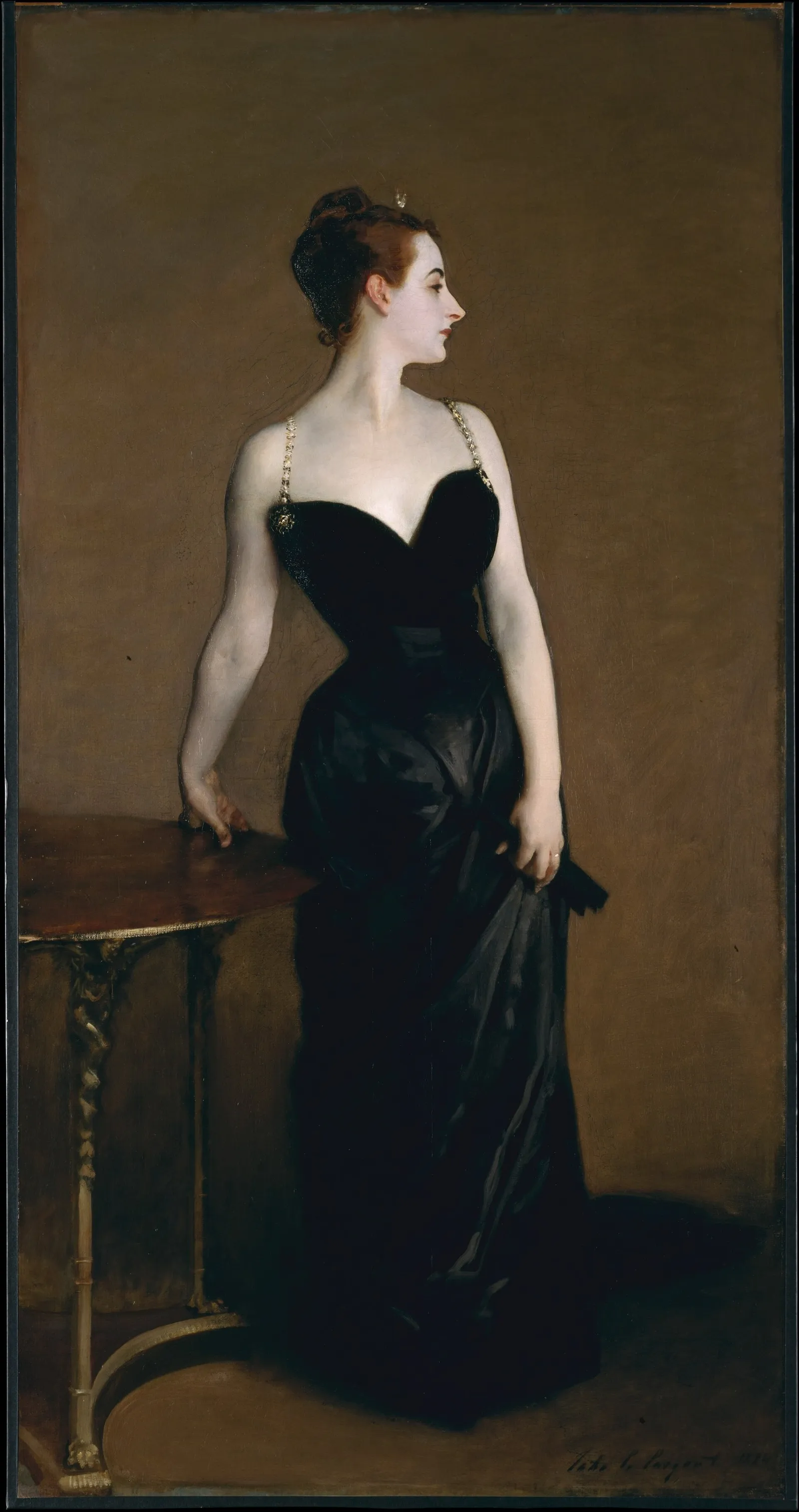
John Singer Sargent's Madame X (Virginie Amélie Avegno Gautreau), dated 1884, is in the collection of the Metropolitan Museum of Art. This full-length portrait of a Paris society figure in a black gown is one of the best-known portraits of the late nineteenth century. In front of it, the pleasure lies in how much Sargent achieves with a restrained palette, a daring pose and a nearly empty background.
Where to see it
Madame X (Virginie Amélie Avegno Gautreau) belongs to the Metropolitan Museum of Art, which is also listed as its location. Works in large collections can be moved, rotated off view, or lent to other institutions, so check the Metropolitan Museum of Art's official website for current display status and visitor information before you go.
What to look for in person
The pose: profile against frontal body
Stand back first and take in the silhouette. The sitter's head is turned sharply into profile while her body faces outward, creating a twist that feels both elegant and deliberately strained. Her right arm rests on a small table behind her, and her left hand gathers her skirt and holds a closed fan. The effect is closer to a statue or a cameo than a relaxed portrait. Notice how the profile line of nose and chin reads clearly against the plain background, almost like a cut-out shape.
Pale skin and the black dress
Move closer to compare the skin and the gown. Sargent paints the sitter's face, shoulders and arms in a cool, powdery pallor, sometimes described as slightly lavender, reflecting the cosmetic fashion she was known for. Against this, the black satin dress is handled with broad, confident strokes that suggest sheen without fussy detail. The low-cut bodice and jeweled shoulder straps sharpen the contrast. Look at the edges where pale skin meets dark fabric: that boundary is where much of the picture's tension lives.
The repainted strap and small details
Look at the right shoulder strap. When the portrait was first exhibited, that strap was shown slipping off the shoulder, and the detail drew strong criticism. Sargent later repainted it in its upright position, as you see it now. Also look for the small crescent-shaped ornament in her hair, often read as an allusion to Diana, the classical goddess of the moon and the hunt. The warm, muted brown background is kept simple, so these few details carry real weight.
About the painting
Sargent painted this portrait in Paris, where he was building his career as a portraitist in the early 1880s. The sitter, Virginie Amélie Avegno Gautreau, was an American-born woman who had become a prominent figure in Parisian society after marrying a French banker, and she was much discussed for her striking appearance. Sargent appears to have sought her as a subject rather than receiving a conventional commission, hoping a portrait of such a recognizable beauty would raise his profile.
The painting, dated 1884, was shown at the Paris Salon that year. Its reception was largely hostile. Critics and visitors objected to the sitter's bold display, her conspicuous pallor and, above all, the fallen shoulder strap, which many found improper. Sargent responded by repainting the strap, but the episode remained attached to the work's reputation.
Sargent kept the portrait for many years. He eventually sold it to the Metropolitan Museum of Art, where it remains in the collection. Over time, opinion shifted: the qualities that unsettled the Salon audience, the stark silhouette, the confident handling of black and the refusal of sentimental charm, came to be admired as signs of Sargent's originality.
For visitors, the painting rewards looking at it as a study in design. Very few elements are present: one figure, a small table, a fan, a dark dress and a plain background. Yet the arrangement of light against dark, the turn of the head and the tension in the arms create a portrait that is as much about presence and self-presentation as about likeness. Take time to look from a distance for the overall shape, then closer for the brushwork in the gown.
Key facts
| Artist | John Singer Sargent |
|---|---|
| Date | 1884 |
| Size | 2432 × 1438 cm |
| Medium | oil paint, canvas |
| Collection | Metropolitan Museum of Art |
| Gallery | Gallery 771 Checked in the museum's open data on 2026-11-12 (galleries can change) Source |
How to visit: Metropolitan Museum of Art
New York City, United States · Museum guide
| Opening hours | Sun, Mon, Tue, Thu 10:00–17:00 Fri, Sat 10:00–21:00 |
|---|---|
| Closed | Wednesdays; Thanksgiving Day, 25 December, 1 January and the first Monday in May |
| Admission | Adults USD 30 Seniors (65 and over) USD 22 Visitors with a disability (in person only) USD 22 Students USD 17 Children (12 and under) free Care partners of visitors with a disability (in person only) free New York State residents; NY, NJ and CT students: pay what you wish (minimum USD 0.01). Online requires a NY State billing address; NJ/CT students in person with student ID |
| Free entry | Free for children 12 and under, Members and Patrons, and care partners of visitors with a disability. Pay what you wish for New York State residents and NY/NJ/CT students. |
| Booking | No reservation is required and there is no timed entry. |
The Cantor Roof Garden, the Modern and Contemporary Galleries, and the Ancient West Asia and Ancient Cyprus Galleries are closed for renovation.
Official ticket page
Official website
View on map
Hours and prices can change. Please check the official website before you go. (Checked on: 2026-11-09)
More by John Singer Sargent
 Carnation, Lily, Lily and Rose — Tate Britain
 El Jaleo
 The Daughters of Edward Darley Boit — Museum of Fine Arts Boston
 The Misses Vickers