Art! Art! Art! › Works
El Jaleo
 John Singer Sargent, 1882
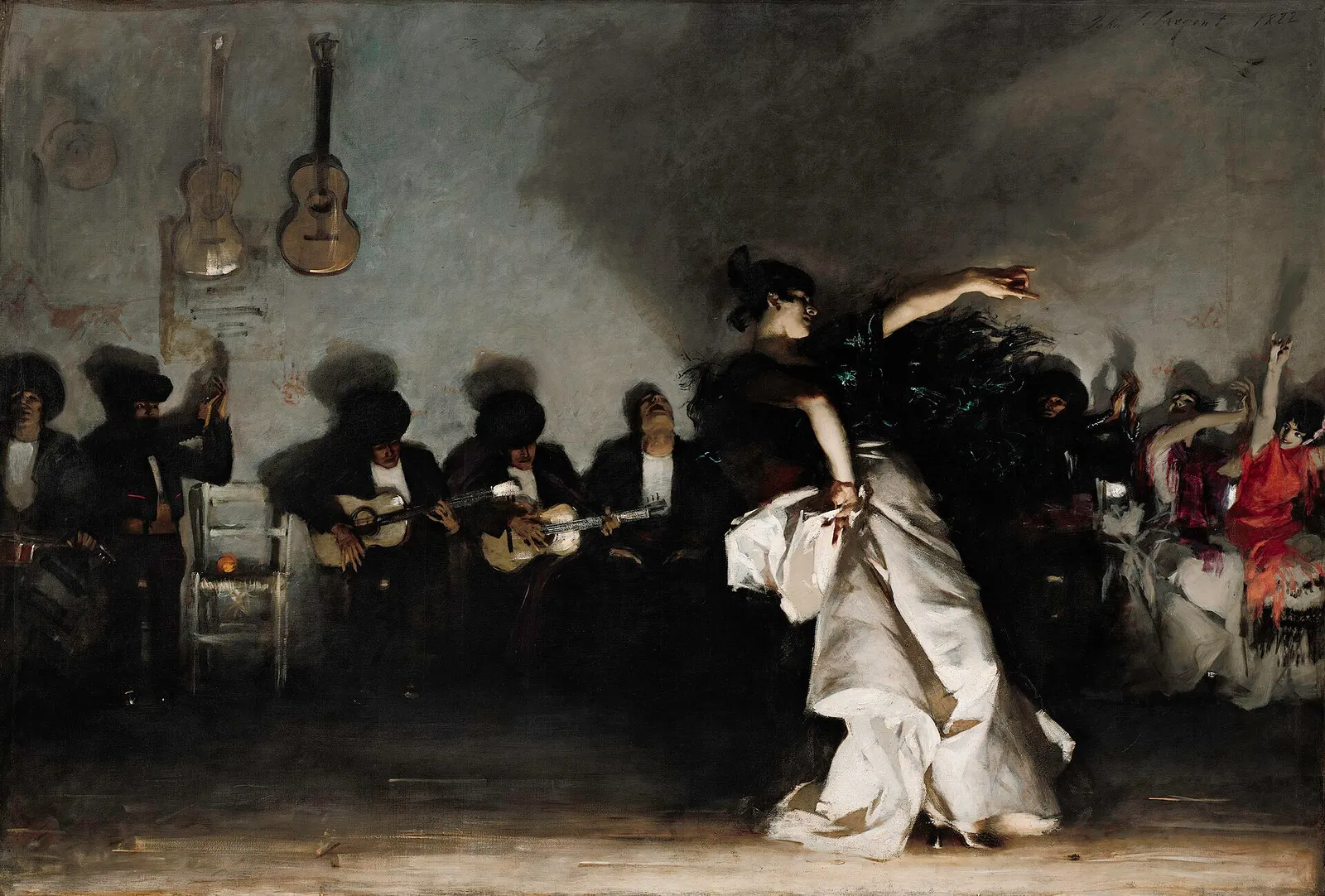
El Jaleo, painted by John Singer Sargent in 1882, is in the collection of the Isabella Stewart Gardner Museum. The canvas measures 232 by 348 cm and shows a flamenco dancer performing before a row of musicians. Seen in person, its scale and theatrical lighting make the scene feel close to a live performance.
Where to see it
El Jaleo is held by the Isabella Stewart Gardner Museum, which is both its collection and its recorded location. Displays can change because of conservation, rehanging or special events, so check the Isabella Stewart Gardner Museum's official website for current display status, opening hours and ticketing before you visit.
What to look for in person
Light from below
Start with the lighting. The scene appears lit from low in front, like footlights on a stage, rather than from a window or from above. Look at how the light catches the underside of the dancer's face and arms, and how her shadow and the musicians' shadows are thrown large and dark onto the pale wall behind them. This upward light is a big part of why the painting feels dramatic and nocturnal. Step back to see the whole pattern of shadows, then move closer to see how simply some of them are painted.
The dancer's pose and skirt
The dancer is the focal point, but she is placed off center rather than in the middle of the canvas. Notice her backward lean, the raised arm and the sweep of her heavy white skirt, which Sargent paints with broad, quick strokes that suggest movement and the rustle of fabric. Compare the bright skirt with the dark bodice and the shadowed wall: much of the picture's energy comes from these strong contrasts. Up close, the skirt dissolves into loose brushwork; from a distance it reads as a solid, swirling form.
The musicians and the room
Look along the wall at the seated figures. Guitarists play while others clap, lean forward or call out, and their varied poses give the scene its rhythm. The title refers to this noisy encouragement, the shouts and clapping that urge the dancer on. Scan the background too: objects hanging on the wall, scattered chairs and touches of warm color such as orange break up the long horizontal band of figures. The very wide format, 348 cm across, lets the eye travel along the line of performers almost as if walking past them.
About the painting
John Singer Sargent painted El Jaleo in 1882, when he was a young painter building his reputation. It is generally accepted that the picture grew out of his travels in Spain a few years earlier, where he sketched music and dance and studied Spanish painting, especially the work of Diego Velázquez. His interest in deep shadow, restrained color and confident, visible brushwork is often linked to that study, and you can see it in the dark tones and loose handling of El Jaleo.
The painting is large, 232 by 348 cm, and it was conceived as an ambitious exhibition piece. It is widely recorded that Sargent showed it at the Paris Salon in 1882, where a big, eye-catching canvas could help an artist stand out. Its subject, a flamenco performance in a plain interior, fit a wider taste in Paris at the time for Spanish themes.
For visitors, the key is to treat the painting as a stage. The composition is a long frieze of figures against a wall, with the dancer breaking the line on one side. The low light, the exaggerated shadows and the sense of sound, from guitars, clapping and shouting, all work together. Try viewing it first from a distance to take in the whole performance, then move closer to see how much of the detail is suggested with a few rapid strokes rather than carefully finished. That shift between impression and detail is one of the main pleasures of seeing Sargent's work in person.
Key facts
| Artist | John Singer Sargent |
|---|---|
| Date | 1882 |
| Size | 232 × 348 cm |
| Medium | oil paint, canvas |
| Collection | Isabella Stewart Gardner Museum |
How to visit: Isabella Stewart Gardner Museum
Boston, United States
Hours and prices can change. Please check the official website before you go.
More by John Singer Sargent
 Carnation, Lily, Lily and Rose — Tate Britain
 Madame X (Virginie Amélie Avegno Gautreau) — Metropolitan Museum of Art
 The Daughters of Edward Darley Boit — Museum of Fine Arts Boston
 The Misses Vickers