Art! Art! Art! › Works
The Whole
 Wassily Kandinsky, 1940
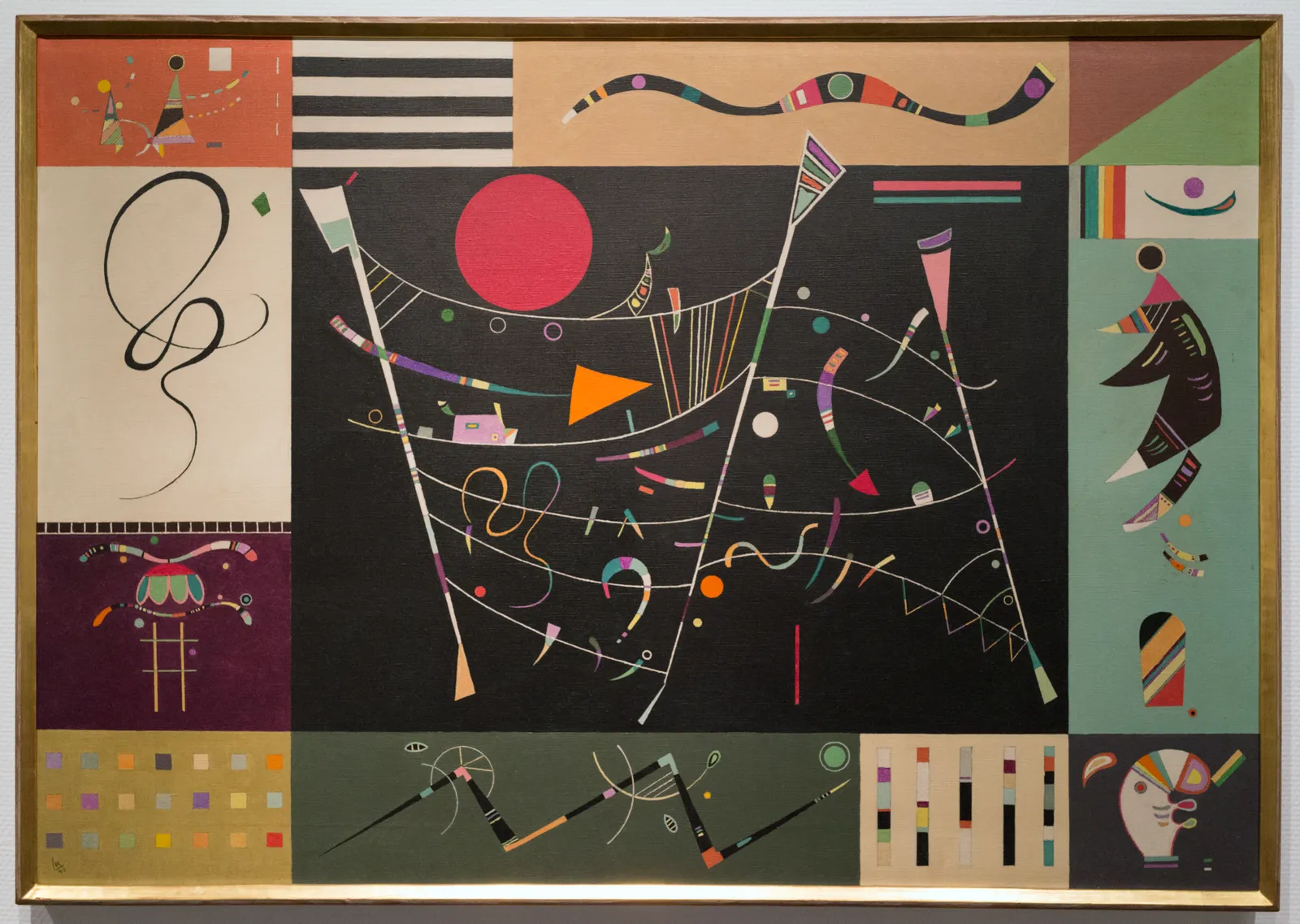
The Whole is a 1940 painting by Wassily Kandinsky, made during the final decade of his career. It belongs to The National Museum of Modern Art, where visitors can look for the inventive, abstract visual language of his last years.
Where to see it
The Whole is in the collection of The National Museum of Modern Art. Works on paper and paintings in permanent collections are often rotated, lent or temporarily removed for conservation. Check the museum's official website for current display status before you visit.
What to look for in person
A late work from the Paris years
Kandinsky dated this painting 1940, when he was living in France after leaving Germany in 1933. Viewers who know his earlier Bauhaus pictures, with their crisp circles, triangles and grids, may find his late work feels different in mood. Stand back first and take in the overall arrangement before focusing on details. Ask yourself how the forms relate to one another across the surface, and whether the picture reads as one unified field or as a collection of distinct parts held together, a question the title itself seems to invite.
Look for organic, biomorphic forms
Art historians widely note that Kandinsky's work of the 1930s and early 1940s introduced softer, organic shapes alongside geometric ones. Some of these forms suggest tiny creatures, cells or embryonic shapes rather than strict geometry. In front of the painting, look for outlines that curl, bend or sprout small appendages, and compare them with any straighter lines or measured shapes nearby. Noticing how these two kinds of form coexist is one of the most rewarding ways to approach his late abstraction.
Colour as a structuring force
Kandinsky wrote at length about the expressive power of colour, believing hues could act on the viewer much as musical tones act on a listener. When you look at The Whole, follow how colours repeat or answer each other across the composition. Notice where a colour appears only once and draws the eye, and where tones are muted to let neighbouring shapes stand out. Moving slowly from one area to another, rather than scanning quickly, helps reveal the rhythm he built through colour placement.
About the painting
Wassily Kandinsky, born in Moscow in 1866, is widely regarded as one of the pioneers of abstract painting. After early years in Munich, where he helped found the Blue Rider circle, and a period back in Russia, he taught at the Bauhaus in Germany from 1922 until the school closed in 1933. That same year he moved to France and settled in Neuilly-sur-Seine, near Paris, where he lived and worked until his death in 1944.
The Whole dates from 1940, placing it within this final French period. These years are often discussed as a distinct chapter in his output. Alongside the geometric vocabulary he had refined at the Bauhaus, Kandinsky increasingly used rounded, organic shapes that many viewers associate with natural science imagery, such as forms seen through a microscope. His colour in this period is frequently described as more varied and sometimes softer than in his Bauhaus work.
The year 1940 was also a difficult moment historically, as war spread across Europe and France was occupied. Kandinsky remained in France and continued painting through these years.
For visitors, the painting offers a chance to see how an artist who had spent decades theorising about abstraction continued to experiment late in life. Rather than looking for a hidden subject, it is more useful to treat the work the way one might listen to music: noticing balance, contrast, repetition and the relationships between individual elements and the composition as a whole.
Key facts
| Artist | Wassily Kandinsky |
|---|---|
| Date | 1940 |
| Medium | oil paint, canvas |
| Collection | The National Museum of Modern Art |
How to visit: Museum of Modern Art
New York City, United States · Museum guide
| Opening hours | Mon–Thu, Sat–Sun 10:30–17:30 Fri 10:30–20:30 |
|---|---|
| Closed | Open every day except Thanksgiving and Christmas. |
| Admission | Adults USD 30 Seniors (65 and over, with ID) USD 22 Visitors with disabilities USD 22 (accompanying care partner free) Students (full-time, with ID, incl. international students) USD 17 Children 16 and under free (ticket still required) Members free |
| Free entry | Free for children 16 and under and members. New York State residents enter free on Friday evenings 17:30–20:30 (UNIQLO Friday Nights); free tickets must be reserved in advance and proof of residency is required. Tickets include all galleries and special exhibitions. |
| Booking | Booking in advance is strongly recommended. |
Official ticket page
Official website
View on map
Hours and prices can change. Please check the official website before you go. (Checked on: 2026-11-11)
