Art! Art! Art! › Works
Points
 Wassily Kandinsky, 1920
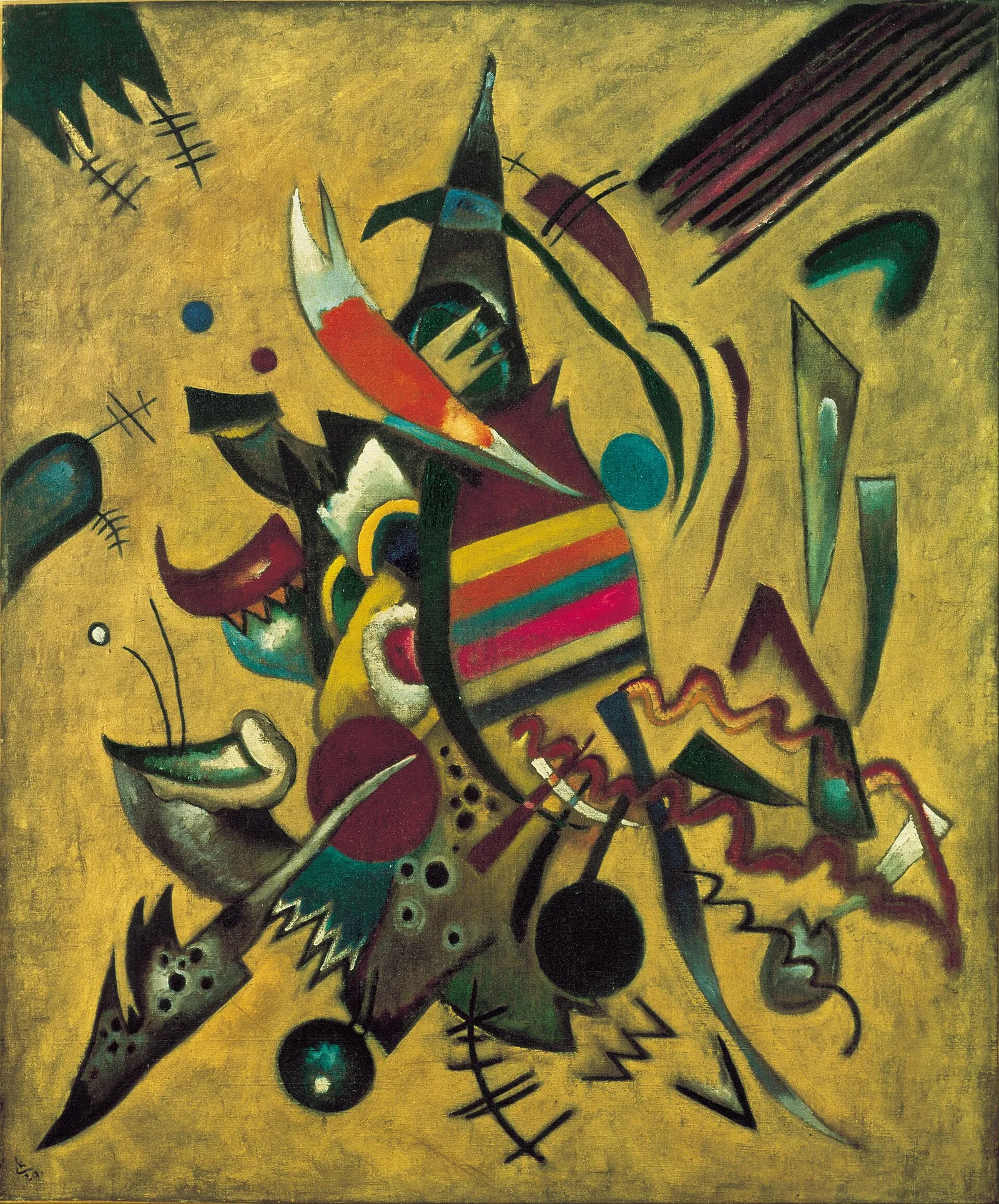
Points is a 1920 painting by Wassily Kandinsky, one of the pioneers of abstract art. It belongs to the Ohara Museum of Art and measures 110 x 91 cm. The title points to an idea Kandinsky returned to throughout his career: the point as the most basic building block of a picture.
Where to see it
Points is in the collection of the Ohara Museum of Art. Works in a collection are not always on view, because of rotations, loans or conservation. Check the Ohara Museum of Art's official website for current display status, opening hours and visitor information before you plan a trip around this painting.
What to look for in person
Start with the title
Kandinsky treated the point as the starting element of painting, the smallest unit from which lines and planes grow. He later set out this thinking in his book Point and Line to Plane, published in 1926 as part of the Bauhaus book series. Points comes from several years earlier, so it is best seen as part of the practice that fed that theory, not an illustration of it. In front of the canvas, look for small, concentrated marks. Notice how they hold their own against larger shapes and how your eye jumps from one to the next.
A work from the Moscow years
In 1920 Kandinsky was working in Moscow. He had returned to Russia at the outbreak of the First World War and stayed until the end of 1921, when he left for Germany. Paintings from this transitional period often mix the free, loosely brushed forms of his pre-war abstraction with sharper, more clearly bounded shapes that point toward his later geometric style. As you look, try to sort the forms into these two kinds, soft and hard-edged, and see how the painting balances them.
Mind the scale
At 110 cm high and 91 cm wide, Points is an upright canvas of substantial size, larger than a typical easel study. That scale changes how you meet it. First stand back far enough to take in the whole composition at once and register its overall rhythm and balance. Then move closer and let individual marks, edges and color contacts fill your view. Kandinsky thought of abstract painting as working on the viewer much as music does, so give the picture time. Don't rush to identify recognizable objects in it.
About the painting
Wassily Kandinsky (1866-1944) was born in Moscow and trained first in law before turning to painting in Munich in the late 1890s. There he became a leading figure of the Blue Rider circle, and in the early 1910s he was among the first artists to make paintings without recognizable subjects. His essay Concerning the Spiritual in Art, published in 1911, argued that color and form could act directly on the viewer's inner life, much as music does. When war broke out in 1914 he returned to Russia. In the years after the 1917 revolution he took part in the new state's cultural and educational institutions in Moscow, and this is the period in which Points was painted in 1920. At the end of 1921 he left for Germany, and from 1922 he taught at the Bauhaus. There he developed a more systematic, geometric language and wrote about the basic elements of painting, the point among them. Points sits on the threshold of that shift. Its title announces a concern with elementary pictorial units that would become central to his teaching. The painting, 110 x 91 cm, is held by the Ohara Museum of Art. For visitors, it offers a chance to see an abstract work from a less familiar chapter of Kandinsky's career, between his Munich and Bauhaus years.
Key facts
| Artist | Wassily Kandinsky |
|---|---|
| Date | 1920 |
| Size | 110 × 91 cm |
| Medium | oil paint, canvas |
| Collection | Ohara Museum of Art |
How to visit: Ohara Museum of Art
Kurashiki, Japan
Hours and prices can change. Please check the official website before you go.
