Art! Art! Art! › Works
The Baptism of Christ
 Piero della Francesca, 1448
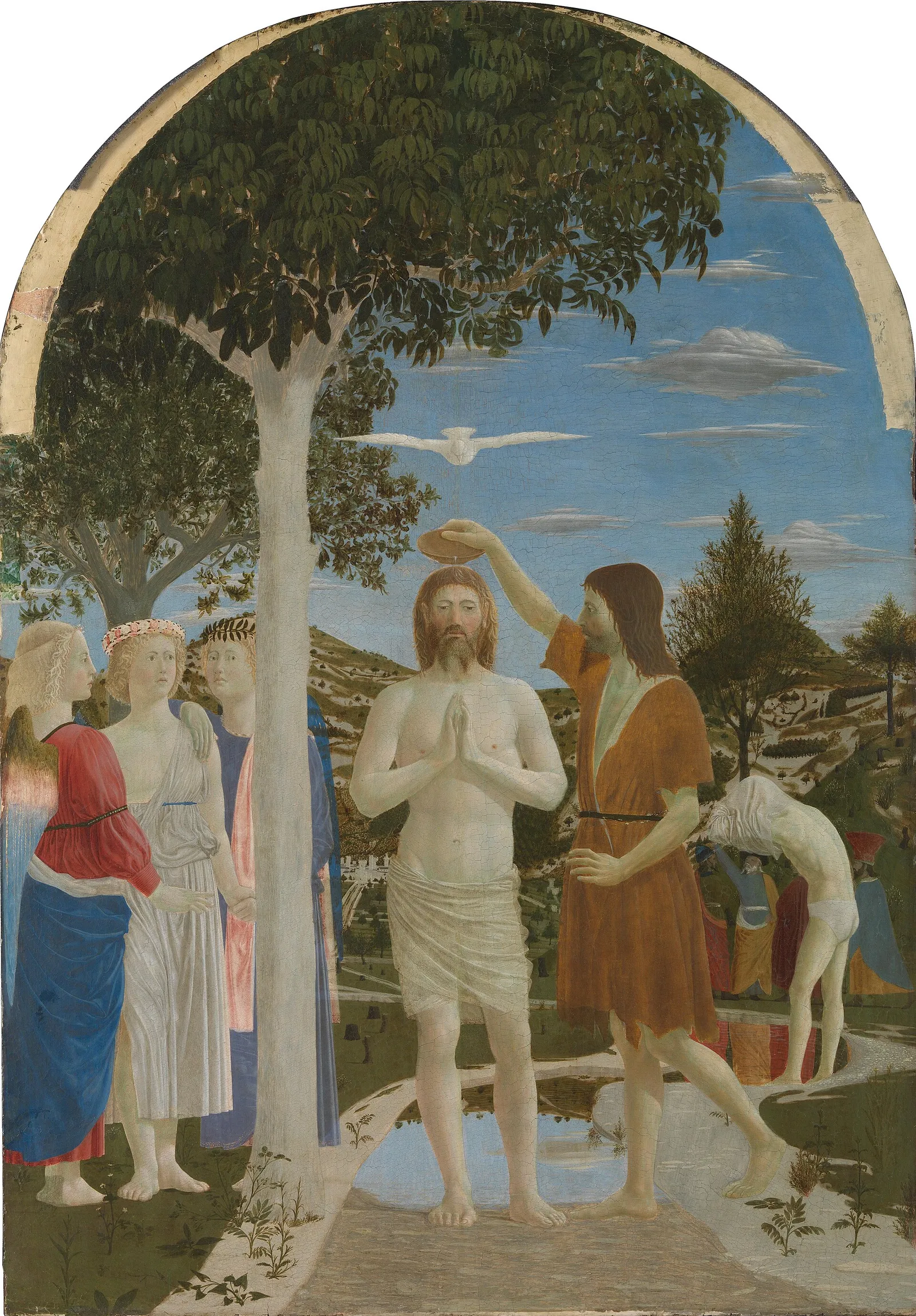
Piero della Francesca's The Baptism of Christ is in the collection of the National Gallery. Painted for Sansepolcro, Piero's home town in Italy, it shows Christ standing in a shallow stream under a pale sky. It is still, clear and carefully ordered, and it rewards a slow look in front of the panel.
Where to see it
The Baptism of Christ is held by the National Gallery. Its location is recorded as National Gallery; Sansepolcro; Italy, reflecting the painting's link to Sansepolcro, the town it was made for. The panel measures 168 cm high by 116 cm wide, so it reads clearly from across a room, but its finer details reward standing close. Paintings can be moved, rehung or lent to other institutions, so check the National Gallery's official website for current display status, opening hours and ticketing before you visit.
What to look for in person
The vertical line through the centre
Start at the top of the arched panel and look straight down. The white dove of the Holy Spirit hovers with its wings spread flat, almost like a small cloud. Below it, John the Baptist's hand holds a bowl that pours water over Christ's head, and Christ stands with his palms pressed together. The dove, the bowl, Christ's face, his joined hands and his feet line up on one central axis. This alignment gives the scene its calm, measured feeling and reflects Piero's well-known interest in geometry and proportion.
The angels and the tree
On the left, three angels stand beside a tree. They do not take part in the baptism. Instead, they look on with quiet, composed expressions. Look at their varied clothing, the garlands and wreaths on their heads, and the way their hands touch or rest on one another. Then notice the tall pale tree trunk beside them. It runs parallel to Christ's body and helps divide the picture into clear sections. Its smooth bark and leafy crown are painted with the same even, cool light as the figures.
Water, reflections and landscape
Look at Christ's feet. The stream around them is so still that it seems to stop there, while the water behind turns into a mirror. In it you can see reflections of the hills and of the figures on the far bank. Behind Christ, a man pulls his shirt over his head as he prepares to be baptised next. Beyond him, a winding valley with small trees, paths and hills recedes into the distance. It is often linked to the countryside around Sansepolcro. The pale, clear daylight unifies the whole scene.
About the painting
Piero della Francesca was an Italian painter from Sansepolcro, a town in the upper Tiber valley, and The Baptism of Christ is tied closely to that place. The fact sheet gives its date as 1448. It was painted on a wooden panel measuring 168 by 116 centimetres and is now in the collection of the National Gallery.
The subject comes from the Gospels: John the Baptist baptises Christ in the River Jordan, and the Holy Spirit descends in the form of a dove. Many painters treated this scene, but Piero's version stands out for its restraint. There is little dramatic movement. The figures stand or pause, and their gestures are slow and deliberate. The light is even and cool, without strong shadows, so forms appear solid but gentle.
Piero is known not only as a painter but also as a writer on mathematics and perspective. Visitors often notice how the picture seems built from simple shapes: the arch at the top, the vertical of Christ and the tree, and the horizontal bands of the landscape. Faces are smooth and rounded, and the bodies have a sculptural calm.
The painting was originally made as the central part of a larger altarpiece in Sansepolcro. Other sections were added by another artist, and the panel was later separated from them. Seen today on its own, it can still be read as a complete image. Give yourself time to move between the large, clear structure seen from a distance and the small details visible up close: the reflections in the water, the plants along the riverbank, and the distant figures on the road.
Key facts
| Artist | Piero della Francesca |
|---|---|
| Date | 1448 |
| Size | 168 × 116 cm |
| Medium | wood, tempera |
| Collection | National Gallery |
How to visit: National Gallery
London, United Kingdom · Museum guide
| Opening hours | Mon–Thu, Sat, Sun 10:00–18:00 Fri 10:00–21:00 (Friday late) |
|---|---|
| Closed | 24–26 December and 1 January. |
| Admission | General admission (collection) free; donations invited Some exhibitions are charged (e.g. Renoir and Love, until 31 Jan 2027) |
| Free entry | General admission is always free. |
| Booking | No reservation or timed entry is required. Free timed booking gives fast-track entry. |
Building work and improvements are under way: some rooms are closed and some paintings have moved, so check the floorplans or collection search before visiting. A new Research Centre is due to open in 2028. On 17 November only, some east wing rooms and the Espresso Bar close from 16:00.
Official ticket page
Official website
View on map
Hours and prices can change. Please check the official website before you go. (Checked on: 2026-11-11)