Art! Art! Art! › Works
Diptych of Federico da Montefeltro and Battista Sforza
 Piero della Francesca, 1465
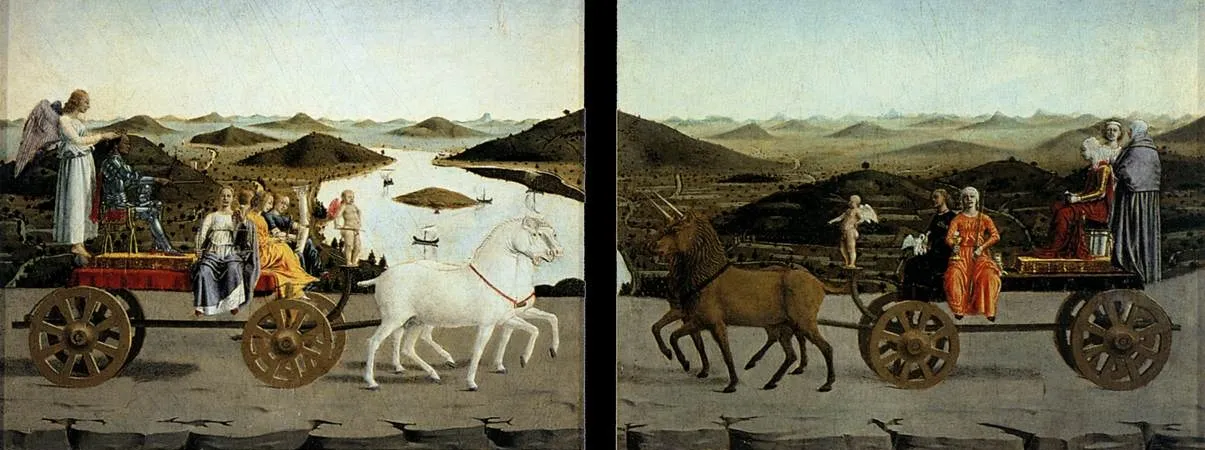
Piero della Francesca's portraits of Federico da Montefeltro and Battista Sforza belong to the Uffizi Gallery in Florence. The ruler of Urbino and his wife face each other in strict profile across a shared landscape. On the backs of the panels, painted triumphs celebrate their virtues, so the work rewards a look at both sides.
Where to see it
The diptych is in the collection of the Uffizi Gallery in Florence. The museum's records place it in Room A9, a room devoted to Paolo Uccello, Filippo Lippi and Piero della Francesca. Displays can change, so check the Uffizi's official website for current display status before you visit.
What to look for in person
Two profiles, one view
Stand back first and treat the two panels as a single image. Federico and Battista are set in profile, turned toward each other, and the landscape behind them runs on from one panel to the next as if seen through a shared window. Notice how Piero keeps both figures still and sharply outlined against the distance, while the countryside opens up below the horizon line. That background stands for the territory the couple governed, so the view is as much a statement of rule as a scenic setting.
The triumphs on the reverse
Walk around to the back. Each panel carries a triumphal procession in its own small landscape. Federico sits on a car pulled by white horses, accompanied by the four cardinal virtues. Battista's car is drawn by unicorns and carries the theological virtues. Compare the pace and character of the two teams, and look at how the vehicles travel through a wide, light-filled landscape. These scenes turn the portraits on the front into a moral statement about the couple's character and their partnership.
Inscriptions and hidden changes
Below each triumph, Piero painted what looks like a stone architectural base carrying Latin inscriptions that praise the couple's virtues. Check how convincingly the painted ledge imitates carved stone. Technical study has also revealed something you cannot see with the naked eye: reflectography showed that Piero first drew the triumph figures without clothing, transferring the design with spolvero, a pounced-dot method, and only afterwards dressed them. Knowing this, look at the drapery on the virtues and consider how it was built over a carefully planned underlying figure.
About the painting
The Uffizi's record dates the diptych to 1465. It pairs portraits of Federico da Montefeltro, ruler of Urbino, and his wife Battista Sforza. Each panel measures 47 × 33 cm, a modest size meant for close viewing rather than display from across a large hall. The front and back of each panel form a complete programme. On one side are the likenesses set against a continuous landscape of the couple's lands. On the other are allegorical triumphs, with Latin verses on a painted stone base. Together they present the pair as rulers of a real territory and as models of virtue.
The work's history follows the fortunes of Urbino's ruling families. It was once shown in the audience hall of the Ducal Palace in Urbino, where visitors to the court would have seen it. It later passed into the collections of the Della Rovere family. In 1631 it travelled to Florence as part of the dowry of Vittoria della Rovere on her marriage to Ferdinando II de' Medici. In 1773 it entered the Royal Galleries, the predecessor of today's Uffizi. The two panels are now housed in a single frame made in 1825, designed so that both the portraits and the triumphs can be viewed. For visitors, this means the diptych works as a freestanding object to circle and study from both sides, not only as a pair of pictures on a wall.
Key facts
| Artist | Piero della Francesca |
|---|---|
| Date | 1465 |
| Size | 47 × 33 cm |
| Medium | tempera, oil paint, panel |
| Collection | Uffizi Gallery |
How to visit: Uffizi Gallery
Florence, Italy · Museum guide
| Opening hours | Tue–Sun 08:15–18:30 (visitors leave by 18:30) |
|---|---|
| Closed | Mondays, 1 January and 25 December. |
| Last entry | Ticket office closes at 17:30. |
| Admission | Regular, bought on the day EUR 25 Regular, bought in advance EUR 29 Regular, entry from 16:00 (from 1 January 2026) EUR 16 Reduced (EU citizens aged 18–25; citizens of Switzerland, Norway, Liechtenstein, Uruguay etc.; ID required) EUR 2 Under 18 free (under 12s must be accompanied) Uffizi + Vasari Corridor EUR 43 on the day / EUR 47 in advance; named ticket, reservation required, non-refundable PassePartout 5 days (Uffizi, Pitti Palace, Boboli) EUR 40 (EUR 58 with Vasari Corridor) Audio guide EUR 6 |
| Free entry | Free for under-18s; disabled visitors plus one companion; tour guides and interpreters, ICOM members, certain journalists, and university teachers/students on the official list. Admission is free on the first Sunday of each month (national museums), when reservations are not possible. |
| Booking | Reservation is not required, except for the Uffizi + Vasari Corridor ticket, which must be reserved. |
Restoration and rearrangement works mean some rooms are temporarily closed and some artworks are not on display. A staff assembly on 11–12 November 2026 may change opening times.
Official ticket page
Official website
View on map
Hours and prices can change. Please check the official website before you go. (Checked on: 2026-11-12)
More by Piero della Francesca

Sources
- Wikidata Q1227359
- Wikipedia (en) (CC BY-SA 4.0)
- Wikipedia (ja) (CC BY-SA 4.0)
- Wikipedia (it) (CC BY-SA 4.0)
- Wikipedia (fr) (CC BY-SA 4.0)
- www.uffizi.it