Art! Art! Art! › Works
Still life with pears
 Paul Cézanne, 1895
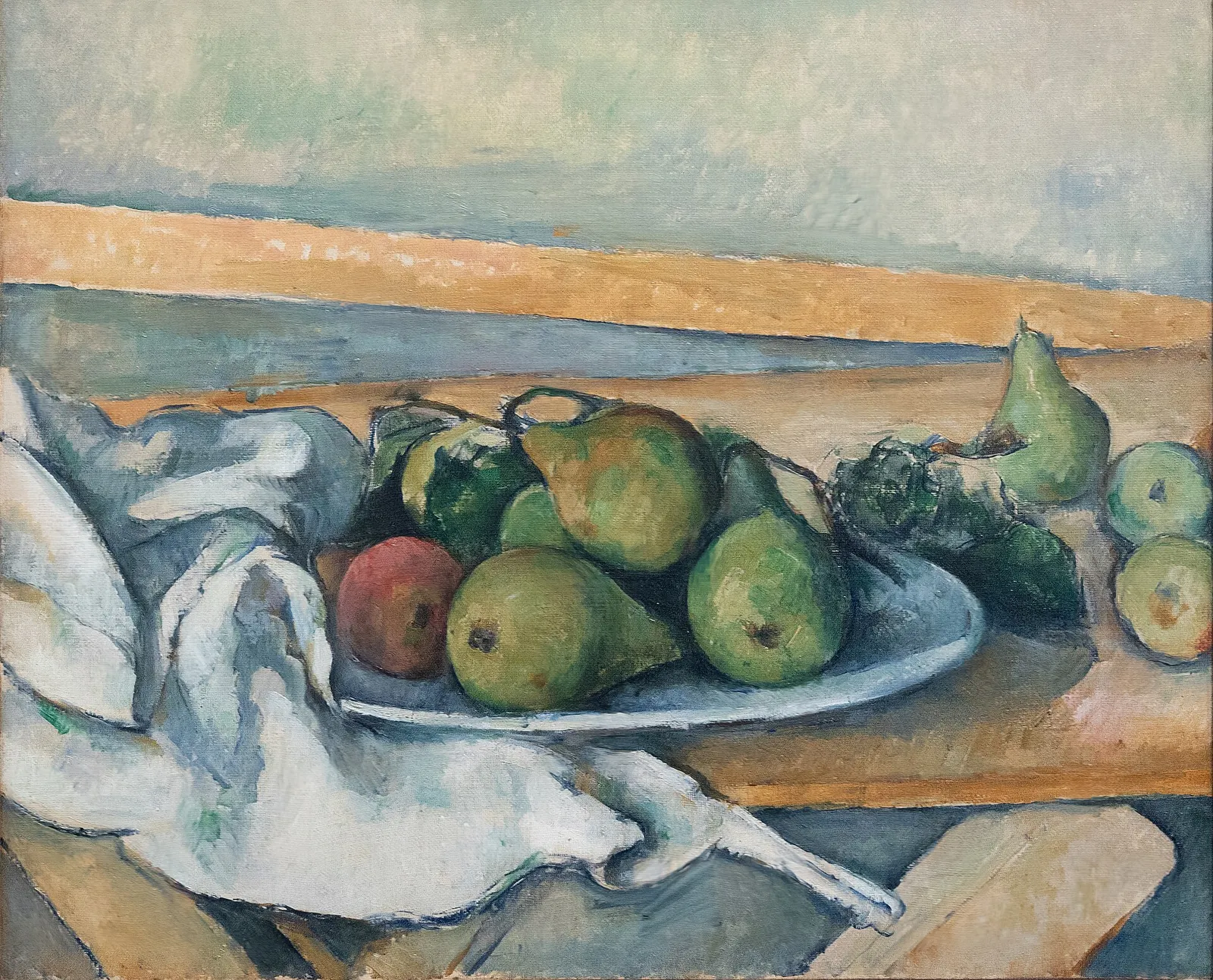
Paul Cézanne's Still life with pears, dated 1895, is in the collection of the Wallraf–Richartz Museum. At 38 by 46 centimetres it is a modest, close-range picture that rewards slow looking at how fruit, colour and space are put together.
Where to see it
Still life with pears belongs to the Wallraf–Richartz Museum, which is also its recorded location. Works in a collection are not always on view, since paintings rotate, travel on loan or are removed for conservation. Before you plan a trip around this painting, check the Wallraf–Richartz Museum's official website or contact the museum for current display status, opening hours, address and ticket information.
What to look for in person
Colour that builds form
Stand close and watch how the pears are shaped. Cézanne generally modelled fruit less through smooth light-to-dark shading and more through shifts of colour, setting warmer and cooler patches side by side so that a surface seems to turn toward or away from you. Follow the edge of a single pear and notice how its colour changes as it curves. Then step back and see whether those separate touches settle into a solid, weighty object. That interplay between visible patches and a convincing whole is central to his still lifes.
Small, deliberate brushstrokes
The canvas measures 38 by 46 centimetres, so you can take in the whole picture and still read individual marks. In his still lifes of the 1890s Cézanne often laid paint in short, directional strokes, sometimes grouped in parallel, that give surfaces a built-up, constructed feel rather than a polished finish. Look for places where the paint is thin and others where strokes overlap, and for any areas where the ground seems to show through. These details reveal a painter working step by step instead of hiding his process.
Space that does not quite add up
Cézanne's still lifes are known for arrangements that seem to be seen from more than one position at once. Table edges may fail to line up, surfaces can tilt toward the viewer, and objects may sit in ways that would be unstable in real life. As you look, ask where you seem to be standing in relation to the table and the fruit, and whether every part of the picture agrees. This loosening of single-point perspective is a large part of why painters of the following generation studied his work so closely.
About the painting
Paul Cézanne (1839–1906) returned to still life again and again, and the fact sheet dates this picture to 1895, when he was in his mid-fifties. The mid-1890s were a turning point in his public reputation: in 1895 the Paris dealer Ambroise Vollard gave him his first solo exhibition, which brought his work before a wider audience of collectors and younger artists after years of relative isolation. Whether this particular canvas had any connection to that show is not recorded in the fact sheet.
For Cézanne, a table with fruit was a controlled subject. Apples and pears did not move, did not tire and could be arranged and rearranged over long working sessions. That freedom let him concentrate on the questions that run through his whole career: how to make objects feel solid on a flat surface, how colour itself can describe volume, and how the parts of a picture can be tied together into a firm structure rather than simply copied from life.
The result is rarely a straightforward record of a tabletop. Viewers often notice a quiet tension in his still lifes, with fruit that sits heavily and at the same time seems to belong to a carefully balanced pattern of shapes and colours across the canvas. Painters of the early twentieth century, including those associated with Cubism, looked to this approach as a way of rethinking how space and form could be shown in painting.
At 38 by 46 centimetres, Still life with pears is an intimate work. It is best seen at close range first, for the brushwork, and then from a few steps back, where the separate touches resolve into a unified arrangement.
Key facts
| Artist | Paul Cézanne |
|---|---|
| Date | 1895 |
| Size | 38 × 46 cm |
| Medium | oil paint, canvas |
| Collection | Wallraf–Richartz Museum |
How to visit: Wallraf–Richartz Museum
Cologne, Germany
Hours and prices can change. Please check the official website before you go.

